Pyotr Tchaikovsky is one of the most beloved composers of the Romantic Era.
One reason Tchaikovsky’s music has endured is that he had a devoted younger brother named Modest, who spent years of his life tending to his brother’s legacy.
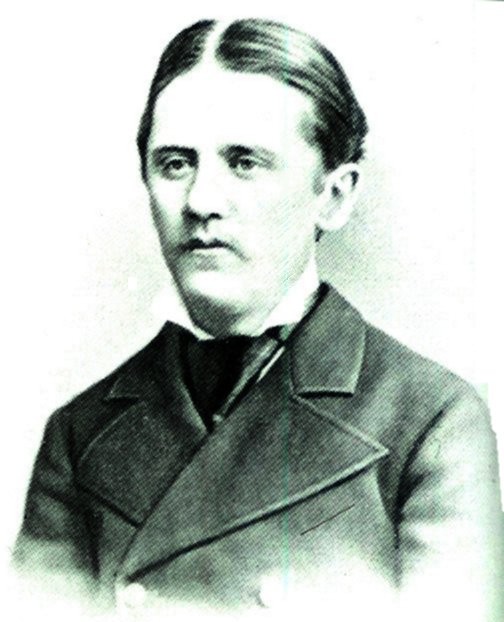
Modest Tchaikovsky
Today, we’re putting a spotlight on the story of Modest Tchaikovsky, the younger Tchaikovsky brother who spent his entire life in Pyotr’s shadow.
Modest’s Beginnings
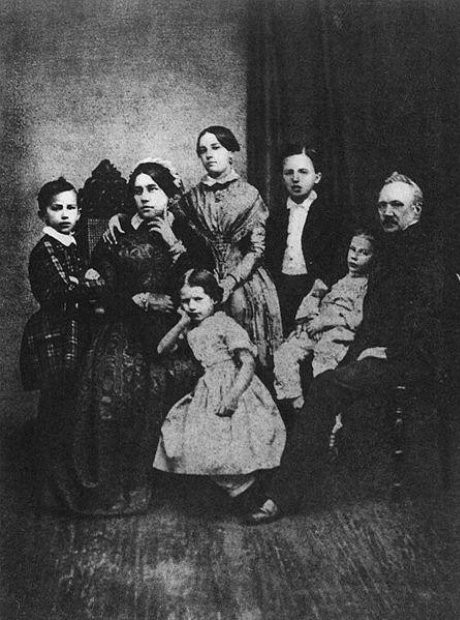
Tchaikovsky’s parents and older siblings
Modest Tchaikovsky was born in May 1850 in the town of Alapayevsk, 2400 kilometres east of St. Petersburg.
He was the sixth of seven children born to his parents, Ilya and Aleksandra. (The seventh was his twin, Anatoly.)
Modest was born ten years after his older brother Pyotr, whom he would grow up idolising.
Tragedy Strikes the Tchaikovskys
Just a few months after the twins’ birth, Pyotr left the household to attend the Imperial School of Jurisprudence, a boys’ boarding school in St. Petersburg.
Four years later, in 1854, their mother would die of cholera. Pyotr was fourteen, and Modest was four.
Their father was much older than their mother: at the time of his wife’s death, he was almost sixty. For a variety of reasons, he was physically and emotionally unable to parent young twins.
To make matters worse, their older sister Alexandra, who had initially helped raise the boys, departed the household to get married in 1861.
Consequently, in the years to come, Pyotr fulfilled multiple vital roles in Modest’s life. In his memoirs, Modest would call Tchaikovsky his “brother, mother, friend, mentor, and everything else in the world.”
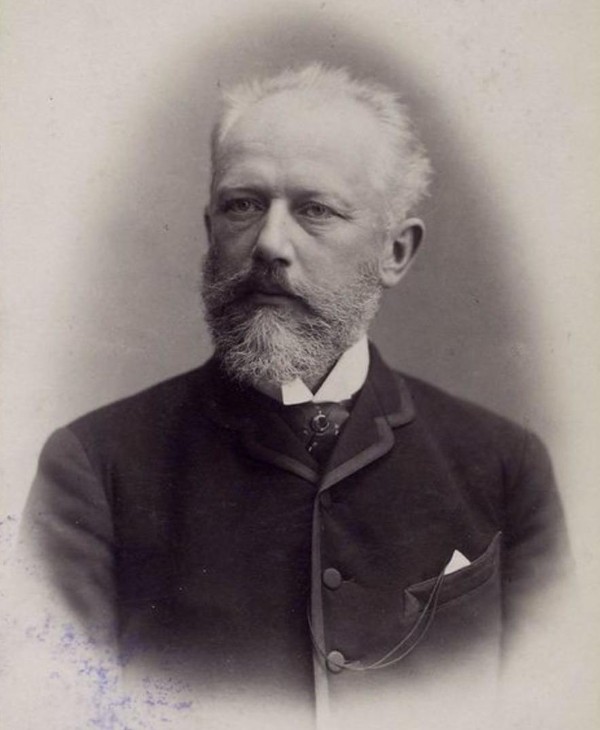
Émile Reutling: Pyotr Ilych Tchaikovsky, ca. 1888
For his part, Tchaikovsky later reminisced to his benefactress and confidant Nadezhda von Meck:
My relationship with [the twins] took a shape that made me love them more than myself and be ready for any kind of sacrifice, and made them be devoted to me beyond any limit.
This dynamic was understandable, given the circumstances. But it also led to an unusual relationship, with striking elements of dysfunction. It also ensured that Modest’s life was doomed to always revolve around his brother’s.
Boarding School and Sexual Awakenings
Modest and Anatoly would follow in their brother’s footsteps, departing for the Imperial School of Jurisprudence in the mid-1860s.
In 1864, while at the Imperial School, Modest discovered that he was attracted to men.
This is a destabilising realisation for any queer person, even today, but it was especially terrifying in Imperial Russia.
Thirty years earlier, Tsar Nicholas I had outlawed sodomy, and men convicted of it were sentenced to brutal prison terms in Siberia.
Around the same time that Modest began coming to terms with his sexuality, Anatoly told him a shocking family secret: Pyotr was also attracted to men.
Anatoly was appalled by his brother’s tastes. But Modest was hugely relieved. In his words:
I forgot every trouble and was filled with inexpressible joy. A heavy weight fell from my shoulders. I am not a freak, I am not alone in my strange desires. I may find sympathy not merely with the pariahs among my comrades, but with Pyotr. I may fall in love and feel no shame since Pyotr understands me!
Given the dangers of acting on their desires or even speaking openly about them with others, it makes sense that Pyotr and Modest would become each other’s confidants when it came to their love lives.
Pyotr’s Criticism
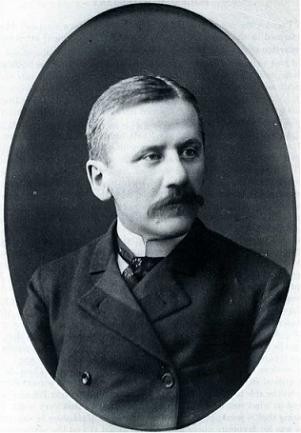
Modest Tchaikovsky
Like Pyotr, Modest initially intended to go into the civil service or a legal career.
But after he graduated in 1870, he gained a reputation as a rakish “man about town.” It became increasingly clear that Modest was destined for a more unconventional life path.
For a while, it was unclear what exactly that path might be. For a time, he contemplated becoming an actor. However, Pyotr shot that particular goal down immediately, ridiculing it as “just nonsense.”
It wasn’t the only time Pyotr was so blunt. As Pyotr was establishing his own creative and professional identity, he frequently punched down.
In 1869, the twenty-nine-year-old Pyotr wrote this rather startling assessment to his teenage brother:
You had the misfortune to be born with the soul of an artist, and you will always be drawn into that world of the highest spiritual joy, but since, in addition to this artistic sensitivity, you are endowed with no talent, for God’s sake, be on guard lest you yield to this temptation.
Modest took the criticism hard.
Tchaikovsky’s Romeo and Juliet Overture, first version, 1869
Modest Finds His Way
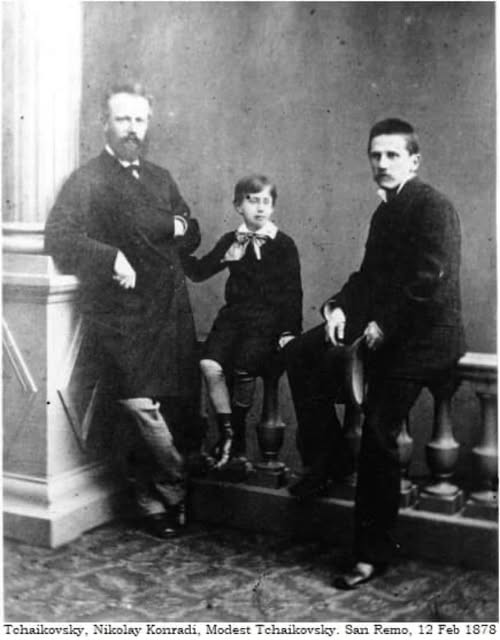
Modest, Pyotr Tchaikovsky and Nikolay Konradi
When Modest was 26, he took a job working for the wealthy Konradi family, who hired him to tutor their deaf-mute eight-year-old son, Nikolay.
Tutor and pupil would enjoy a fruitful partnership that continued for nearly twenty years.
During this time, Modest put his polyglot talents to good use, teaching Nikolay Konradi multiple languages, despite his deafness and inability to speak. (Pyotr also befriended the Konradis and wrote dozens of letters to Nikolay over the years.)
Modest also began exploring his interest in creative endeavours more seriously. Pyotr had mastered music, so Modest focused on writing and translating.
The Ties Between Modest and Pyotr’s Works
Despite his brother’s early dismissal of his work, Modest longed to collaborate with Pyotr on a libretto or a program for some symphonic poem, writing, “The only dream I entertain during my strolls every day is to hit upon some theme for a symphonic tableau… If you only knew how much I yearn for you to write music on my theme!”
In 1877, Modest submitted the outline of an opera called Ines de las Sierras to Pyotr. Pyotr was exasperated:
It did not rouse even a shadow of interest in me… No, my friend Modya [Pyotr’s nickname for Modest], you are not fit to be a librettist, but merci for your good intentions.
However, in 1889, Tchaikovsky was proven wrong when Modest prepared the libretto for The Queen of Spades. (That said, Pyotr edited it heavily.)
Liza’s Aria from The Queen of Spades
Modest repeated the feat with 1891’s Iolanta.
Iolanta’s Aria from Iolanta
If Pyotr had lived longer, it seems likely that the two would have teamed up again.
Modest also provided librettos for Anton Arensky and a young Sergei Rachmaninoff.
Modest’s Other Works
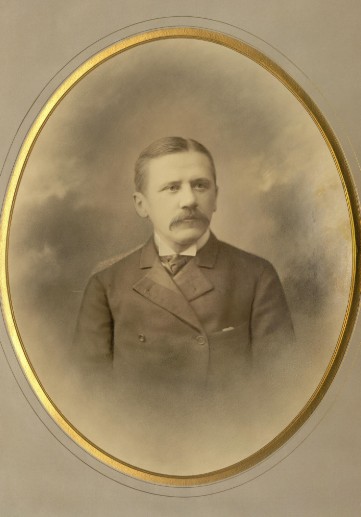
Modest Tchaikovsky
Modest continued to be preoccupied with Pyotr even when writing works that had nothing to do with him.
One of Modest’s plays, 1890’s Symphony, features a composer main character, strikingly similar to his older brother, as well as fictional versions of other figures from his brother’s career.
In what must have been a thrill, Anton Chekhov himself wrote Modest in February 1890, saying, “I greatly liked your Symphony.”
It was promising feedback. Tragically, however, Modest’s preoccupation with his theatre career arguably contributed to his brother’s death.
Pyotr’s Death
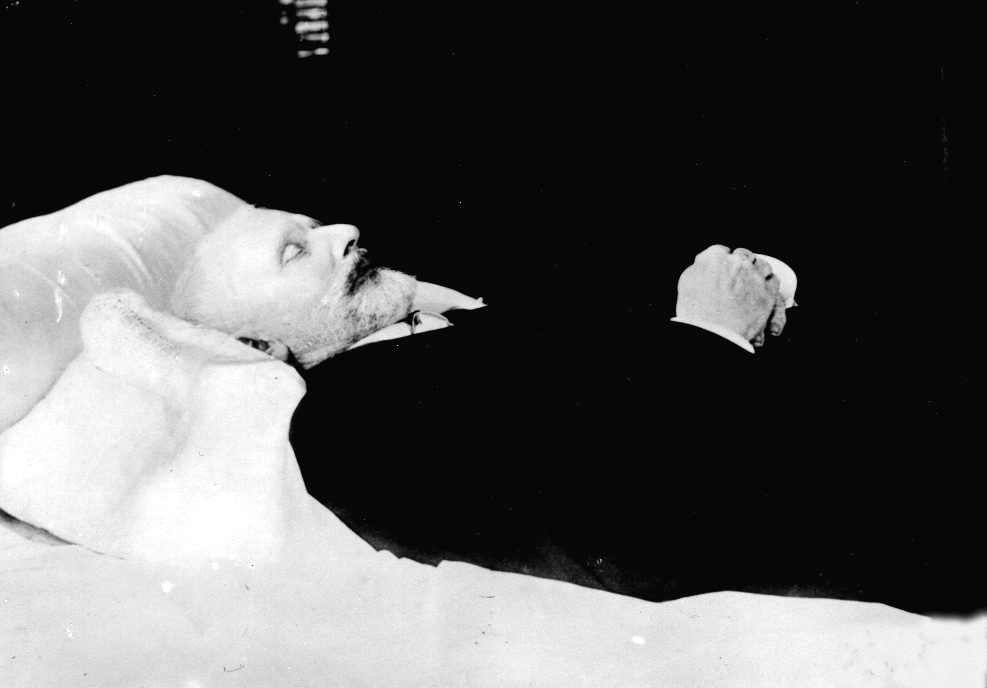
Tchaikovsky on his death bed
On the day that Tchaikovsky came down with his fatal case of cholera, Modest was busy supervising rehearsals for his new play, Prejudices.
It was only when he was done for the day and came back to their shared lodgings that he understood the severity of his brother’s illness and arranged for the appropriate medical care.
Pyotr suffered for over three days. Both of them were well aware that their mother had died from the same disease.
Pyotr died in late October 1893, two weeks after conducting the premiere of his tragic sixth symphony.
Tchaikovsky’s Symphony No. 6
Life After Pyotr
After Pyotr’s death, Modest struggled with strong emotions of guilt.
He did manage to write his best work, the play Catherine of Siena, almost fifteen years after Pyotr’s death. However, predictably, much of his life post-1893 revolved around preserving the legacy of his beloved brother.
One major project was establishing the Tchaikovsky Museum and Archives in the town of Klin, Pyotr’s final residence. Klin is a hundred kilometres from Moscow, and also, thanks to Modest’s efforts, the site of a Tchaikovsky museum.
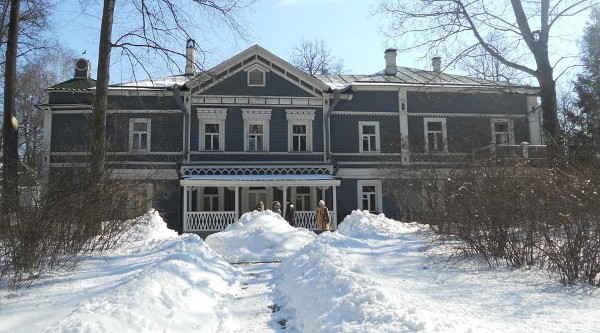
The Tchaikovsky Museum
Modest also embarked on an ambitious years-long process of writing a multi-volume biography of his brother.
He had trouble separating himself from his subject, but the ensuing volumes are still valuable, and, for better or worse, have shaped how historians view Tchaikovsky today.
While working on this project, he ran into difficult questions having to do with Pyotr’s gay relationships.
One way Modest addressed the difficulties was by drafting his own autobiography, in which he was more open about his and his brother’s love lives.
The opening to that book reads:
If some day people glance at this manuscript, as I am counting on, though I almost have no hope that they will—may they be rewarded for the interest they take in my obscure existence by what I have to say about my brother Pyotr.
Modest Tchaikovsky, ever-faithful promoter of his brother’s legacy, died in January 1916. He was 65 years old. He never escaped his brother’s shadow – but also maybe he never wanted to.
For more of the best in classical music, sign up for our E-Newsletter