In 1841 in Paris, Richard Wagner awkwardly introduced himself to Franz Liszt.
The two men were close in age: Wagner was twenty-eight and Liszt was thirty.
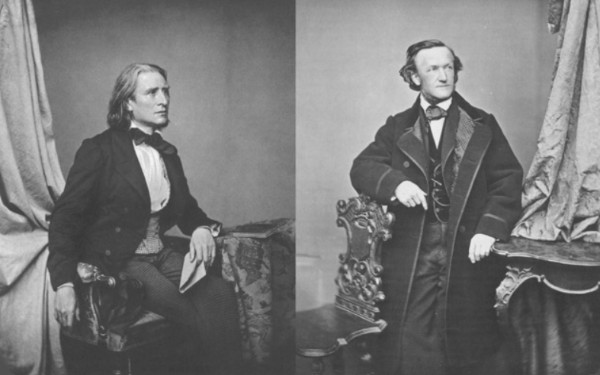
Richard Wagner and Franz Liszt, 1860
However, their career trajectories could not have been more different.
Liszt had been a child prodigy pianist and was one of the preeminent virtuosos in Europe.
Meanwhile, Wagner was a struggling conductor and composer who was desperately trying to get his operas performed.
It took a few years (and some obsequious letters from Wagner) for the two titans to truly warm up to each other, but once they did, they stayed close for the rest of their lives.
Their allyship was cemented in 1870, when Wagner married Liszt’s daughter, Cosima.
Today, we’re looking at the early years of their unlikely friendship, as gleaned from their accounts and the English translations of letters they sent to one another.
Wagner was skeptical about Liszt at first…
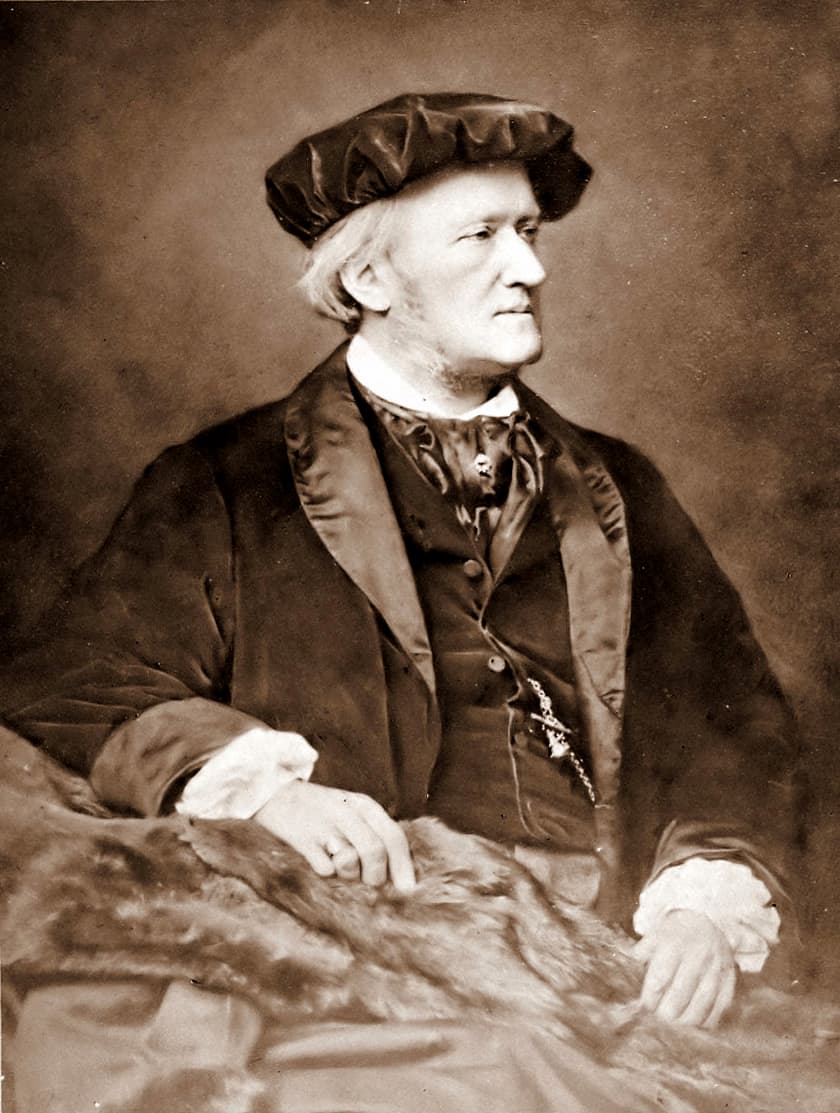
Richard Wagner
In 1851, in an autobiographical sketch, Wagner wrote that before they became friends, he was suspicious of Liszt’s professional successes and resentful of Liszt’s seeming disinterest in him.
I looked upon him with suspicion. I had no opportunity of disclosing my being and working to him, and, therefore, the reception I met with on his part was altogether of a superficial kind…
…But lucky for Wagner, Liszt became desperate for his approval.
Liszt picked up on the hints that Wagner felt coolly about him. Liszt badly wanted to be liked by everyone, so he set to work charming Wagner.
Wagner later recalled:
[Liszt] was surprised to find himself misunderstood with such violence by a man whom he had scarcely known, and whose acquaintance now seemed not without value to him.
I am still touched at recollecting the repeated and eager attempts he made to change my opinion of him, even before he knew any of my works.
Liszt was the one who convinced Wagner to stick to music.
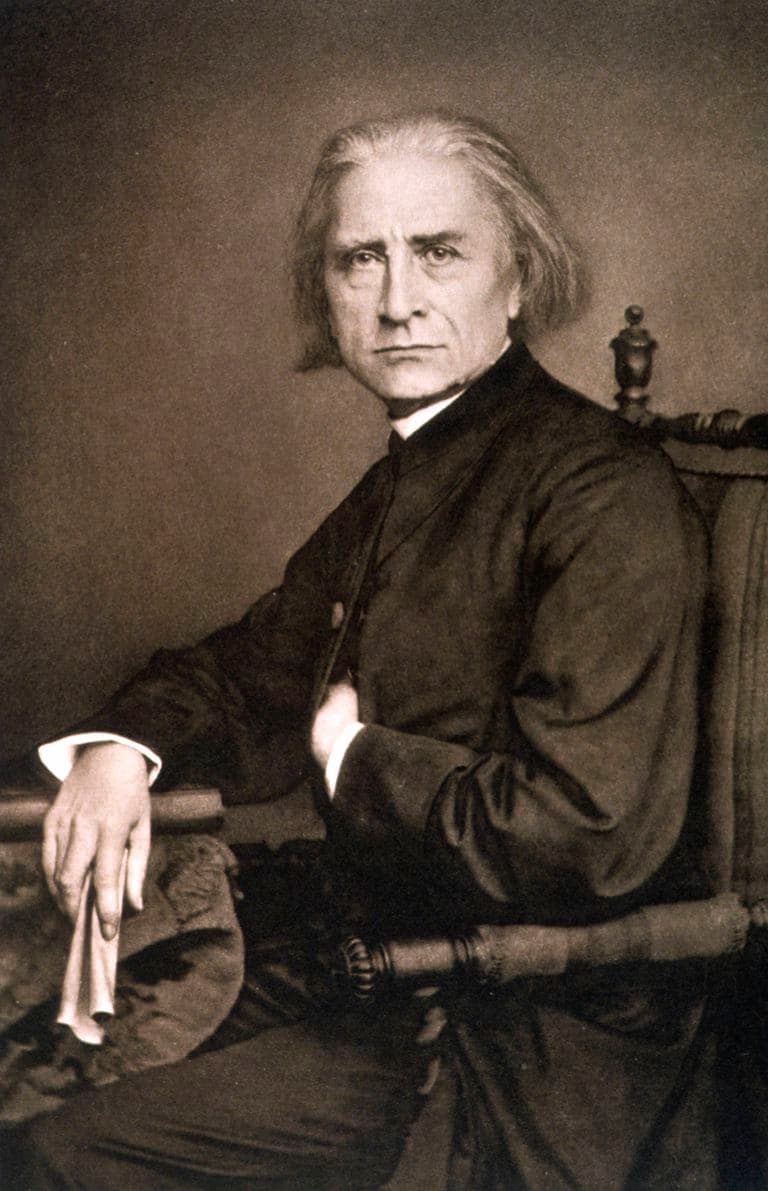
Franz Liszt in 1870
In 1851, Wagner wrote about their early friendship, claiming that he’d been close to giving up music before Liszt encouraged him to stick it out:
Only recently, I had had proofs of the impossibility of making my art intelligible to the public, and all this deterred me from beginning new dramatic works. Indeed, I thought everything was at an end with my artistic creativeness.
From this state of mental dejection, I was raised by a friend. By the most evident and undeniable proofs, he made me feel that I was not deserted, but, on the contrary, understood deeply by those even who were otherwise most distant from me: in this way, he gave me back my full artistic confidence.
This wonderful friend has been to me Franz Liszt.
Liszt’s transcription of Isolde’s Liebestod (1867), from Tristan und Isolde (1859)
Wagner was awed by how Liszt interpreted his music.
In his autobiography, Wagner alludes to his legal troubles.
He had participated in revolutionary activities in Dresden in 1848 and 1849, and for quite some time, a warrant was out for his arrest in Germany.
The very day when my personal danger became a certainty, I saw Liszt conduct a rehearsal of my Tannhäuser, and was astonished at recognising my second self in his achievement. What I had felt in inventing this music, he felt in performing it; what I wanted to express in writing it down, he proclaimed in making it sound.
Wagner went on to describe what a comfort Liszt’s understanding of his music was to him during this tumultuous time:
Strange to say, through the love of this rarest friend, I gained, at the moment of becoming homeless, the real home for my art, which I had longed for and sought for always in the wrong place.
In 1849, he wrote to Liszt:
All is possible to you.
Liszt’s transcription (1848) of Wagner’s overture from Tannhäuser (1845)
Liszt’s partner, Carolyne zu Sayn-Wittgenstein, wrote warm addendums in his letters to Wagner, praising Wagner’s work.
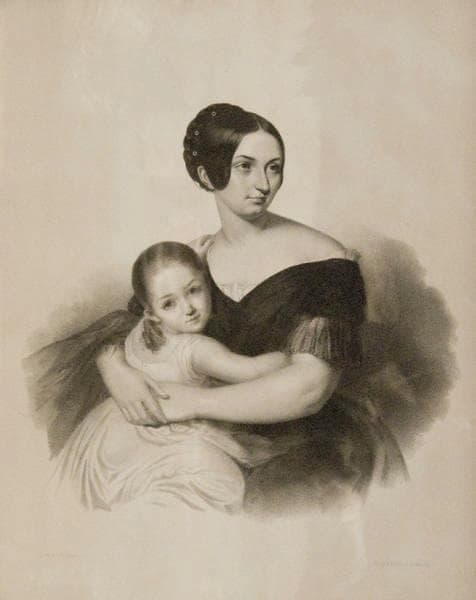
Carolyn Sayn-Wittgenstein
After Liszt conducted Wagner’s opera Tannhäuser, she wrote a lengthy “P.S.” in a Liszt letter to Wagner, bestowing the blessing of the entire household:
Believe, above all, in the admiration which has been given to you here, and which we should be so happy to express to you personally. I am amongst those most desirous of seeing you, sir, and of repeating from mouth to mouth the expression of the admiring and devoted sentiments of which I ask you to be a thousand times assured.
Wagner wrote back to Liszt:
Have I really so pleased your esteemed friend with my feeble work that she thought it worthwhile to give me such great and unexpected joy in return? … I pray you with all my power to express my gratitude to her as fervently, as joyfully, as you are able. Will you grant me this favour?
Liszt was the first person to whom Wagner showed the score of Lohengrin.
In 1849, Wagner wrote:
Liszt will shortly receive a parcel of scores, etc., from my wife; let him open it. The score of [my opera] Lohengrin I want him to try at some leisure; it is my last and ripest work.
As yet, I have not shown it to any artist, and therefore have not been able to learn from anyone what impression it produces. How curious I am to hear Liszt about it!
Liszt viewed the eventual triumph of Lohengrin as their shared success.
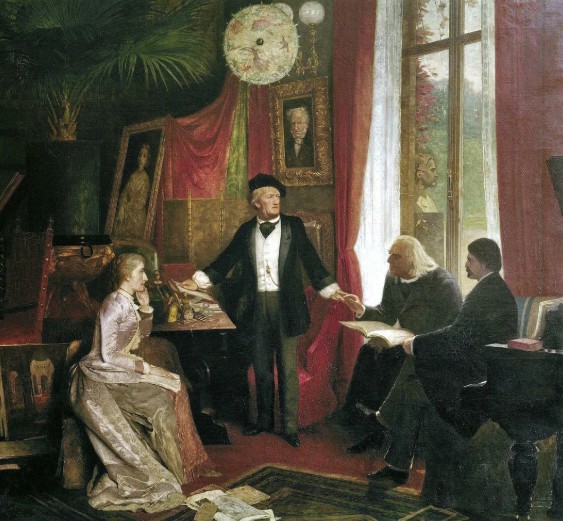
Wagner, Liszt, and Cosima
Wagner described how Liszt viewed his advocacy for Lohengrin in Weimar:
Everything that men and circumstances could do was done in order to make the work understood. Success was his reward, and with this success, he now approaches me, saying, “Behold, we have come so far; now create us a new work that we may go still further.”
Liszt’s transcription of Elsas Brautzug zum Münster (1852) from Wagner’s opera Lohengrin (1848)
Wagner was absolutely shameless about asking Liszt for huge amounts of money.
In his translation of the Wagner/Liszt letters, Francis Hueffer describes one interaction when Wagner asked:
I once more return to the question, can you let me have the 1,000 francs as a gift, and would it be possible for you to guarantee me the same annual sum for the next two years?
Most friends would balk at this sense of entitlement, but Liszt immediately sent a 1,000 franc gift to Wagner. This happened multiple times throughout Wagner’s career.
Liszt encouraged Wagner to keep composing the Ring cycle, his greatest artistic accomplishment.
When Wagner was overwhelmed by the epic four-opera project he had dreamed up for himself, it was Franz Liszt’s confidence in him that gave him the strength to keep going.
Hueffer wrote in his introduction to the letters:
Every further step in [Wagner’s] career was watched and encouraged by the loving sympathy of Liszt, and when Wagner, overpowered by the grandeur and difficulties of his Nibelungen scheme, was on the point of laying down the pen, it was Liszt who urged him to continue in his arduous task, and to go on in spite of all discouragement.
Liszt transcription of Walhall aus Der Ring des Nibelungen (1875) by Wagner (1869–1876)
Whether you love Wagner or hate him, a major reason we remember him today is all the work that Liszt did on his behalf.
For better or worse, these two composers should be remembered today as being friends and colleagues who were inextricably linked.
For more of the best in classical music, sign up for our E-Newsletter