If you love Baroque instrumental music, you will undoubtedly have come across the “concerto grosso,” also known as the “big concerto.” It’s a specific form where the musical material is passed between a small group of soloists, called the “concertino,” and the full orchestra, the “ripieno” or “tutti.”
Some of the most famous compositions from the Baroque era are scored in that particular form. There is Corelli’s “Christmas Concerto,” some “Brandenburg Concertos” by Bach, and countless pieces by Vivaldi.
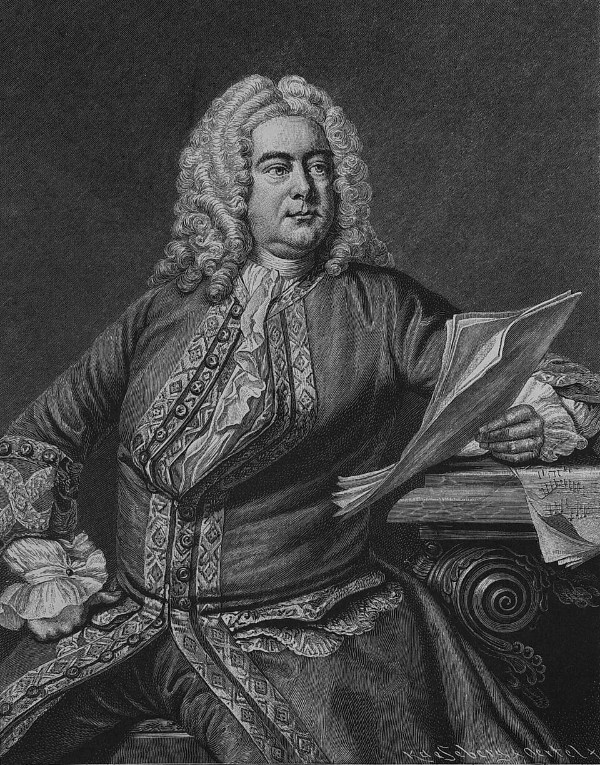
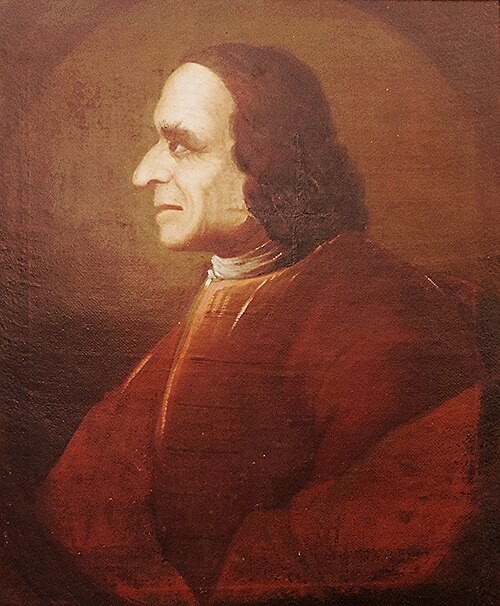
George Frideric Handel
George Frideric Handel (1685-1759) composed many such pieces but his Concerto Grossi Op. 6 are by far the most popular. To mark the anniversary of Handel’s death on 14 April 1759, let us feature some of the most exciting pieces in this set.
George Frideric Handel: Concerto Grosso in G Major, Op. 6, No. 1
Church and Court
Basically, there were two types of Concerto Grossi depending on the location of the performance. The “Concerto da chiesa” was typically performed in churches or during religious services and ceremonies. These compositions alternated slow and fast movements and could be used as instrumental overtures before and during Mass.
The “Concerto da camera,” on the other hand, was more secular and performed in courts, palaces, and aristocratic homes. The music had the character of a suite and featured a number of dance movements. If you attended a state banquet or an important social gathering, this is the music you would have heard.
The Handel Concerto Grossi started as part of his oratorio performances. During the 1739-40 season, Handel composed Twelve Grand Concertos to be performed during the intervals in his oratorios. They were composed to attract audiences, as forthcoming performances of the new concertos were advertised in London newspapers.
George Frideric Handel: Concerto Grosso in F Major, Op. 6, No. 9
Composed in Five Weeks
Handel composed the twelve concertos in only five weeks, between late September and October 1739. Ten concertos are basically newly composed, while the remaining two were reworkings of earlier organ concertos. As such, No. 9 in F Major and No. 11 in A Major had already been heard by London audiences.
It was rather common practice during this time for composers to recycle their own music. Bach certainly adapted his secular cantatas for church use, and he adapted the concertos by Vivaldi as well. However, Bach never claimed that they were his works.
Handel borrowed freely from himself and others during his lifetime without giving credit. Charles Jennens wrote on his copy of the score of Opus 6 above the opening movement “The subjects of this movement are from the Opera of Numitor by Porta, the 1st opera performed at the Royal Academy and at which Handel presided.”
George Frideric Handel: Concerto Grosso in G minor, Op. 6, No. 6
Borrowed Melodies
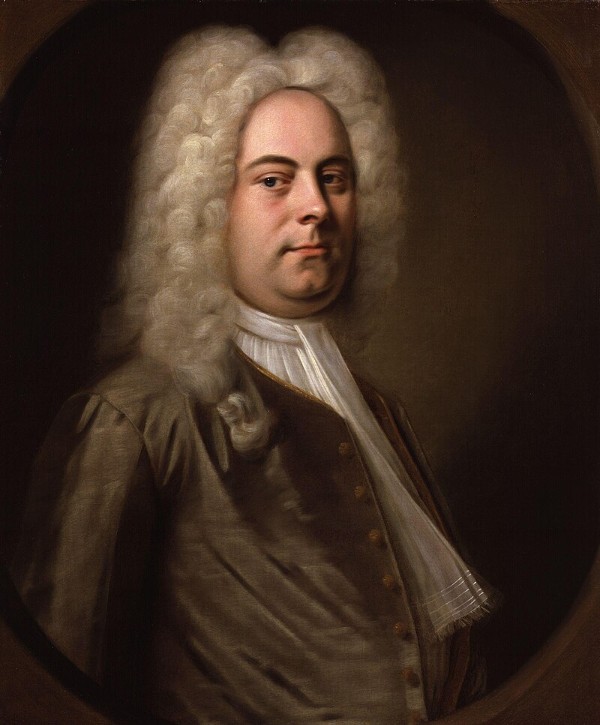
Balthasar Denner: George Frideric Handel, ca 1726–1728 (London: National Portrait Gallery)
For a great example of how Handel employed his method of borrowing, let’s look at the 8th concerto grosso in the set. The Op. 6, No. 8 in C minor is actually a suite of dances, as it includes an Allemande, a Siciliana, and an early form of a Polonaise.
The opening Allemande is a reworking of the first movement of Handel’s second harpsichord suite, which in turn is a direct transposition of the opening measures of one of Johann Mattheson’s Pièces de clavecin.
The 4-note figure used in the third movement goes back to a quartet from Handel’s opera Agrippina. In the fourth movement, Handel quotes the opening ritornello of Cleopatra’s aria “Piangerò la sorte mia” from the third act of his opera Giulio Cesare. In the fifth movement, Handel uses material from the discarded aria “Love from such a parent born” from Saul.
George Frideric Handel: Concerto Grosso in C minor, Op. 6, No. 8
Tradition and Originality
Borrowing aside, in his Opus 6, Handel looked to the models left by Arcangelo Corelli, which included both concerto da chiesa and concerto da camera. Here we find no three-movement works modelled after the Venetian concerto by Antonio Vivaldi.
The model for his Concerto Grossi was conventional, but Handel used the full range of his compositional styles at hand. We find trio sonatas, operatic arias, French overtures, Italian sinfonias, airs, fugues, themes and variations, and a substantial variety of dances.
When the music historian and composer Charles Burney heard the sixth Concerto Grosso in 1784, he wrote, “The Musette, or rather chaconne, in this Concerto, was always in favour with the composer himself, as well as the public… Indeed, no instrumental composition that I have ever heard during the long favour of this seemed to me more grateful and pleasing, particularly in subject.”
George Frideric Handel: Concerto Grosso in B minor, Op. 6, No. 12
Beyond the Printed Score
In the published edition of Opus 6, the printer specifies strings and harpsichord continuo, but we know from contemporary accounts that Handel routinely employed dual continuo instruments. Typically, that means either two harpsichords or a harpsichord paired with a chamber organ. This allowed for the realisation of the figured bass with greater colour and sustain.
In the printed scores, there is no mention of the addition of the oboes. However, Handel added oboe parts to at least four concertos for specific performances. Modern ensembles frequently use these parts, and some recordings add them across all concertos.
Handel left no tempo or ornamentation markings, probably encouraging performers to apply embellishments in slow movements and repeats. And there is always the question of using period bows and gut strings versus modern instruments. Many performers and critics prefer period-instrument performances, as they deliver “solid and unambiguous” expression with sharper attacks and vibrant resonance.
George Frideric Handel: Concerto Grosso in D Major, Op. 6, No. 5
Enduring Legacy
As we saw in Charles Burney’s reaction, contemporary reception was overwhelmingly positive. His verdict on the entire set praises the innovative spirit of the music. “Handel sports with a band, and turns it to innumerable unexpected accounts, of which neither Corelli nor Geminiani had ever the least want or conception.”
Once the concerto grosso style had fallen out of fashion, Handel’s music migrated into domestic and recital use. Countless arrangements for piano solo and duet versions were printed in the 19th century. These versions kept the music alive, at least in domestic settings.
It was with the rise of the early-music movement and period-instrument performances that Handel’s music made it into the 20th century. Today, of course, we can hear and choose from performances by both modern orchestras and historically informed recordings.
The Concerto Grossi Op. 6 have been in the repertoire continuously, probably because they have proven endlessly adaptable. And they do rank among the finest Baroque orchestral works available.
For more of the best in classical music, sign up for our E-Newsletter