I know a lot of people who are almost afraid of the symphonies by Johannes Brahms. Everybody keeps telling them how wonderful and how great these pieces are, but it can be a little difficult to connect with them.
Brahms didn’t give any explanations for his music, nor did he provide pretty pictures or stories. Brahms was a very private person who encoded his experience and feelings straight into the musical score.
I can’t give you a play-by-play because then the verbiage becomes more complicated than the music itself. What I can offer is some background and context, alongside some musical signposts for orientation.
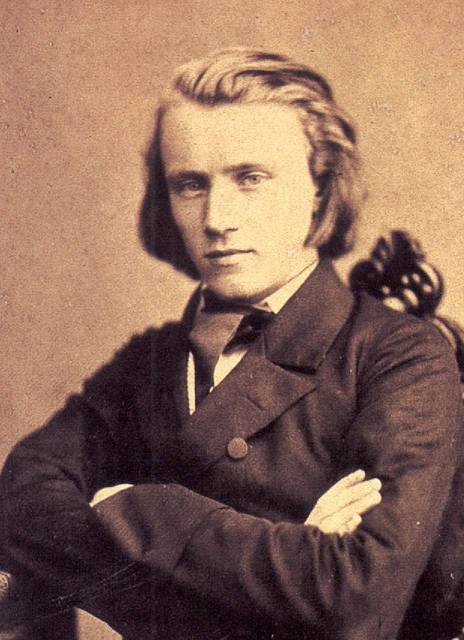
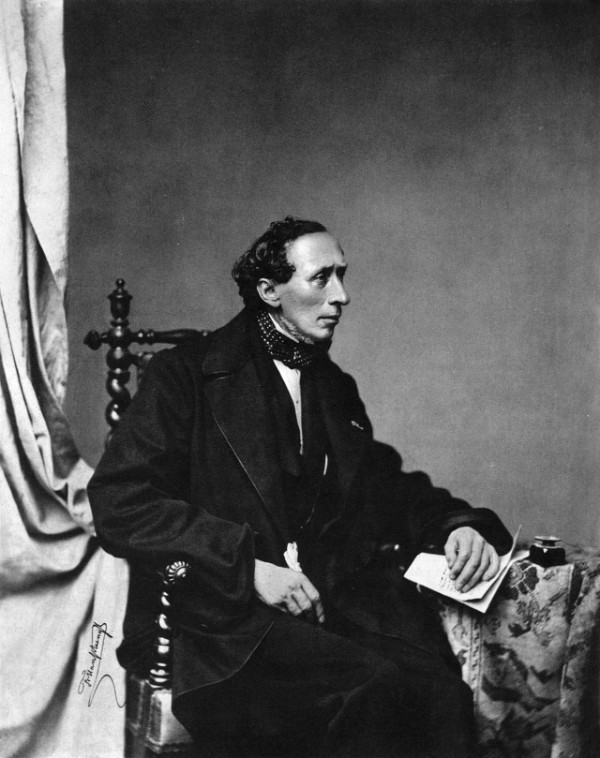
Johannes Brahms, ca 1855
Don’t worry about what Brahms tries to express frame by frame, just relax and explore your personal reactions to the music. So, on the occasion of Brahms’s death on 3 April 1897, let’s explore his four cornerstones of the orchestral repertoire with “A Beginner’s Guide to the Brahms Symphonies.”
Beethoven’s Shadow
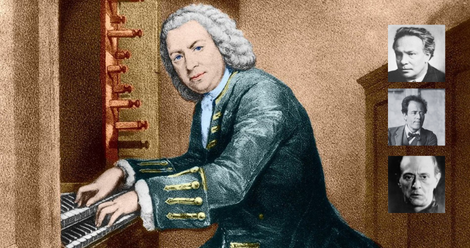
Did you know that Johannes Brahms (1833-1897) was initially terrified at the prospect of writing a symphony? He once told a friend, “I shall never compose a symphony! You have no idea how someone like me feels when he hears such a giant marching behind him all the time.”
The giant marching behind him was Ludwig van Beethoven, and Brahms just could not decide if he wanted to follow or reject the “Beethovenian” models. He had plenty of compositional talent but suffered from a real sense of musical insecurity in his youth.
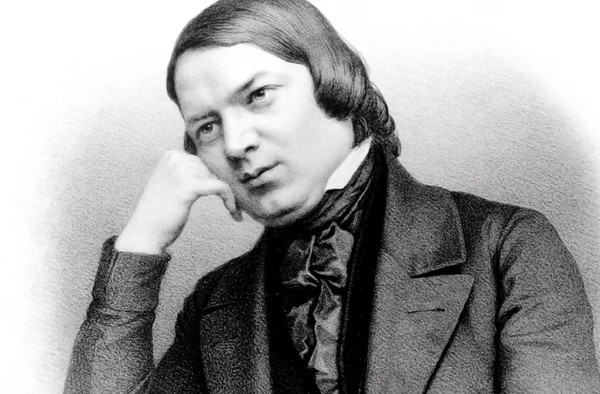
Robert Schumann
Brahms famously visited his musical hero Robert Schumann in 1853. He was mortified when Schumann proclaimed him the new musical Messiah in an article for the New Music Journal.
However, he slowly began to experiment with orchestral colours in his Serenades, blended symphonic sketches with a sonata for two pianos to produce his first piano concerto, solved thematic processes in his chamber compositions, and refined variation form in his Haydn Variations.
After 20 years, Brahms finally issued his first completed symphonic work in 1876, and the conductor Hans von Bülow immediately referred to it as “Beethoven’s Tenth.”
Johannes Brahms: Symphony No. 1 in C minor, Op. 68 “Un poco sostenuto—Allegro”
Johannes Brahms: Symphony No. 1 in C minor, Op. 68 (1876)
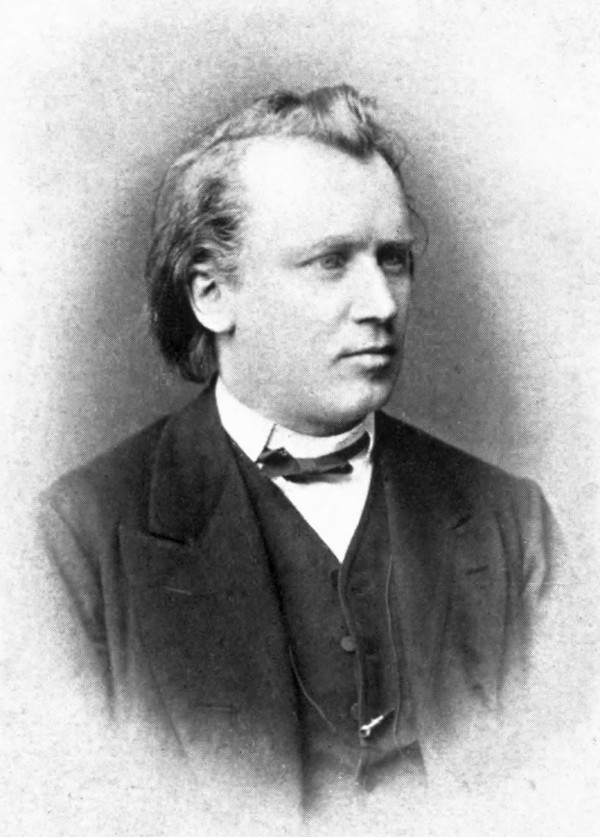
Johannes Brahms, c. 1872
Brahms’s First Symphony opens with a dissonant outburst by the full orchestra over pounding timpani. One lamenting musical line in the woodwinds is opposed by a tortured rising line in the violins and cellos.
This extraordinary introduction is like a dictionary of musical ideas presented simultaneously. Everything you will hear from now on refers back to this introduction.
Blazing fanfares and relentless energy drive the “Allegro” proper. The oboe introduces a chorale-like passage in the major mode, and there are some sunnier interjections; these look forward to the triumphant ending of the work.
A stormy section with moments of sheer desolation and hopelessness is built from the opening material, and the fateful strokes of the timpani lead to a thoughtful conclusion.
In this opening movement, Brahms had essentially collapsed musical space and time.
Johannes Brahms: Symphony No. 1 in C Minor, Op. 68 – II. Andante sostenuto (London Philharmonic Orchestra; Marin Alsop, cond.)
Turning Inward
The lyrical “Andante” movement offers a sense of intimacy that is commonly associated with chamber music. This modest movement highlights magnificent woodwinds, and it even offers a tender violin solo at the end.
A flowing clarinet theme initiates the “Allegretto.” What at first appears like an innocent dance tune is twice contrasted by themes that recall the second movement and the opening movement, respectively.
In these inner movements, Brahms has turned the symphony inward, in both a musical and an emotional sense. By focusing on the inner workings of the musical material rather than on a programme, Brahms addresses us as individuals.
Johannes Brahms: Symphony No. 1 in C Minor, Op. 68 – II. Andante sostenuto (London Philharmonic Orchestra; Marin Alsop, cond.)
From Struggle to Triumph
However, the “Finale” relentlessly thrusts us back into the tightly wound world of the first movement. And we quickly come to understand that the slow introduction prefaced Brahms’s solution to the 19th-century symphonic problem.
Instead of placing the entire dramatic and emotional weight on the opening movement, Brahms now provides a dramatic and grandiose stage for his symphonic conclusion.
Pizzicato strings provide a shimmering soundscape, and timpani rolls announce a horn call in the major key. The sonic vista suddenly broadens, and we hear a theme that sounds like the “Ode to Joy” from Beethoven’s Ninth.
The violins introduce another theme, and eventually the movement comes full circle to unify the entire symphony. It had taken 20 years, but Brahms had finally managed to control his symphonic demons.
Johannes Brahms: Symphony No. 1 in C minor, Op. 68 “Adagio—Allegro non troppo”
Johannes Brahms: Symphony No. 2 in D Major, Op. 73 (1877)
It had taken Brahms nearly two decades to complete his First Symphony, but now he produced his second symphonic work in record time.
The work was completed in a matter of weeks during his 1877 summer holiday in the village of Pörtschach, picturesquely located on the shore of the magnificent Lake Wörthersee in the Austrian province of Carinthia.
When his friend Theodor Billroth played through the score for the first time, he wrote to the composer at once: “It is all rippling streams, blue sky, sunshine, and cool green shadows.”
Johannes Brahms: Symphony No. 2 in D Major, Op. 73 “Allegro non troppo”
Pastoral Radiance
This pastoral work features highly original and independent musical ideas. Brahms jokingly suggested, “The melodies flow so freely that one must be careful not to trample on them.”
Brahms composed a spontaneous work that combines the extroverted and the introspective, with everything growing organically.
Horns and rustic woodwind chords sound a pastoral introduction to the opening “Allegro non troppo.” With one soaring phrase in the violins the radiant main theme emerges, followed by a second theme in the cellos.
An early commentator suggested that this movement “resembles an agreeable landscape into which the setting sun casts its sublime and sombre lights.” However, in this longest movement in any of Brahms’s symphonies there are moments of surprising darkness.
Johannes Brahms: Symphony No. 2 in D Major, Op. 73 – II. Adagio non troppo – L’istesso tempo, ma grazioso (Hamburg Philharmonic Orchestra; Simone Young, cond.)
Startling Seriousness and Light-hearted Grace
The “Adagio” is a complex and chromatic movement that projects a startling seriousness.
It is hardly surprising that Brahms suggested to his publisher that this movement should be published on pages with black borders.
Thankfully, the “Allegretto grazioso” is much more relaxed. A simple tune in the oboe alternates with playful and highly syncopated string and wind sections, while Brahms keeps adding layers of orchestration to the musical textures.
Johannes Brahms: Symphony No. 2 in D Major, Op. 73 – III. Allegretto grazioso (quasi andantino) – Presto ma non assai (Hamburg Philharmonic Orchestra; Simone Young, cond.)
Explosive Joy
The joyous and exuberant “Finale” explodes into a rousing dance. Great orchestral roars of triumph reminiscent of Beethoven are contrasted by moments of pure Brahms.
We hear a bright trombone passage near the end, which leads the work to a brilliant conclusion. In this work, Brahms finally freed himself from his compositional anxiety, and he musically announced that he was ready to follow his own compositional path.
Johannes Brahms: Symphony No. 2 in D Major, Op. 73 “Allegro con spirito”
Johannes Brahms: Symphony No. 3 in F Major, Op. 90 (1883)
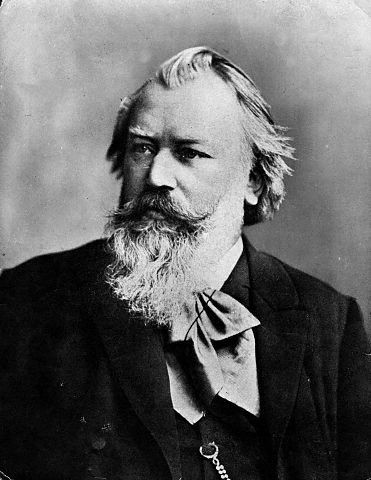
Johannes Brahms
Brahms generally composed during the warm summer months. After celebrating his 50th birthday in the company of his close friends, he decided to spend the summer of 1883 in the town of Wiesbaden on the Rhine River.
He found a little studio looking towards the river and completed his Third Symphony in a matter of weeks. Brahms never really disclosed his inspirations, and even his closest friends were left to guess at the actual meaning of the work.
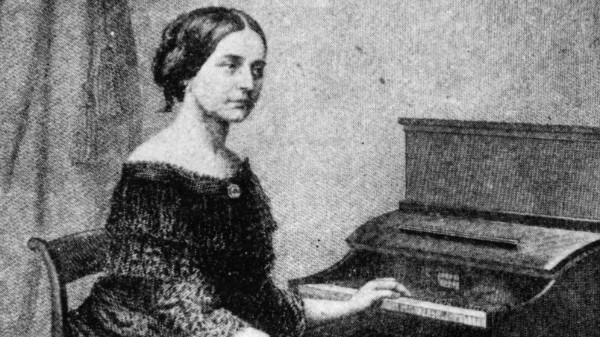
Clara Schumann
Clara Schumann wrote to him after playing through the symphony at the piano: “What harmonious mood pervades the whole! All the movements seem to be of one piece, one beat of the heart, each one a jewel.”
Johannes Brahms: Symphony No. 3 in F Major, Op. 90 “Allegro con brio”
A Musical Self-Portrait
Brahms’s choice of Wiesbaden and its proximity to the Rhine River was no accident, as the symphony abounds with allusions and memories of the three personalities that forever shaped his life.
There is Robert Schumann, who had proclaimed him a musical Messiah when he was 20. We also find his passion and love for Clara Schumann, even though he could not commit to marriage. And his artistic collaborations with the violinist Joseph Joachim produced some enduring masterworks.
In his most personal symphonic work, filled with conflicts and warm resolutions, Brahms looked back over his life and composed a highly revealing musical self-portrait.
Johannes Brahms: Symphony No. 3 in F Major, Op. 90 – II. Andante (German Radio Saarbrücken-Kaiserslautern Philharmonic Orchestra; Stanisław Skrowaczewski, cond.)
A Summer on the Rhine
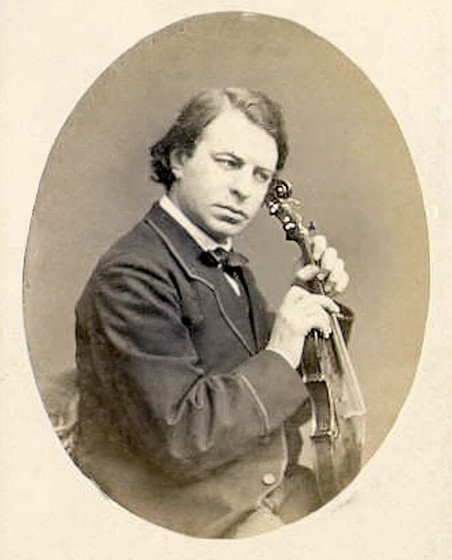
Joseph Joachim
Brahms’s retrospective immediately takes shape in the first measures of the opening “Allegro con brio.” The opening theme is almost verbatim taken from Robert Schumann’s Symphony No. 3, tellingly subtitled “Rhenish.”
And you can immediately hear a three-note motto that dates back to 1853. “F-A-E” translates to Joachim’s life motto “Free but Lonely.” Brahms adjusted the motto to “F-A-F,” or “Free but Happy.”
This motto appears in various guises, transpositions, and variations, throughout the entire symphony. The opening chord on “F” is bright and in the major key, the minor chord on “A” introduces a dramatic contrast, and by the time we arrive at the third chord on “F,” the music has once again turned brightly optimistic.
Johannes Brahms: Symphony No. 3 in F Major, Op. 90 – III. Poco allegretto (German Radio Saarbrücken-Kaiserslautern Philharmonic Orchestra; Stanisław Skrowaczewski, cond.)
Clara’s Presence
Both the second and third movements hold back as much as they reveal. The clarinet announces the main theme of the second movement “Andante,” and Clara is ever-present. The music never rises above a piano dynamic as it suggests an almost timeless character.
A cello theme opens the “Poco allegretto,” one of Brahms’s most expressive and stunningly beautiful movements. The solo horn sings a tune with accented tones in the melody that are dissonant. This dissonance imbues the music with a sense of mysterious yearning.
The concluding “Allegro” returns to the major-minor contrast of the opening movement. Near the end, Brahms returns to the main theme of the first movement, unifying the entire work. The music simply unwinds as it is content with the memory of the opening.
Johannes Brahms: Symphony No. 3 in F Major, Op. 90 “Allegro”
Johannes Brahms: Symphony No. 4 in E minor, Op. 98 (1885)
Brahms’s Fourth Symphony is one of the familiar staples on concert programmes around the world, yet it contains some of the darkest and most profound music of the 19th century. Brahms presented it to his publisher with the words “… I still think catastrophe is coming.”
The Fourth Symphony essentially stands as a funeral song for Brahms’s heritage, “for a world at peace, for an Austro-German middle class that honoured and understood music like no other culture, for the sweet Vienna he knew, and for his own lost loves.”
In this work, Brahms announced that he was not a reactionary symphonist but a renovator of tradition. It is rather pessimistic, yet presents the crowning conclusion of an extended Austro-German musical tradition.
Johannes Brahms: Symphony No. 4 in E minor, Op. 98 “Allegro non troppo”
Melodic DNA in Thirds
The first movement, “Allegro non troppo,” opens directly with a melodic chain of descending and ascending thirds that covers the 12 notes of the diatonic scale. It is the melodic DNA that generates not only the first movement, but the entire symphony.
Unusually, first subject presents the lyrical melody, while the second theme has a more robust character. As the music continues, we arrive at a musical complexity “that produces one of the most complex and motivically convoluted sections in all music.”
Johannes Brahms: Symphony No. 4 in E Minor, Op. 98 – II. Andante moderato (Chicago Symphony Orchestra; Carlo Maria Giulini, cond.)
Medieval Mode and Baroque Passacaglia
In the second movement, Brahms looked to early musical models and employed a medieval mode to communicate an archaic quality. By contrast, the “Allegro giocoso” presents an explosion of vitality and life that sounds like the triumphant end of the symphony.
But it isn’t. The Finale is without doubt the most powerful movement Brahms ever wrote. In thirty variations on a passacaglia theme adapted from a Bach cantata, Brahms creates one of the wonders of musical architecture. Drawing on this Baroque model, he pays homage to an era of music history that is coming to a tragic conclusion.
Most remarkably, and unsurpassed in all of symphonic literature, the ferocity and concentration of expression do not need an explanatory text but are achieved through a relentless focus on musical details.
Johannes Brahms: Symphony No. 4 in E Minor, Op. 98 – III. Allegro giocoso – Poco meno presto (Chicago Symphony Orchestra; Carlo Maria Giulini, cond.)
Brahms Speaks Directly to the Heart
The Four Symphonies by Brahms are lushly scored, grand in scope, and deeply expressive.
This music, ranging from an early dramatic struggle to an architectural masterpiece, speaks directly to the heart.
We really don’t need stories or explanations, just a willingness to listen and to discover our own emotional responses. So relax, listen to these symphonies often, and allow them to unfold at their own pace. Trust me, even after listening to them for decades, there are always new facets to discover with every encounter.
For more of the best in classical music, sign up for our E-Newsletter