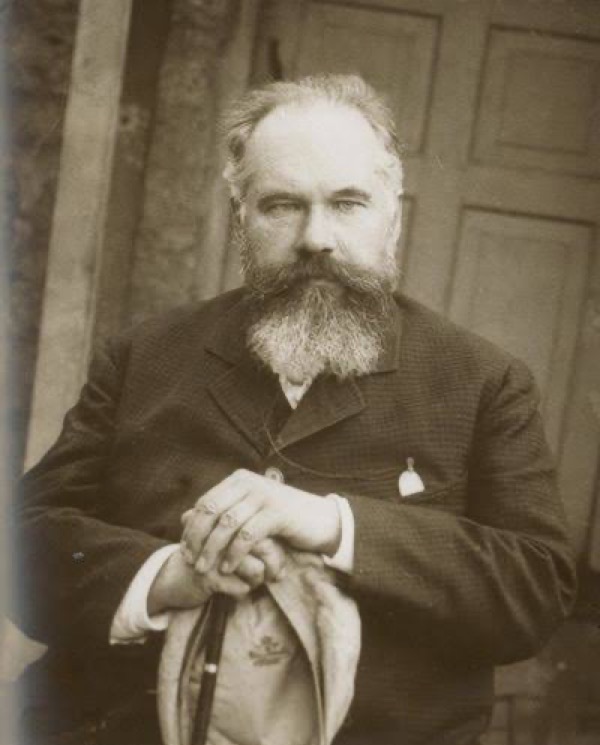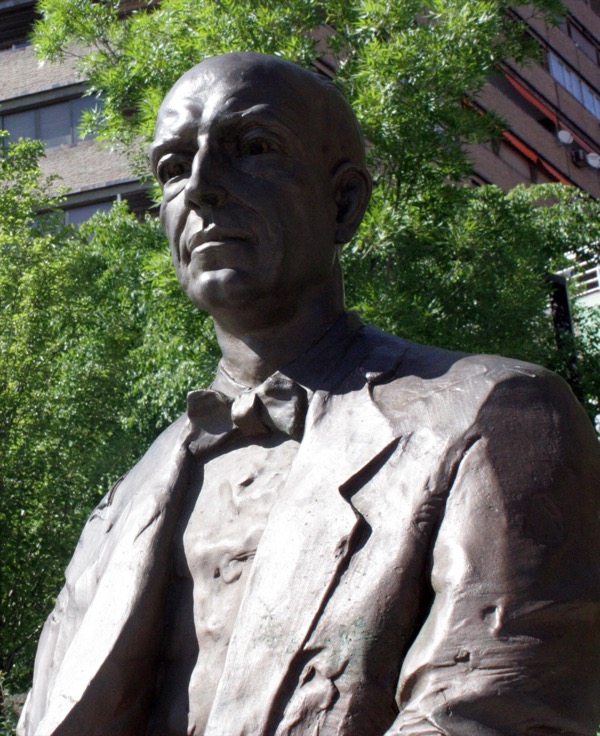
I have to confess that I know very little about the Swiss composer Arthur Honegger (1892–1955). I do know that he was a member of Les Six, and that he contributed to various projects of the group, which sought to establish a fresh French style of composition.
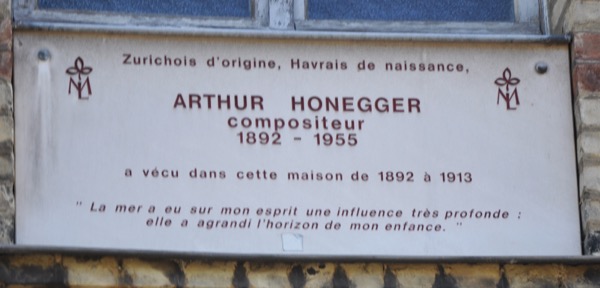
Plaque to Arthur Honegger, Le Havre (France)
The other thing I know is a symphonic movement entitled Pacific 231, a musical and physical representation of the power and acceleration of a locomotive. It is often labelled futuristic music as it presents technology as a symbol of human progress.
But what I didn’t know, for example, is that Arthur Honegger composed five symphonies. Musicologists suggest that they convey deeply held convictions and messages, and are intended to exert moral and social influence.
To commemorate Honegger’s death on 27 November 1955, let’s introduce a beginner’s guide to the five symphonies. I am learning alongside you, trust me.
Arthur Honegger: Pacific 231
Bach and Brilliant Disorder
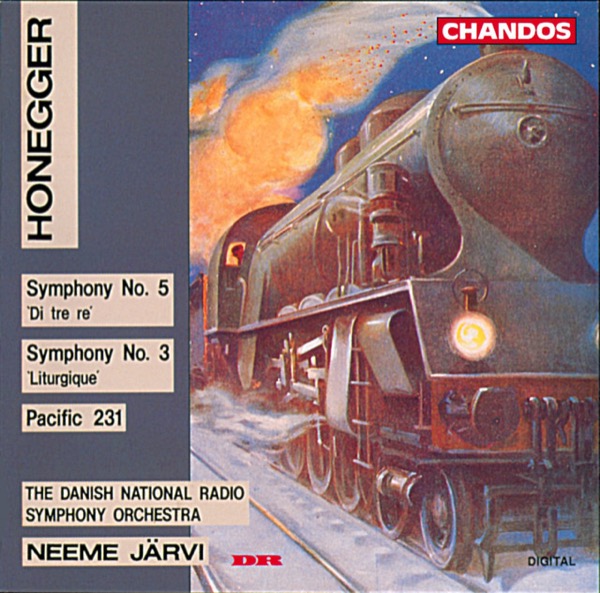
Honegger Symphonies
Honegger was decidedly unhappy that the titles of his first two symphonic movements, Pacific 231 (1923) and Rugby (1928), were misinterpreted by the public as specific programmes. In fact, both movements did try to paint pictures of the subjects indicated in the title, but they simply functioned as sources of musical inspiration.
And thus, his Symphony No. 1, composed in 1929–30, does not carry a title at all. The Belgian musicologist Harry Halbreich describes it as “written in a language that is rougher and less spare than the following ones, despite a perfectly mastered form, at the crossroads of youth and maturity.”
That sounds a bit complicated, but it really isn’t if we understand that Honegger’s principal style is based on the counterpoint of Johann Sebastian Bach. As he freely admitted, “My great model is J.S. Bach.” Of course, we find impressionistic use of orchestral sonorities and colouristic harmonies, but Honegger’s primary concern is always formal architecture.
The Symphony No. 1 was essentially commissioned for the Boston Symphony Orchestra’s fiftieth birthday celebration by conductor Serge Koussevitzky. It premiered in Boston on 13 February 1931, and features only three movements.
Much of the music unfolds in the industrial style of Pacific 231, with hammered rhythms in the opening “Allegro marcato” and violent outbursts in the “Adagio.” Things do calm down in the final movement, and throughout the work, Honegger opposes different themes in a dialogue-like contrast.
Each movement is principally built on a single musical element, and subsequently joined by other elements, creating a conflict between linear and chordal forces. It has been described as “brilliant disorder,” but it still features a clear tonal language. This symphony is hardly ever heard in the concert hall these days.
Arthur Honegger: Symphony No. 1 (Basel Symphony Orchestra; Dennis Russell Davies, cond.)
From Darkness to a Trumpet of Hope
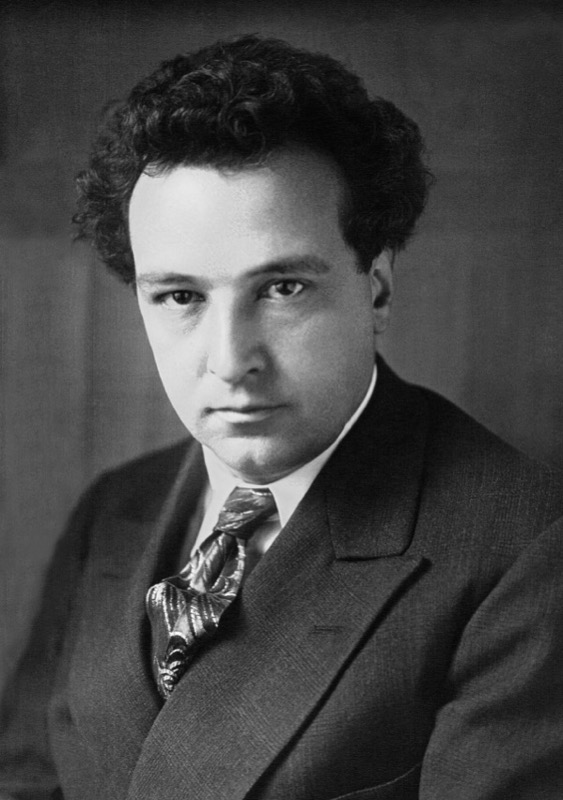
Arthur Honegger (1928)
We now move from Honegger’s least frequently performed symphony to his most popular, the Symphony No. 2. In fact, the composer’s output during the 1940s was dominated by four symphonies. Honegger’s Symphony No. 2, commissioned by the Swiss conductor and patron Paul Sacher for the tenth anniversary of his Kammerorchester Basel in 1936, was first performed only on 18 May 1942.
According to Geoffrey K. Spratt, “it portrays the abject misery, hidden violence and all-pervasive depression that characterised Paris and its citizens during the Occupation.” Honegger also gives us a kind of listening guide by describing his considerations.
“1. Strictness of form, dispensing with the recapitulation, which is customary in classical pieces and which evokes a feeling of length.
2. Search for sufficient characteristic themes to get the listener’s attention and to permit him or her to follow the course of the entire ‘story’.
3. I sought no program, no literary or philosophical event. If this work triggers a certain emotion, the reason is that it occurred to me in an entirely natural way. For I express my thoughts through the music, and perhaps without even being quite conscious of it myself.”
Honegger started the composition of this “String Symphony” with the slow “Adagio.” He described it as a rather sombre piece that, in places, is despairing. And he understood that the slow tempo might be challenging for conductors and audiences.
Apparently, Honegger took a long time working out the first movement, as the initial motif was too weak to sustain the concentrated and strict form. The work is for string orchestra, except for the addition of a trumpet in the concluding chorale.
There is a lot going on in the closing pages of this symphony, and the ad libitum trumpet part makes the chorale melody soar over the entire orchestra. This also seems to be going back to Bach, who often used the same device for a sense of hope and faith.
Arthur Honegger: Symphony No. 2, “Symphonie pour cordes” (Bavarian Radio Symphony Orchestra; Charles Dutoit, cond.)
From Despair to the Promise of Peace
Honegger said of his Symphony No. 3, “Liturgique”, that “it is a drama in which three protagonists participate: Misfortune, Happiness, and Man.” As he wrote, “In this work I wanted to symbolise the modern rebellion against the flood of barbarism, stupidity, suffering, machine-thinking and bureaucracy that has been breaking over us for some years now.
In the music, I have described the fight that takes place in the heart of man between relinquishing the blind, constrictive powers and the desire for happiness, love of peace and divine refuge.”
Written in 1945–1946 on commission from the Foundation Pro Helvetia, and dedicated to the Swiss conductor Charles Munch, who premiered the work in Zürich in 1946, this symphony is a reflection on World War II. It is the only symphony by Honegger that has a clear programme.
Although Honegger was a Protestant, all three movements take their titles from the Catholic liturgy, with the composer explaining in no uncertain terms the nature of his imagery. The first movement is “Dies irae” (Day of Wrath), and it predictably features plenty of dissonances and a stark rhythmic structure.
There are visions of the Last Judgement; powerful forces oppose one another; painful sorrow brings bursts of concentrated sound and tonal conflicts. The sound of a gigantic orchestra crowds in on the listener, and the movement ends with a sombre trombone chorale.
The second movement is “De profundis clamavi” (From the Depths I have cried out), and Honegger referred to the highly elaborated endless melody as a “prayer beyond hope.” It is meditative and lyrical, with Honegger using soft tone colours.
The third movement is “Dona nobis pacem” (Give us peace). It all starts not with a message of peace, but by repeating the horrors of reality. We hear war scenes in the march motif rising to a dissonant climax before a long and lyrical coda finally finds the long-awaited peace.
Arthur Honegger: Symphony No. 3, H. 186, “Liturgique” (Oslo Philharmonic Orchestra; Mariss Jansons, cond.)
A Little Sunshine After the Storm
Against the darkness of Honegger’s second and third symphonies, the Symphony No. 4, “Deliciae basiliensis” of 1946, is known for its unclouded optimism. It is a beautifully crafted work expressing the joy of emerging from the horrors of the war, and Honegger’s pleasure in visiting friends in the Swiss countryside.
It was once again commissioned by Paul Sacher, for the twentieth anniversary of the founding of the Kammerorchester Basel. The orchestral forces are limited to two flutes, an oboe, two clarinets, two bassoons, two horns, a trumpet, piano and percussion, plus strings in what we could describe as a standard chamber-music layout.
The texture is transparent throughout, and once again aligned with Bachian counterpoint. As the composer writes, “The first movement, composed in July 1946, clearly expresses a state of the soul. In the midst of the disgusting and stupid conditions of existence then imposed on us, it expresses the hope of escaping this atmosphere for a time, prompted by the prospect of a summer break in Switzerland, among dear friends, and where music played an important role.”
The slow “Larghetto” is refined and somewhat serious, but it is also based on an old Basel folk-song. We hear this song quoted in its simple and original form towards the end of the movement.
The finale, as Honegger explains, “uses a fairly complex polyphonic structure (although the listener should not be unduly disturbed), in which the various elements gradually overlap. The formal layout is that of a rondo, passacaglia and fugue.”
At the climax of all this overlapping, another folk-song springs into prominence, cheerfully soaring above the stretta of the main theme. It all ends in a short conclusion, and in view of the quotations from popular tunes, Honegger gave the piece the subtitle “Deliciae Basiliensis,” which basically translates as “The Delights of Basel.”
Arthur Honegger: Symphony No. 4, “Deliciae basiliensis” (Suisse Romande Orchestra; Ernest Ansermet, cond.)
The Sound of Nothingness
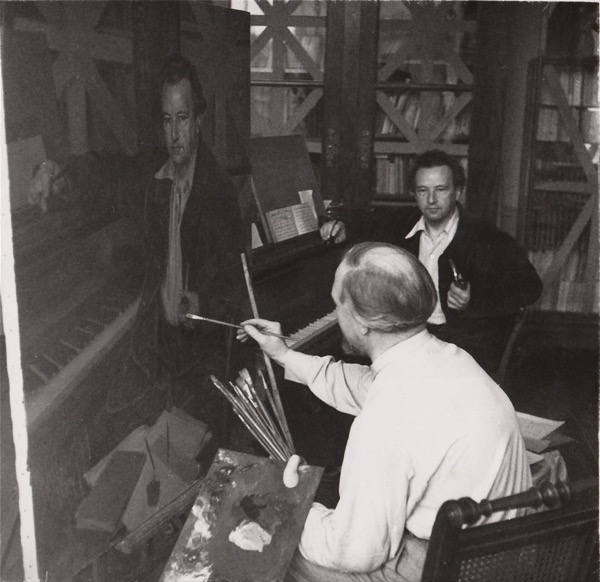
Serge Ivanoff and Arthur Honegger
During the last eight years of his life, Honegger’s health was rapidly deteriorating as a result of a stroke, and he strongly believed that the end of civilisation was near. As such, his fifth and final symphony “Di tre re” of 1950 is coloured by profound and dark emotions.
The subtitle refers to the three D notes played by the kettledrum at the end of each movement, and unlike the “Symphonie liturgique,” this work ends with a vision of nothingness. The work opens with a cry of despair, a unison fortissimo in sostenuto chords. The contrasting lyrical idea is presented by the clarinet and bass clarinet, and a trumpet figure is set against the flowing line. This conflict leads to an inevitable crisis, and even though the music drops to pianissimo, the tension remains.
The central movement is a fusion of a scherzo and an Adagio. The principal theme of the scherzo is given its initial outline and subsequently presented in inversion and retrograde. It’s a movement that sounds technically obsessed, but it all revolves around internal balance and symmetry.
The finale introduces a chorale in the middle of uncompromising intensity, as if to inject a suggestion of hope. Yet, the pounding rhythms persist, and the struggle is lost. The symphony closes in a shadowy atmosphere, for there is only rigidity and emptiness.
As I listened to all five symphonies by Arthur Honegger, I was struck by the notion of how he used the symphony as a means of responding to the world around him. There is great discipline and wonderful orchestration, but at the centre is a personal struggle between despair and hope.
I started this listening project knowing very little about Honegger and his music. I still don’t know enough, but I have discovered music that deserves considerably more attention. It seems that he tried to reach a profound and universal dimension of humanity, and that he was not satisfied with easy answers or immediate pleasures. I feel that I have only begun to scratch the surface of his art.
For more of the best in classical music, sign up for our E-Newsletter
Arthur Honegger: Symphony No. 5, “Di tre re” (Danish National Radio Symphony Orchestra; Neeme Järvi, cond.)