So, you want to try to learn how to play the cello? You wouldn’t be alone. Audiences love the cello. Its golden tones are the closest sounds to the human voice, and whenever there is a romantic or heartbreaking scene in a video, it’s the soulful cello you hear.
Sergei Rachmaninoff: 14 Songs, Op. 34: No. 14. Vocalise (arr. for cello and piano) (Lynn Harrell, cello; Vladimir Ashkenazy, piano)
I have several adult students who’ve embarked on this journey after retirement. There are many reasons to learn a musical instrument. The benefits for the brain are unequalled: brain synapses, or grey matter, can be formed at any age. Few activities replicate the use of both sides of your brain like playing an instrument does. It’s your thinking, moving, and emotional brain simultaneously engaging your auditory, visual, and motor skills. You’ll see an improvement in your coordination, dexterity, listening skills, memory, concentration, problem-solving, and time management, and let’s not forget that note reading is like learning another language. Clearly, it is also an emotional outlet that naturally reduces stress, but it takes commitment, motivation, discipline, drive, and patience to learn an instrument, and there are frustrations along the way.
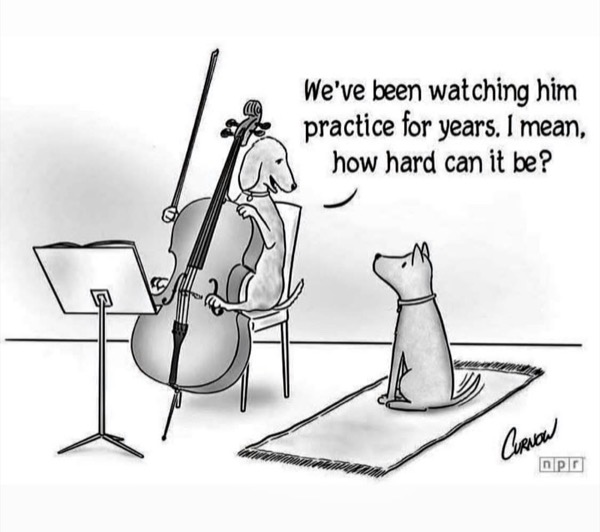
I would say the most difficult challenge on a string instrument is the independence of your right and left hands. Each must do completely different things. It’s easy to get so bogged down with finding the notes (even somewhat accurately) in the left hand that often the bow is adversely affected.
The bow is your voice, and making a beautiful sound is the goal. Being able to fine-tune dynamics and articulation and play in the style of the music, whether it is clear and light, or airy and floating, heavy, marked and accented, or rich and full, takes practice and control.
Understanding these variables and considering them whenever you play is like imagining your bow is the palette that allows you to choose and mix colours. Your palette consists of:
The bow speed
The amount of bow
The contact point or location of the bow in relation to the fingerboard or bridge
The part of the bow to use, closer to the frog or closer to the tip, the lower half or the upper half.
No problem, right?
We teachers often use the analogy of ‘singing’ on your instrument. The use of the bow is what gives phrases direction and breath as well as meaning without distorting the rhythm. British cellist Jane Cowan (1915-1996), Steven Isserlis‘ cello teacher, would say, “each phrase/clause has a main note towards and away from which every other note flows—exactly as speech.”
Connecting the notes is easier said than done. A pure legato requires the downbow (frog to tip) and upbow (tip back to frog) to be fluid. My teacher János Starker used to say the downbow action is like pulling, and the upbow action is like pushing, leading with the index finger as if you’re spreading peanut butter or wielding a paintbrush, and avoiding downward pressure. We draw out the sound using arm weight and motion with a loose wrist, the arm closer to the body on the downbow and higher on the upbow.
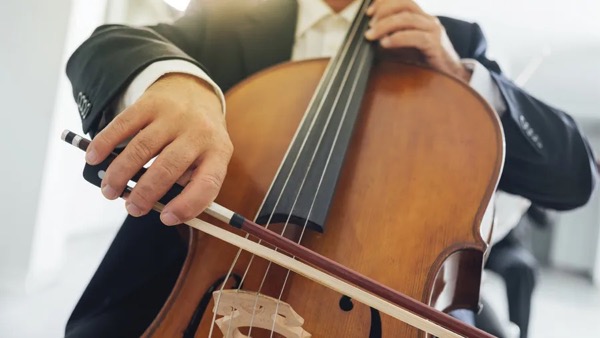
Cello downbow
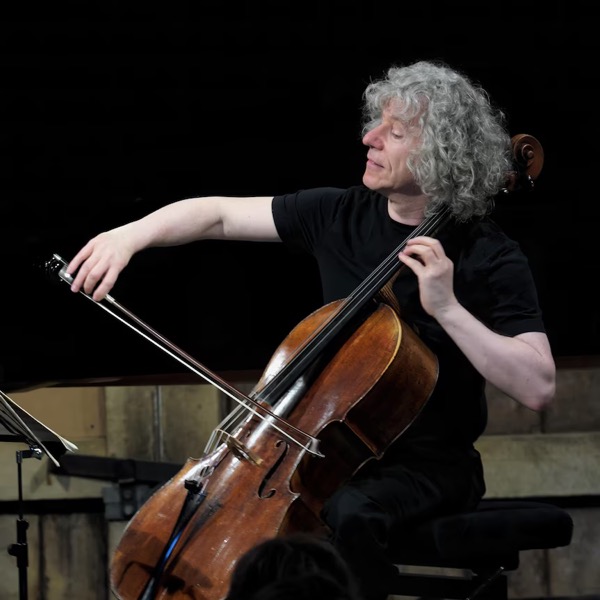
Cello upbow
What complicates the matter on the cello is that these considerations vary according to the string you’re playing on. The A string, the highest, is much thinner than the C string, the lowest, and each string has a different quality of sound. The A string, upon which we often play lyrical melodies, in general requires more bow with less weight, while, in my experience, cellists often use too much bow on the lowest string. It’s a bit counterintuitive, but to sound clearly, especially in louder dynamics, one needs to play with less bow and less bow speed on the lower strings.
This concept was challenging for one of my adult students. He announced he’s been practising dynamics and then he played a few long tones saying, “This is piano p (or soft), and this is mezzo forte mf, (medium loudness).” He eagerly looked at me for my agreement, but I said, “It depends.” Perhaps true in a vacuum… but it’s all relative—It depends on the string you are playing; it depends on the piece you are playing; it depends on whether you are playing in a practice room or a larger hall; it depends on the juxtaposition of the volume of the soft sound you just played whether the mf will be perceived as louder; it depends on whether you are playing legato (connected with several notes on a bow), or if you’re playing separate notes; and it certainly depends on who else you might be playing with.
On the A string, for example, a melody can sound floaty or flautando and delicate when playing with lots of bow and on or near the fingerboard, but we can make the sound focused, resolute, edgy, or even gritty the closer you get to the bridge and with a slower bow speed. Notice the winner of the 2026 Queen Elisabeth Cello Competition, Ettore Pagano, playing very close to the bridge.
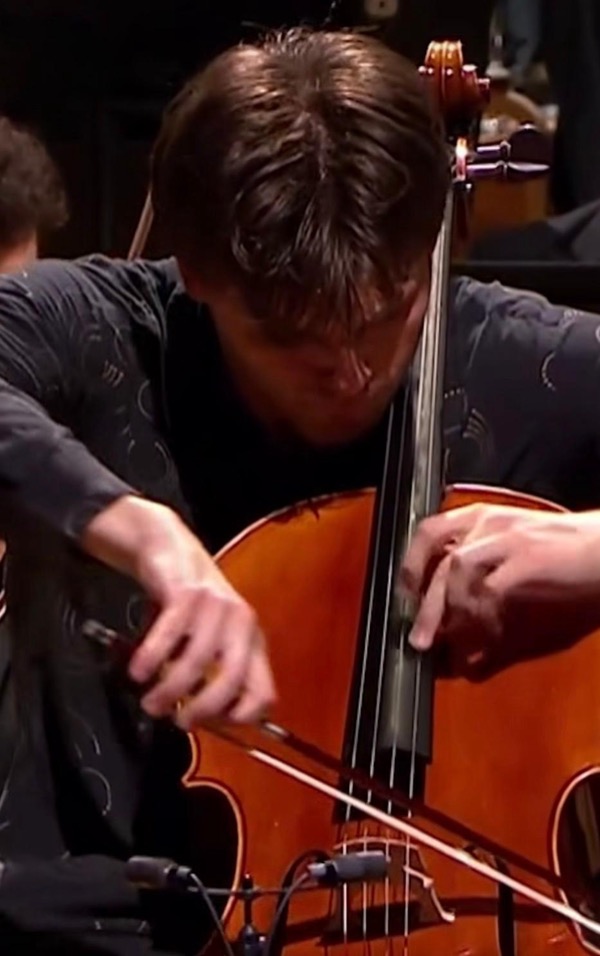
Cello on bridge Pagano
We can also play lovely melodies on the D string for a more mezzo soprano, covered, and intimate sound.
I think my student expected there to be absolutes to work towards. No such luck.
I suggested we try the concepts in a piece rather than working only on long notes. We went to the beautifully lyrical “Swan” from Camille Saint-Saëns‘s Carnival of the Animals.
The first challenge is beginning without an accent and the right quality of sound. It’s often helpful to visualise the effect you are trying to emulate or to think of an adjective: is the mood melancholy, urgent, tragic, anxious, passionate, brooding, breathless, lilting, gentle, hushed?
I urged my student to imagine a loon landing on a lake, to first breathe in and to breathe out as he slowly put the bow in motion, gracefully landing on the string. It took several tries to get the right weightlessness and motion he needed for a gorgeous opening G. Of course, a lovely vibrato in the left hand adorns the note too.
The next challenge occurs at the 3rd note. It’s a long shift from fourth position to first position. It’s easy to have it stick out either due to the left-hand jerking back quickly or inadvertently stopping the bow or reacting with the bow and losing the contact point during the left-hand movement. It’s the 3rd beat of a ¾ signature. We don’t want an accent there or have the third note stick out—we want it to feel like one impulse, not three—but nonetheless it needs to lead to the downbeat of the following bar.
We tried several times without the bow. Using a counterclockwise gesture in the left elbow, gently releasing the left hand, he slowly glided on the string, shifting to the B with a graceful movement to avoid a jerky backward motion and an unwanted crescendo when changing position. Next, we added the bow, keeping it gently moving at a constant speed, unperturbed by the shift in the left hand and maintaining a constant contact point near the fingerboard.
Connecting the B to the second bar downbeat E took some doing. The challenge here is that now we are at the tip of the bow. Somehow, we need to reach a similar dynamic on the E that we had for the opening G, to approach the tip and smoothly change the bow at the tip without allowing the sound to drop. With the second bar on an upbow, we need to again avoid an accent in this bar on the 3rd note G. Due to a natural weight in the bow as we get closer to the frog, we don’t really want a crescendo, but still, we want it to lead and connect to the A in the third bar. Sound complicated? It is. This is the kind of analysis we do for every bar! It’s called deliberate practice.
Let’s hear it. This is a lovely rendition with cellist Sheku Kanneh-Mason. It’s smooth as silk but a bit faster than some cellists play.
Camille Saint-Saëns: Carnival of the Animals: XIII. Le Cygne (The Swan) (arr. T. Hodge for cello, harp and cello ensemble) (Sheku Kanneh-Mason, cello; Katherine Thomas, harp; City of Birmingham Symphony Orchestra, cello section)
We will often experiment with the bowing and fingerings to achieve the sound we are seeking. Mischa Maisky plays it exquisitely beautifully—quite a bit slower than the previous performance. He begins, unusually enough, on an upbow and plays some of the melody on the D string to achieve that tender and hushed introverted sound.
Carnival of the Animals – The Swan (Original Music Video)
Got the hang of it? Please do try playing the cello. What could be better than hugging this beautiful instrument that is capable of such a wide range of expressions?
For more of the best in classical music, sign up for our E-Newsletter