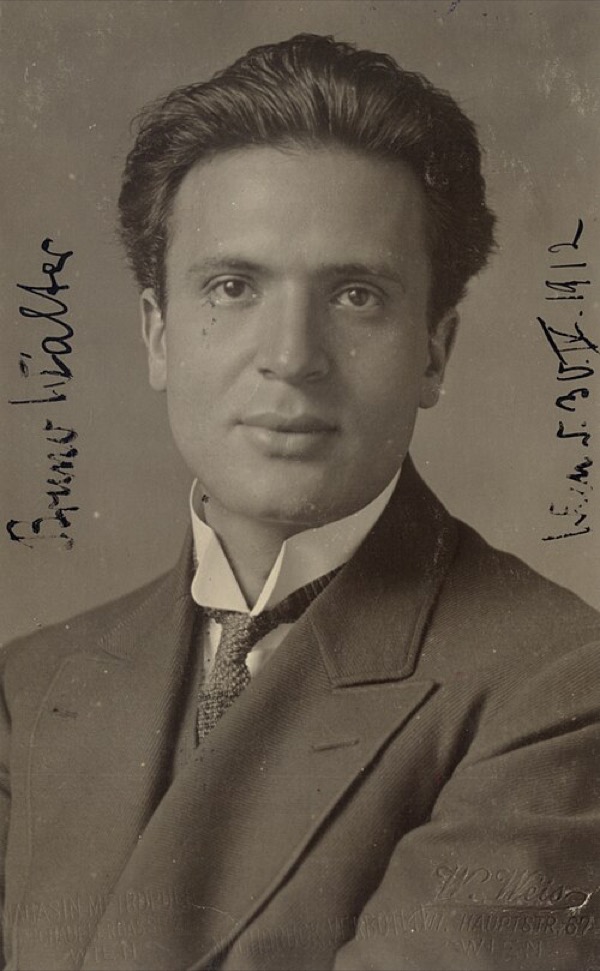
In 1901, Gustav Mahler (1860-1911) married Vienna’s most eligible bachelorette, Alma Schindler. For Mahler, this instigated an immensely fulfilling period in his personal life. Nevertheless, his music took on a more ominous, grotesque, and deeply pessimistic tone.
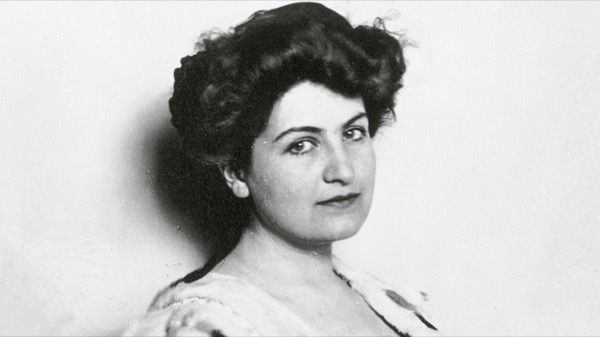
Alma Mahler (Schindler)
His musical language now looked into the depths of the human soul, and it confronted man’s destructive impulses and tendencies. This new direction was in part inspired by the personal directness, oriental flavour, and intellectualism expressed in the poems of Friedrich Rückert.
As we commemorate Gustav Mahler’s death on 18 May, let us explore how Mahler’s Rückert settings created a new link between music and literature, and also between the Lied and the Symphony.
Gustav Mahler: Rückert Lieder “Blicke mir nicht in die Lieder”
The Poet Behind a Musical Legacy
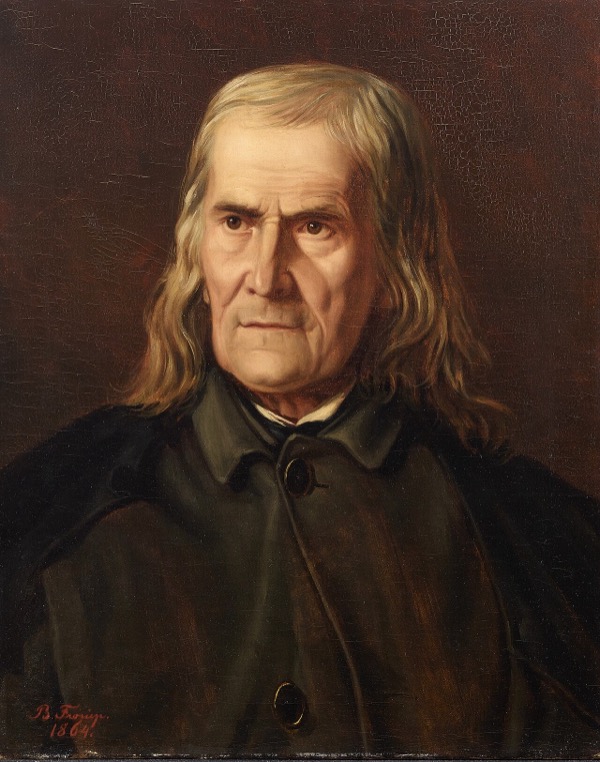
Friedrich Rückert (1788-1866)
Friedrich Rückert (1788-1866), professor of Oriental languages at the University of Erlangen and Berlin, chiefly made his name with a number of highly esteemed translations of Oriental poetry. A master of more than thirty languages, he also began writing poems conceived in the spirit of the Oriental masters.
Among his original writings dealing with Oriental subjects, we find Oriental Myths and Poems (1837), Edifying and Contemplative, from the Orient, (1836-38), and Brahmin Stories (1839). His most elaborate collection is titled The Wisdom of the Brahmins, published in six volumes from 1836 to 1839. The Spring of Love, a cycle of love songs from 1844, is probably the best-known Rückert collection.
Rückert’s poetry, much of it published after his death in 1866, provided the inspiration for roughly 121 settings of his work. This makes him the fourth most-set German poet, behind Goethe, Heine, and Rilke. Among the composers drawn to Rückert’s poetry, we find Schubert, Clara and Robert Schumann, Johannes Brahms, Max Bruch, Max Reger, Elise Schmezer, and Gustav Mahler.
A New Lyrical Language
Composed between 1901 and 1902, the Rückert Songs mark a change of style, from the childlike and often satirical settings of the Wunderhorn to a more lyrical and contrapuntal style. These five settings, for voice and orchestra or for piano, do not constitute a true song cycle but are arranged and presented in various ways in performance.
Do not look into my songs!
I lower my gaze,
As if caught in the act.
I dare not even trust myself
To watch them growing.
Your curiosity is treason.
Bees, when they build cells,
Let no one watch either,
And do not even watch themselves.
When the rich honeycombs
Have been brought to daylight,
You shall be the first to taste!
(English translation © Richard Stokes)
“Blicke mir nicht in die Lieder” (Do not look into my songs) is lightly scored, and the agitation in the vocal line apparently suggests Mahler’s playful admonition against scrutinising the creative process.
The small ensemble does not partake in shaping the melody; it simply provides the perpetual motion that accompanies the vocal line. It has been suggested that the orchestral opening discloses a thematic connection to his unfinished Tenth Symphony.
It is also possible that the orchestral opening might be inspired by the mention of bees in the second stanza. With the vocal melody becoming the principal focus, this unassuming and straightforward setting concludes with a brief coda.
Gustav Mahler: Rückert Lieder, “Ich atmet’ einen linden Duft”
Lyrical Stillness
“Ich atmet’ einen linden Duft” (I breathed a gentle fragrance) captures the wistful atmosphere of romance hinted at in the text. Celeste, harp, single winds, and strings create a dream-like atmosphere that is completely untouched by melancholy.
I breathed a gentle fragrance!
In the room stood
A spray of lime,
A gift
From a dear hand.
How lovely the fragrance of lime was!
How lovely the fragrance of lime is!
The spray of lime
Was gently plucked by you;
Softly I breathe
In the fragrance of lime
The gentle fragrance of love.
(English translation © Richard Stokes)
A simple Celeste arpeggio initiates the rhythm of a lullaby and introduces a gentle diatonic vocal line. Providing occasional touches of harmony and soft, delicate hues, the ensemble continues to support a vocal line that introduces pentatonic intervals in the second stanza.
This gentlest of settings, as the music never rises above a pianissimo dynamic level, concludes with the Celeste arpeggio with which it had begun.
Gustav Mahler: Rückert Lieder: “Um Mitternacht”
The Hour of Inner Struggle
“Um Mitternacht” (At Midnight) searches for the fundamental questions of existence, and the relief from fear, pain, and suffering. This nocturnal meditation features stark instrumental sonorities, sparse orchestration, expressive intensity, and obsessive rhythms.
At midnight
I kept watch
And looked up to heaven;
Not a star in the galaxy
Smiled on me
At midnight.
At midnight
My thoughts went out
To the dark reaches of space;
No shining thought
Brought me comfort
At midnight.
At midnight
I paid heed
To the beating of my heart;
A single pulse of pain
Was set alight
At midnight.
At midnight
I fought the battle,
O Mankind, of your afflictions;
I could not gain victory
By my own strength
At midnight.
At midnight
I gave my strength
Into Thy hands!
Lord over life and death,
Thou keepest watch
At midnight.
(English translation © Richard Stokes)
Mahler forces the music into the low register, and an incessant heartbeat rhythm not only suggests anxiety but also implies the passage of time. In addition, downward spiralling passages expose a sense of utter loneliness and a frightful descent into depression.
Subsequent stanzas present motific variants of the orchestral introduction, and the vocal line imparts a sense of inner torment. As the music becomes more assertive, trumpets and trombones join the orchestral fabric, and the final stanza finds the answers to life’s questions in the simple faith in God.
Gustav Mahler: Rückert Lieder, “Liebst Du Um Schönheit”
Intimacy and Simplicity
Written as a love song for Alma Mahler, Liebst du um Schönheit (If you love for beauty) was composed in considerable haste, possibly to convey its central message quickly.
If you love for beauty,
O love not me!
Love the sun,
She has golden hair.
If you love for youth,
O love not me!
Love the spring
Which is young each year.
If you love for riches,
O love not me!
Love the mermaid
Who has many shining pearls.
If you love for love,
Ah yes, love me!
Love me always,
I shall love you ever more.
(English translation © Richard Stokes)
In fact, in Mahler’s hand, this Lied only exists in a piano version. The orchestration was fashioned by Max Puttmann after 1912, and since then, by various others. Above all, this intimate song expresses tender sentiments without the “Angst” we so frequently encounter in Mahler’s music.
Delicate lyricism unfolds in arched phrases, and it is supported by motific fragments that provide not only a connection to the previous Rückert songs but also look towards future symphonic expressions.
Gustav Mahler: Rückert Lieder, “Ich bin der Welt abhanden gekommen”
From Alienation to Serenity
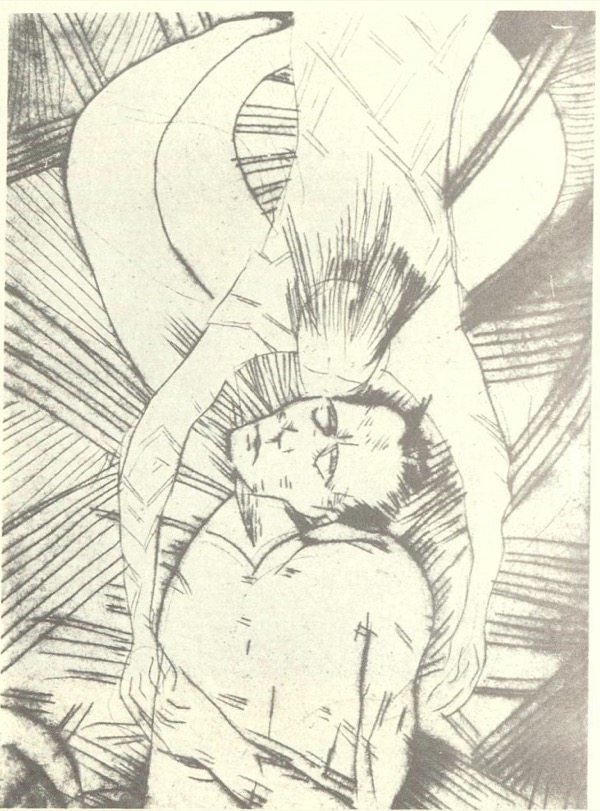
Karl Jakob Hirsch, illustration for Mahler’s ‘Ich bin der Welt abhanden gekommen’, 1915
Retreating from the outer to the inner world, “Ich bin der Welt abhanden gekommen” (I am lost to the world) conveys a symbolic death, through which the narrator is alienated from the external world, eventually attaining a blissful and isolated serenity.
I am lost to the world
With which I used to waste much time;
It has for so long known nothing of me,
It may well believe that I am dead.
Nor am I at all concerned
If it should think that I am dead.
Nor can I deny it,
For truly I am dead to the world.
I am dead to the world’s tumult
And rest in a quiet realm!
I live alone in my heaven,
In my love, in my song!
(English translation © Richard Stokes)
Apparently, Mahler so strongly identified with this poem that he proclaimed, “It is I myself.” In his musical setting, Mahler creates a dream world that frees him from the banal world of exclusion.
This world is not to be found in the afterlife, but rather in the inner world of human emotion. Chamber-like scoring that briefly spotlights virtuoso passages exposes a completely new level of contrapuntal clarity. A plaintive pentatonic melody in the English horn hauntingly emerges and elides with the entrance of the voice.
The melodic phrases are highly irregular, and dissonant harmonies are the result of winding instrumental passages. The vocal melody is constantly shadowed by related melodic ideas in the orchestra, and the text gradually reveals that inner peace can only be achieved through art.
Confessional Soundscapes
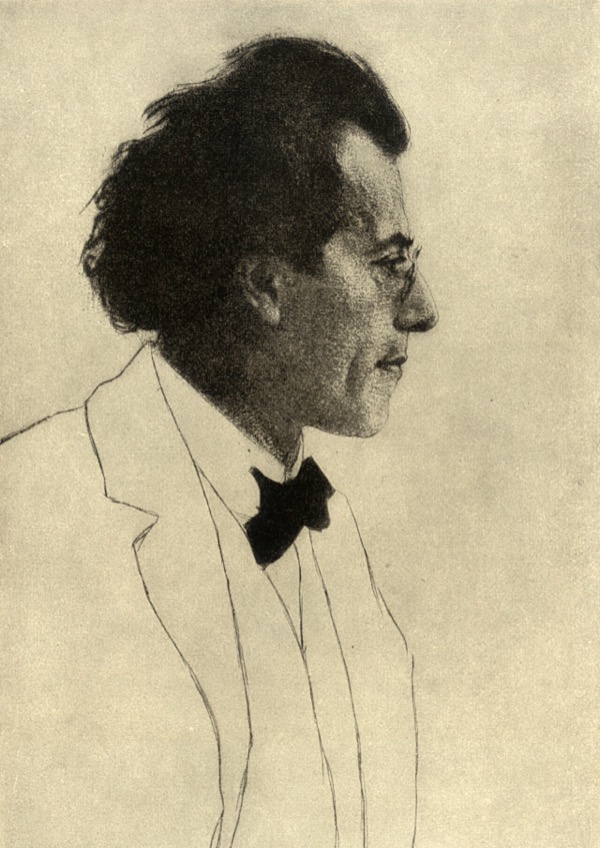
Gustav Mahler, by Emil Orlik, 1902
In 1901, and not connected to the tragic death of his daughter in 1907, Mahler completed three further Rückert settings. He added two more in 1904, and the cycle of five orchestral songs carried the ominous title Kindertotenlieder. Rückert himself had written 428 poems in an attempt to cope with the loss of two of his children to scarlet fever.
Mahler’s orchestral songs based on poetry by Friedrich Rückert became his most personal and intimate musical expressions. In his music, he immerses himself into a sound world of subtle shadings and nuance. Mahler does not provide an evolutionary drama or narrative flow, but he creates contrasting emotions of a confessional nature.
For more of the best in classical music, sign up for our E-Newsletter