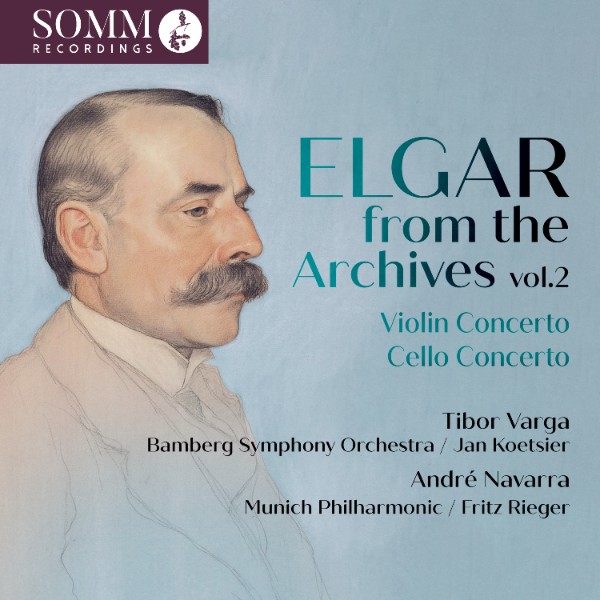
In a new SOMM Recordings release (SOMM Ariadne 5046), two century-old recordings of Edward Elgar have been brought out, providing listeners with an extremely valuable comparative listening session.
The Enigma Variations, recorded by the Royal Albert Hall Orchestra in 3 sessions in 1920 and 1921, and a 1924 session by the New Queen’s Hall Orchestra. The first was led by the composer and the second by Henry Wood.
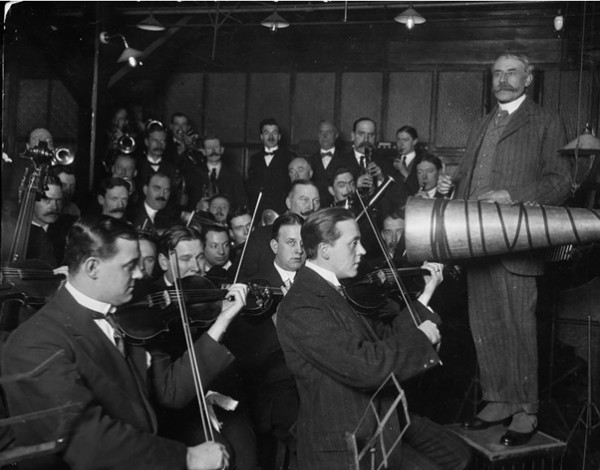
Elgar at the HMV Studios, London, 1914
As you can see in the picture above, this was the land before microphones. These acoustic recordings were made by gathering the sound in a relatively small studio into a horn, which is shown wrapped in tape to reduce vibration and make the sound less ‘tinny’. On the other side of the wall is a ‘diaphragm, which transmits the vibrations captured by the horn to a stylus positioned via a gimbal mechanism over the wax disc to be cut’. The wax master was then used to create the multiple commercial recordings.
In the recording session, the regular orchestra seating had to be compressed and rearranged, with the loudest instruments (brass and drums) being placed at the back of the room, as you can see in the picture.
Critical to the planning of a recording session was where the disc turns would occur. 10-inch 78 records (78 referring to their playback speed in revolutions per minute) could hold about 3 minutes of music, and 12-inch 78s could hold up to 5 minutes of music. In the Elgar recording, because of the disc turns, a substantial cut was made in the middle of ‘Nimrod’, whereas on the Wood recording, he was able to put Variation VIII (“W.N.”) and IX (“Nimrod”) on the same side. This permitted him to retain the held-over strings between the two movements, which are missing from Elgar’s earlier recording.
For the critical listener, what’s most beneficial about these two early recordings being presented together is that the improvement in recording technology is made audible. On the grand scheme of things, Elgar’s recording comes in at 26:35 while Wood’s is full two minutes shorter at 24:36. Some of this is achieved by faster tempos and, in one case, by ignoring a repeat (in Variation III. R.B.T).
The recording engineer for the new release, Lani Spahr, believes the two orchestras were the same size, but says the two conductors balanced the sound differently. Wood’s sound is more forward, reflecting the improvements in recording technology in just 4 years. Elgar noted the limitations in the recording sessions when he wrote to Troyte Griffith (the Troyte of Variation VII) to say that the drums were ‘not possible’. The percussion opening comes off better in Wood’s recording.
Two other works are included on this archival presentation: the Violin Sonata in E Minor, Op.82, and the String Quartet in E Minor, Op.83. Both had to be abridged to fit on the records, so for the violin sonata, movements I and II were shortened, and all the movements of the string quartet were abbreviated.
The violin soloist is Marjorie Hayward (1885–1953), playing with Australian pianist Una Mabel Bourne (1882–1974). Hayward was a brilliant virtuoso and was appointed professor of violin at the Royal Academy of Music in 1924. Bourne was an accompanist for Dame Nelli Melba when she was on tour and came to live in England before returning to Australia in 1930.
The string quartet was performed by the London String Quartet, which had been formed in London in 1908. To fit on 4 record sides, the String Quartet in E Minor, Op.83, was cut in all movements. Something to listen for is the playing technique: little vibrato in evidence, but they clearly have a thorough knowledge of the music so that the cuts aren’t invasive interruptions.
It may be difficult to listen to these recordings if you’re only used to the clarity of modern recording sound. These were recorded under the best conditions of the day, and by later in the 1920s, acoustic recording would be superseded by electrical recording with microphones. However, the wealth of contemporary information in these recordings about tempos, performance styles, recording styles, and performance norms makes them valuable resources for those interested in the history of recordings.
This recording joins the early 4-CD Somm recording Elgar Remastered (SOMMCD 261-4) issued in 2016, which was test pressings from Elgar’s private library with stereo reconstructions and previously unissued performances of the Cello Concerto and Symphony No.1. This recording of the Enigma Variations, violin sonata, and string quartet forms volume 1 of Elgar From the Archives, a series of remastered premiere recordings.
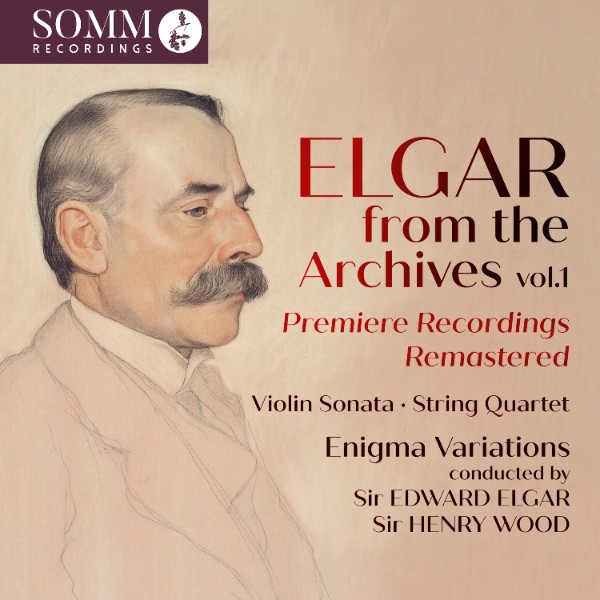 Elgar from the Archives, Vol. 1
Violin Sonata, String Quartet, and the Enigma Variations conducted by Sir Edward Elgar and Sir Henry Wood
Royal Albert Hall Orchestra, Sir Edward Elgar conductor; New Queen’s Hall Orchestra, Sir Henry Wood conductor; Marjorie Hayward, violin, with Una Bourne, piano; The London String Quartet (James Levey and Thomas Petre, violins; H. Waldo Warner, viola; C. Warwick-Evans cello)
SOMM Recordings Ariadne 5046
Official Website
For more of the best in classical music, sign up for our E-Newsletter