Where do we start with embarrassing gigs? There are so many of them. One of my stories is the following: the Minnesota Orchestra plays outdoor concerts for a couple of weeks around the Fourth of July Holiday. We were set up on the grass in a large park without any cover. The program began with Franz von Suppé’s Poet and Peasant Overture, which opens with an extended and lovely cello solo.
Franz von Suppé: Dichter und Bauer (Poet and Peasant): Overture (London Philharmonic Orchestra; Neville Marriner, cond.)
As I neared the final measures, suddenly SPLAT, a bird dropped a big one on me, landing squarely on the top of the cello. What a critic! He must’ve objected to the fingering of the last high D note.
Sometimes the mishaps are more subtle. I remember a concert of Mahler’s Symphony No. 8. The chorus in the finale sings with very soft string accompaniment. The massive group was so far away from us, in the rafters and balconies, that slowly their pitch sank. We strings adjusted, naturally, playing lower in pitch, but when the brass came in, they couldn’t! We tried to hide our grimaces as it sounded briefly like a cacophony. But we covered for them, and we hope the audience didn’t really notice it.
Mahler, Symphony No.8 (Finale) – Franz Welser Möst / Vienna Philharmonic
A cellist relates a similar quandary. “Around 1974-75, I played in the pit band for a performance of The Unsinkable Molly Brown in Hinsdale, Illinois, starring Ruta Lee (of Seven Brides for Seven Brothers fame). She couldn’t hit the high notes and asked that the orchestra play all of her songs down a half step. During the opening performance, the big stereotypical romantic cello solo arrived. I panicked and accidentally played it exactly as written—as I had practised! It brought the house down, but nonetheless, she glared at me sitting in the pit through the applause. I thought she was going to explode any second.”
David went on to say, “There were a lot of funny moments for the band in that show. I remember another unforgettable incident. There was a scene where Molly Brown takes command of a lifeboat on the Titanic. The stage crew cleverly set a rowboat on 4x4s on the stage and covered the stage with fog generated by a fog machine. It looked great in rehearsal! Showtime. We began playing the entr’acte. Fog started seeping from under the curtain into the orchestra pit. We couldn’t help giggling, especially when the fog covered our music stands. We had to stop playing. Then the curtain parted. There was nothing to hold back the 30-foot-high wave of dense fog that rolled out into the audience all the way up to the back of the balcony. Visibility zero. The staff had to open exit doors and set up fans so that we could finish the show. Everyone was laughing so hard that I didn’t see Ruta Lee’s reaction, but after the performance, after the curtain closed, we could hear Ms. Lee yelling at the stage crew for a good ten minutes.”
We cellists have many stories of playing outdoors for weddings in the cold, in the heat, in the wind. Once, a friend told me, the wind was blowing so hard that the little tent sheltering the musicians flew up into the sky and traveled far away like a kite. One of the players was a bagpiper. Let’s just say we now know the truth about what they wear underneath!
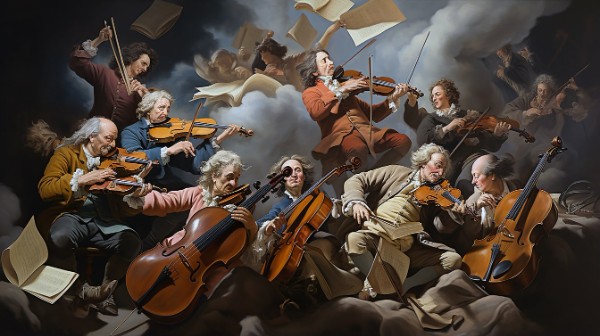
Pixnio illustration of string orchestra in heaven in fine art style
But here’s a location I’ve not heard of, and since it’s Olympic season, it’s quite fitting.
A colleague describes a wedding gig at an ice-skating rink. The audience sat in the bleachers, somewhat bundled up over their dressy outfits. The bride was lovely in her form-fitting stretchy white garment embellished with intricate designs in sequins, rhinestones, and mesh. The bride and groom skated out together to the middle of the rink (the father of the bride didn’t want to embarrass anyone with his minimal skating skills). A preacher was positioned on a podium waiting for the couple.
Metallica was blasting on loudspeakers until the quartet began to play. Of course, it was freezing. The ambient air was about 10 degrees (50 degrees Fahrenheit) and the ice a chilly minus 8°C (17° Fahrenheit.) The musicians donned coats and fingerless gloves. One of the pieces they played was the famous Skater’s Waltz from 1882 by Émile Waldteufel that scandalised Vienna. It was criticised on moral grounds due to the vulgar fast turning and close-hold stances of the waltzers.
Émile Waldteufel: Skaters’ Waltz (Philharmonic Symphony Chorus; Philharmonic Symphony Orchestra; Richard Hayman, cond.)
After the couple were pronounced man and wife, the bride did a little hop, and the groom lifted the bride, throwing her in the air with a triple twist lift and (narrowly) catching her. The girl mustn’t touch the guy on the way down, or they’ll be penalised, and I suppose not ‘forever holding their peace.’ Timing and momentum were perfect, and they skated off to the locker room.
Speaking of chilly settings, there’s the time musicians were engaged to play for a grocery store opening. A worker started to clear a space between shopping carts in the frozen food aisle. That was a cool gig!
Locales can be the bane of our existence. A colleague was to play in a wedding quartet situated in the minstrel’s gallery (or balcony) of a church, positioned high above the floor. They shouldn’t obstruct the wedding party. So, the musicians climbed a ladder to get up there. Don’t ask me how you do that with a cello.
Chariots Of Fire – Main Theme (Vangelis) Wedding String Quartet
To allow the guests and wedding party to enter freely right before the ceremony, the staff took the ladder away (it was, after all, a bit unsightly). After the ceremony, while the quartet played a string version of the Hornpipe from Handel’s Water Music for the recessional, everyone rushed to the reception for champagne and cake. You guessed it: The quartet was forgotten, stranded up in the galley without a ladder. Somehow, I assure you, they got down at some point.
George Frideric Handel: Water Music: Suite No. 1 in F Major, HWV 348 – IX. Hornpipe (Prague Chamber Soloists, Ensemble; Andrew Mogrelia, cond.)
My friend Kirsten Whitson has played for unique and even weird gigs. She mentioned the time she played solo cello for a fish boil. Developed from Scandinavian traditions, it’s a Wisconsin-based culinary, social, and theatrical event famous in Door County. It features fresh Lake Michigan whitefish, potatoes, and onions cooked in a large cauldron over an open wood fire. But the show is a “boil over” spectacle. Watch out! When the fish is finished, the cook throws kerosene onto the wood fire, causing a dramatic flare-up that forces the pot to boil over to remove the oils from the fish.
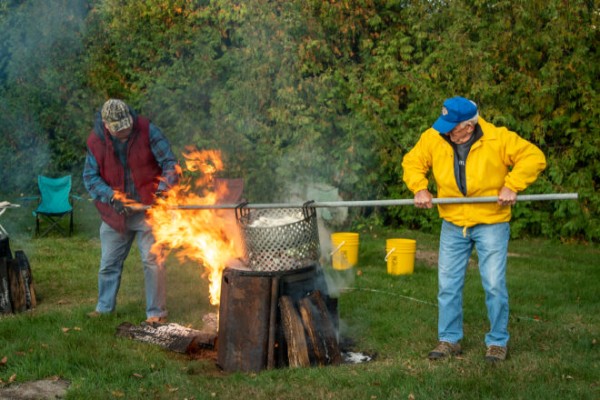
Lion’s Club fish boil
The presenters asked her to play something suitably hot. She chose one of my favourites, the last movement of Zoltán Kodály‘s Sonata for Solo Cello Op. 8 (my esteemed mentor János Starker is playing). Kirsten knew to position herself away from and downwind.
Zoltán Kodály: Sonata for Solo Cello, Op. 8 – III. Allegro molto vivace (János Starker, cello)
Her most singular gig, in my opinion, would have to be the time she played string quartets for a nudist colony. She was only eighteen, so they allowed her to be clothed, but you know, the presenters said, she could’ve hidden behind the cello!
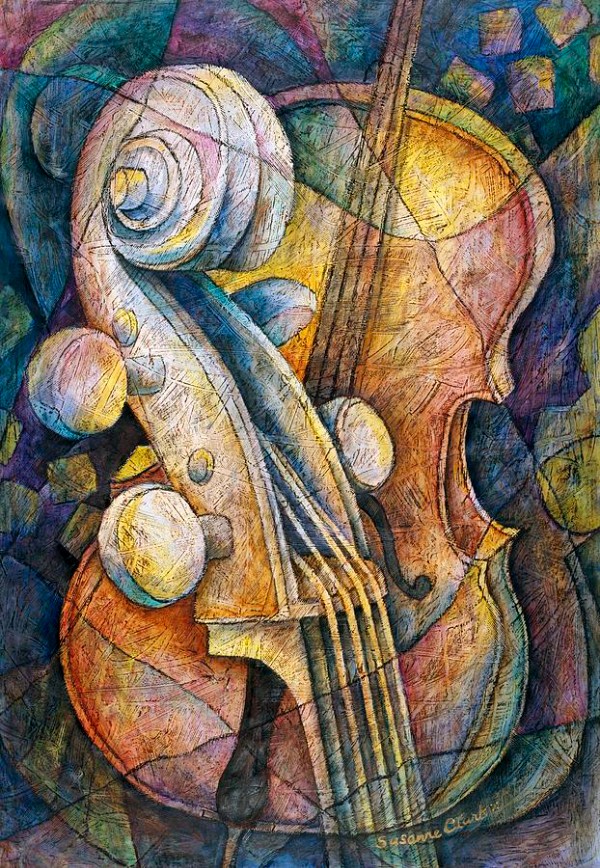
Jazzy cello by Susanne Clark
That was just a smattering of embarrassing gigs. But don’t get us wrong—we often will dance with joy that we have audiences who love music and especially the cello.
For more of the best in classical music, sign up for our E-Newsletter
Joachim Stutschewsky: Hassidic Suite – IV. Dance (Aron Zelkowicz, cello; Luz Manriquez, piano)