Think you know classical music history? Think again.
From the fact that many listeners in the history of classical music never heard a full orchestra, to the rediscovery of Vivaldi’s Four Seasons after nearly two centuries of obscurity, to the fact that the first film composer was born in 1835, the history of classical music is full of surprises.
Many of the traditions we take for granted today – like silent concert halls, orchestras that perform year-round, and soloists playing from memory – are actually relatively modern inventions.
Here are ten surprising classical music facts that will change how you listen.
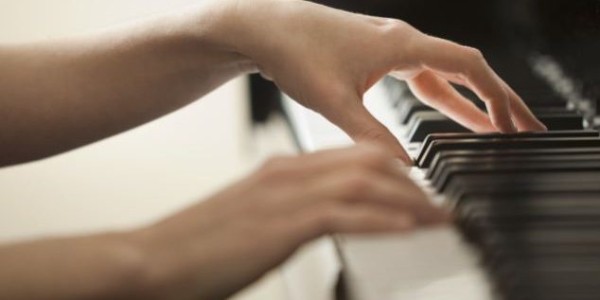
1. During the nineteenth century, most music lovers only heard major orchestral works in piano transcriptions.
© chopinacademy.com
During the nineteenth century, live orchestral concerts were relatively rare, especially outside major cities.
Without recordings, the primary way people became familiar with large-scale works like symphonies and operas was by playing or listening to piano arrangements at home.
Publishers issued many four-hand piano transcriptions of symphonies, allowing amateurs to experience big orchestral works on a piano…or, if they were lucky, two pianos.
Liszt’s transcription of the first movement of Beethoven’s Symphony No. 5
Franz Liszt famously transcribed all nine of Beethoven’s symphonies for solo piano, epitomising this practice.
These kinds of arrangements were phenomenally popular, and essentially became the nineteenth-century equivalent of owning a recording.
Yet nowadays, we very rarely – if ever! – hear piano transcriptions of orchestral music, creating a notable mismatch between the experience of Romantic Era listeners and modern-day listeners.
2. Hector Berlioz wrote his Symphonie Fantastique, a work renowned for its skilful orchestration, less than a decade after hearing an orchestra for the first time.
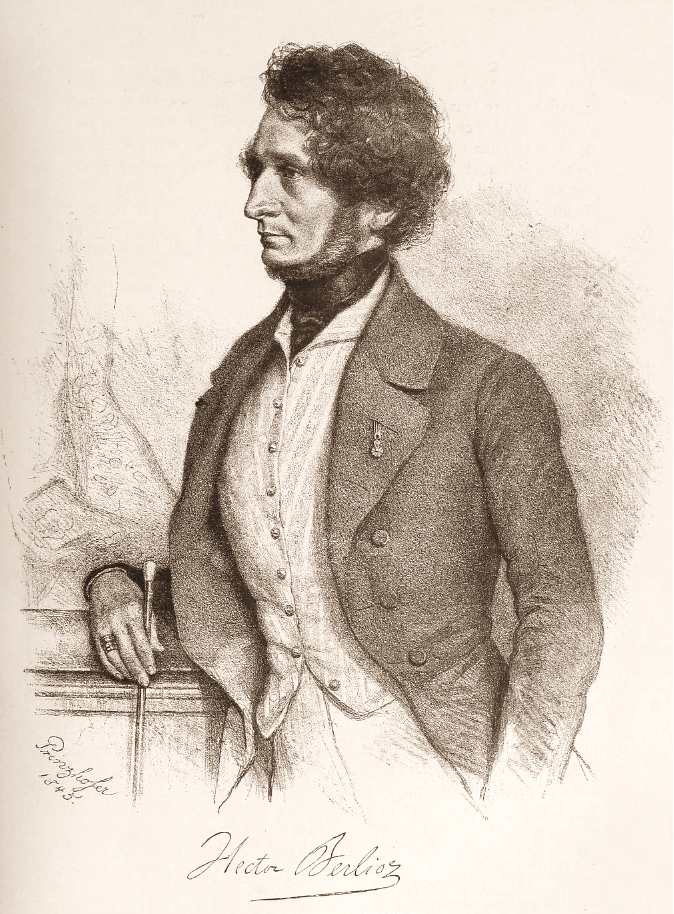
August Prinzhofer: Hector Berlioz, 1845
Hector Berlioz (1803–1869) grew up in rural France with limited exposure to large ensembles.
He began attending operas and concerts only after moving to Paris to study medicine in 1821.
He heard Beethoven’s Third and Fifth symphonies played by an orchestra in 1828.
Berlioz’s Symphonie Fantastique
Just two years later, in 1830, he composed his groundbreaking Symphonie Fantastique. Even today, it’s widely cited as an example of masterly orchestration. It had been just nine years since he’d heard an orchestra for the first time.
Fourteen years after that, in 1844, he wrote his Treatise on Instrumentation.
3. Vivaldi’s works weren’t rediscovered for around two hundred years after their composition.
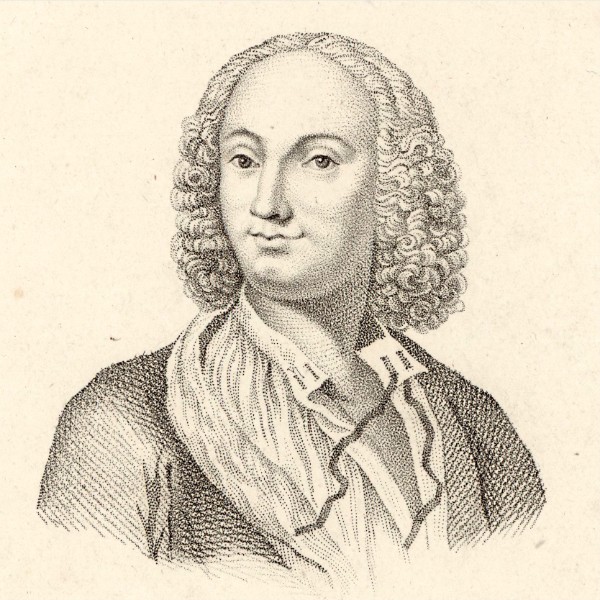
Antonio Vivaldi
Antonio Vivaldi was a celebrated composer in the Baroque era (early 1700s), but after his death in 1741, his music fell into neglect.
During the Classical and Romantic eras, many of Vivaldi’s compositions were forgotten and scattered in archives.
Even his now-famous Four Seasons concertos were rarely played; they were essentially unknown in their original form through the 1800s.
Vivaldi’s Four Seasons
In 1926, crates of Vivaldi’s manuscripts were unexpectedly discovered in Turin, Italy, having been lost for nearly two centuries.
In 1935, violinist Olga Rudge began cataloguing the collection. Other musicologists followed suit.
The Four Seasons only received its premiere in Carnegie Hall on New Year’s Eve, 1947.
They have since become one of the most popular pieces of classical music ever written – if not the most.
The extraordinary Vivaldi revival also suggests the tantalising prospect that a hundred years from now, a composer we don’t know at all will be topping the charts.
4. Beethoven’s fifth and sixth symphonies were premiered at the same concert.
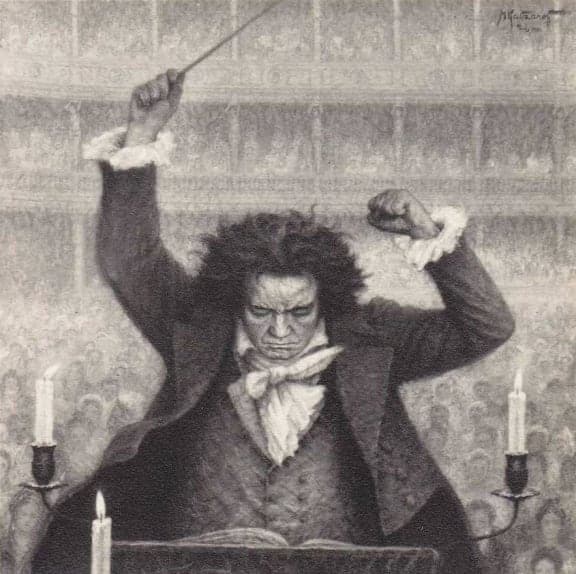
Beethoven conducting
Beethoven’s fifth and sixth symphonies were performed at the same monumental concert.
This concert took place in Vienna on 22 December 1808 at the Theater an der Wien, and it lasted four hours.
Beethoven, who was serving as composer, conductor, and piano soloist, presented the monster program of all-new works.
Beethoven’s Symphony No. 6
In addition to the fifth and sixth symphonies, the performance included the premiere of his fourth piano concerto, parts of the Mass in C, a concert aria, and the Choral Fantasy.
Conditions were far from ideal. The venue was unheated in the dead of winter; the orchestra was under-rehearsed; and the concert was so long that the audience would have been exhausted by the time most of these works finally started.
Yet it’s still remembered as the single most important concert in classical music history.
5. In 2026, we are as far apart from Stravinsky’s Rite of Spring as Stravinsky was from Beethoven’s first set of string quartets (113 years). Yet the Rite is often considered “modern.”
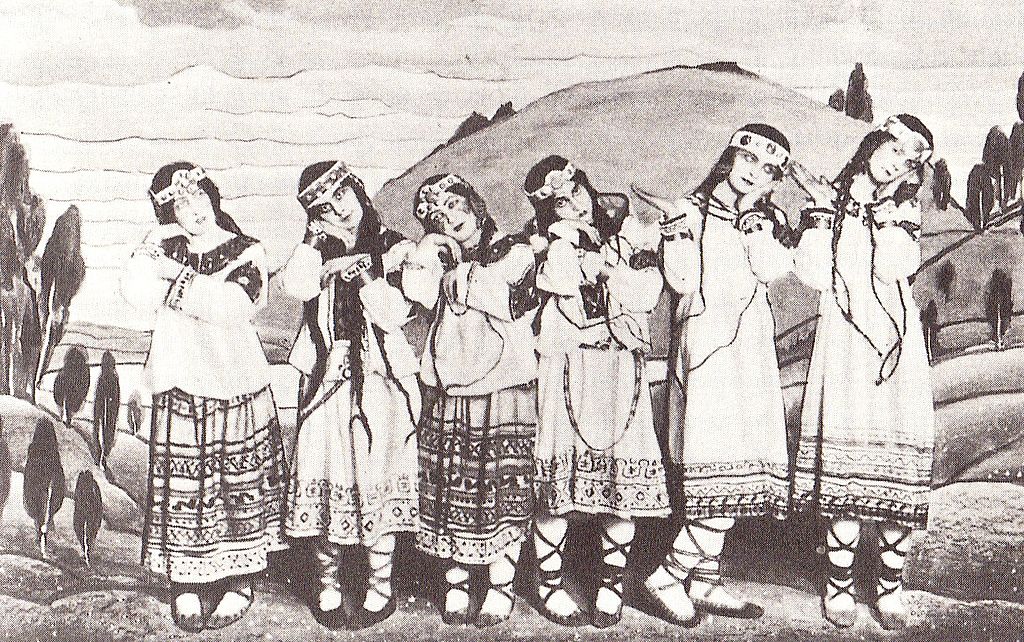
Dancers from The Rite of Spring, 1913
Igor Stravinsky’s The Rite of Spring premiered in 1913. As of 2026, that historic performance occurred 113 years ago.
Igor Stravinsky: Le sacre du printemps (The Rite of Spring) (1913 version) (London Symphony Orchestra; Robert Craft, cond.)
Now rewind 112 years from 1913, which brings us to 1801. That was the year Beethoven published his Op. 18, his first set of six string quartets.
Ludwig van Beethoven: String Quartet No. 1 in F Major, Op. 18, No. 1 (Delian::Quartet, Ensemble)
Many classical music listeners regard Stravinsky’s Rite of Spring as a modernist work, maybe even avant-garde.
However, Stravinsky and his contemporaries were not thinking of Beethoven’s first string quartets as avant-garde.
The question has to be asked: what might that timeline say about Stravinsky and his contemporaries…and what might it say about us?
6. During their lifetimes, by some measures, Joseph Haydn’s composer brother Michael was more famous than he was.
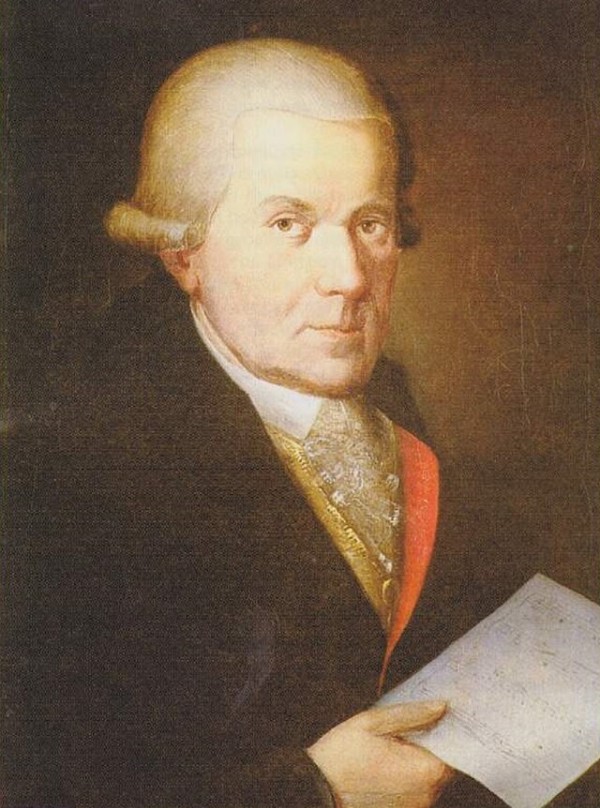
Michael Haydn
Joseph Haydn (1732–1809) is now far more famous, but his younger brother Johann Michael Haydn (1737–1806) was also a respected and admired composer during their lifetimes.
In the eighteenth century, Michael Haydn held important posts, such as court composer in Salzburg (where the Salzburg-born Wolfgang Mozart performed his works in the orchestra alongside his father, and was inspired by him).
Michael Haydn’s Requiem in C-minor
Early in their careers, Michael’s reputation in German-speaking regions rivaled or even surpassed Joseph’s…especially since Joseph spent decades sequestered in the Hungarian countryside working for the rural Esterházy court, while Michael was working in a city and had easier access to publishers and a circle of colleagues who could propagate his work.
Late in his career, Joseph did become internationally famous, especially after a couple of lucrative trips to London. But his brother was also famous, too.
Read more about Michael Haydn and the brothers’ relationship.
7. Full-time professional orchestras as we know them didn’t exist until the twentieth century.
The modern notion of a full-time, year-round, salaried orchestra, with musicians making a living solely from playing in the orchestra, and the orchestra treated as a kind of public institution, is a relatively recent development.
In the 1700s and 1800s, orchestras were often ad hoc or part-time.
Court orchestras served at the pleasure of the aristocracy; opera house orchestras only played during opera seasons; and “philharmonic” societies usually gave a limited number of concerts per year.
Many performers, even the most talented, earned their income through multiple roles – teaching, church music, freelance gigs – rather than a single orchestra job.
By the late 1800s, a few cities had established professional ensembles, but even these often operated seasonally.
For example, the Vienna Philharmonic and the New York Philharmonic (both founded in 1842) initially gave only a handful of concerts each year.
It wasn’t until the early twentieth century that orchestras became stable, salaried organisations with regular seasons.
8. Camille Saint-Saëns – born in 1835 – was the first composer to write a film soundtrack.

Camille Saint-Saëns
In 1908, at the age of 73, Saint-Saëns wrote the music for a short silent film titled L’assassinat du duc de Guise (The Assassination of the Duke of Guise).
This was groundbreaking: it was the first time that a world-famous composer had provided a custom-written original score for a film.
Saint-Saëns’s L’assassinat du Duc de Guise
Prior to this, films typically used compiled music or improvisations played by theatre musicians.
There were a few earlier attempts at film music by lesser-known composers, but Saint-Saëns was the first prominent composer to embrace the art of the film soundtrack.
9. For generations, performers didn’t memorise things; in fact, it could be considered snobby to do so.
The expectation that soloists should perform from memory is a relatively recent invention.
In the eighteenth and early nineteenth centuries, it was common – indeed standard – for even virtuosos to play from sheet music.
Performing without the score was unusual and even sometimes frowned upon. Many felt that playing by memory could be showy or disrespectful, and might suggest to the audience that the soloist was trying to pass the work off as their own!
Chopin even once scolded a student for playing from memory.
Franz Liszt and Clara Schumann, potentially the two greatest pianists of the nineteenth century, kicked off the trend of playing from memory during the 1830s.
10. Applause behaviour used to be very different, and the “no clapping between movements” rule was only instituted in the twentieth century.
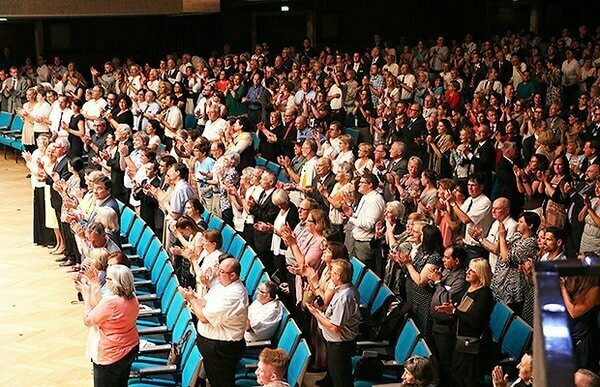
During the 1700s and the 1800s, audiences behaved in ways that would shock today’s concertgoers: they often applauded after (and even during!) movements that they particularly enjoyed, and it was normal to clap between movements of a symphony or concerto.
In fact, in Mozart’s and Beethoven’s era, if a movement was received positively, the listeners might erupt in applause and demand an encore of that section then and there.
By the early 1900s, concert etiquette manuals and conductors started requesting that applause be held until the end, so as not to disrupt the work’s continuity.
This norm solidified during the twentieth century, especially in performances of Austro-German repertoire where cohesive structures were valued.
As a result, many modern audiences are trained to suppress reactions until a piece concludes. It’s not actually a historically correct way to listen to huge parts of the classical music repertoire.
Conclusion
These ten surprising facts reveal just how much classical music history has evolved, not only when it comes to what composers wrote and soloists performed, but also in how audiences listened.
From Liszt’s dazzling piano transcriptions to Berlioz’s obsessive listening to orchestras to Saint-Saëns’s pioneering film score, every generation experienced classical music in a new way…and sometimes it’s good to look back and take stock of all that’s changed.
Which of these classical music facts surprised you the most?
For more of the best in classical music, sign up for our E-Newsletter