
Johannes Brahms had famously difficult romantic relationships with women. He had a penchant for idealising women, as well as sabotaging his romantic relationships with them once he got close to proposing.
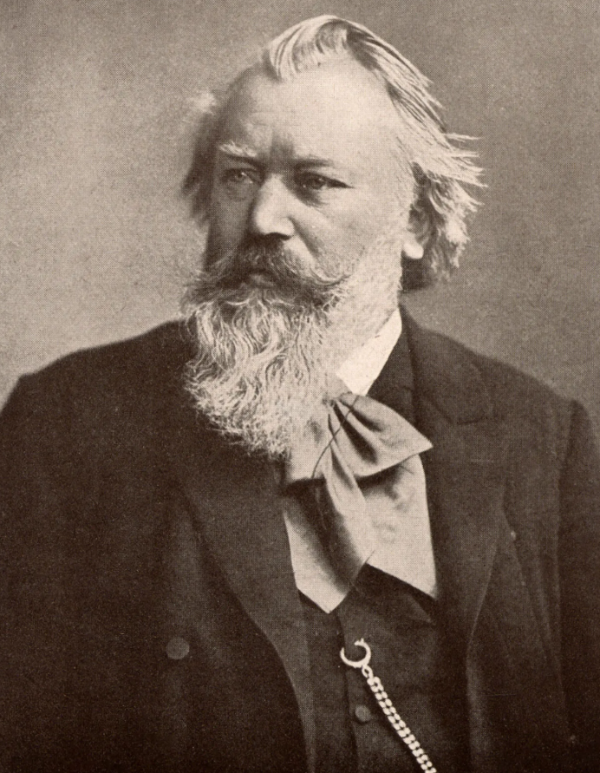
Johannes Brahms
In the first part of this article, we met four women who stole Johannes Brahms’s heart.
- Clara Schumann, the married (and then widowed) virtuoso pianist whom he met at the age of twenty, who was his first love, as well as long-term mentor and inspiration;
- Agathe von Siebold, a soprano whom he actually proposed to, then broke up with;
- Bertha Porubsky, a woman he adored but who married someone else, whom he wrote his famous Lullaby for after she became a mother; and
- Ottilie Hauer, a singer he was going to propose to…but then found out another man had beaten him to the punch just a few hours earlier.
Today we’re looking at four more loves of Johannes Brahms’s life…and why his relationships with all of them were ultimately doomed.
Julie Schumann (1845–1872)
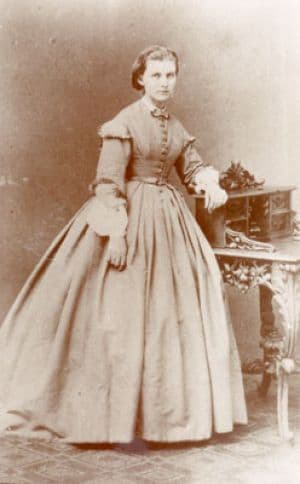
Julie Schumann at 20 years old
In 1861, Clara Schumann was scheduled to play several concerts in Johannes’s hometown of Hamburg. Johannes invited her to come and stay for a while with her beautiful 16-year-old daughter Julie.
Brahms was twelve years older than Julie (coincidentally, the same gap that separated him and Clara).
As she became a young woman, Brahms became increasingly fascinated by Julie. He went to visit the Schumanns in 1866 at their summer home in Baden-Baden. Julie’s sister Eugenie noted, “I often saw his eyes shining when he looked at her.”
However, the connection was doomed. In the words of biographer Jan Swafford:
Julie was beautiful, lively, intelligent, ethereal, magical. Men are apt to fall in love with women like her. But Brahms’s passion was hopeless. Given that he was a kind of surrogate father to Clara’s children, his feelings verged on incestuous. His long relationship with Clara made the idea of marrying her daughter nearly unthinkable, an affair more so. Beyond that, this was the daughter of Robert Schumann, his mentor, almost his second father, and Clara had always been to him some inextricable tangle of mother and forbidden lover. Too much was mixed up in Brahms’s feelings beyond attraction and admiration.
She was also being courted by an Italian nobleman, Count Vittorio Radicati de Marmorito…and her health was poor. Her mother worried that she wouldn’t be able to withstand the physical demands of pregnancy and motherhood.
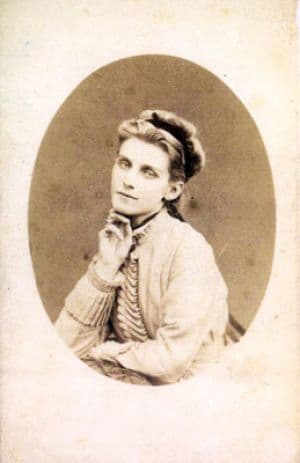
Julie Schumann, 1868
When Clara shared the news of Julie’s engagement with Brahms on 11 May 1869, he was so shocked that he ran out of the house.
A puzzled Clara wrote in her journal:
Johannes is quite altered; he seldom comes to the house and speaks only in monosyllables when he does come. And he treats even Julie the same way, though he always used to be so specially nice to her. Did he really love her? But he has never thought of marrying, and Julie has never had any inclination towards him.
It was a moment of obliviousness on Clara’s part. He had, in fact, really loved Julie.
To process his feelings, Brahms composed his tragic Alto Rhapsody.
Brahms’s Alto Rhapsody, Op. 53
He wrote to his publisher, “Here I’ve written a bridal song for the Schumann countess – but I wrote it with anger, with wrath! What else do you expect?”
He also referred to it ironically as his own bridal song.
The couple married in September 1869. Brahms served as a witness, although his name appears in church records as “Schrams”, which has led some historians to wonder if he mumbled it.
In the end, her mother’s fears proved to be well-founded: Julie died three years later of tuberculosis while pregnant with her third child.
Hermine Spies (1857–1893)
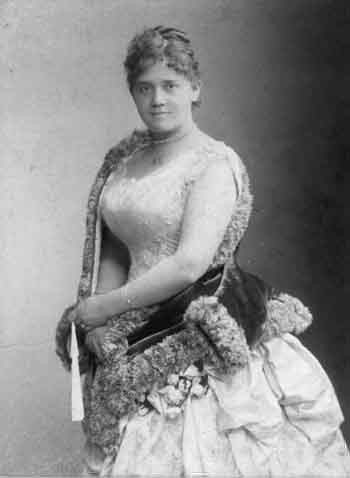
Hermine Spies
In January 1883, Brahms performed his second piano concerto in Krefeld, Germany. An informal Brahms fan club had sprung up and entertained him upon his arrival.
One of the other pieces on the program was his Gesang der Parzen (Song of the Fates), a piece for mixed choir and orchestra, written the year before. One of the soloists was a 25-year-old contralto named Hermine Spies.
Brahms’ Gesang der Parzen, Op. 89
She sang more of his music at an after-party at which Brahms was present, and he immediately became smitten. She became a musical inspiration, proven by the flurry of nicknames he gave her: songstress, Rhine-maiden, Herma, Herminche, Hermione-Without-the-O.
That summer, he went to Wiesbaden, where Spies was also living. It was the summer he wrote his poignant, autumnal, yet boldly heroic third symphony, which ends with a gentle whisper.
Brahms’s Third Symphony, Op. 90
In December 1884, Brahms appeared in Oldenburg, Germany, at a performance of his works, including the Third Symphony and songs sung by Spies. Spies was delighted at being in his company, writing to a friend:
What I value most particularly is to have now enjoyed Brahms as a man. How charming he was with us when we were making and guessing riddles. What delightful hours we spent!… Of course, now I only play Brahms the livelong day.
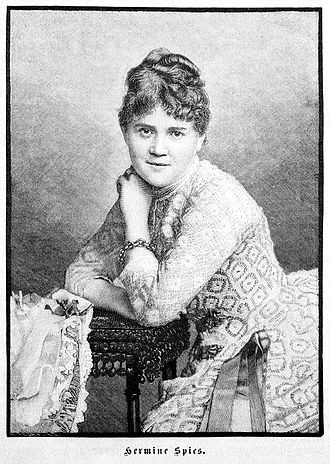
Hermine Spies
In 1886, he arranged Spies’ debut in Vienna. A friend reported:
The composer and the singer sat together like a happy couple… Hermine Spies did not pretend for a moment that she did not adore her neighbour at the table, and he also showed, in a way not to be denied, his great interest in her.
Ultimately, however, it seems that Brahms did not extend a proposal of marriage to Hermine.
A mutual friend, Elisabeth von Herzogenberg, suggested to Brahms in a letter that Spies wasn’t taking her singing as seriously as she should, and that she was “terribly spoilt.”
Brahms also mentioned in a letter a dream he’d had in which Hermine hadn’t sung rhythms correctly…a hint, perhaps, that he agreed with Herzogenberg’s critique.
Brahms biographer Jan Swafford attributes their drifting apart to the fact that Spies never fully blossomed as a performer.
Hermine Spies married a lawyer in 1892 and died during a 1893 pregnancy. She was 36 years old.
Elisabeth von Herzogenberg (1847–1892)
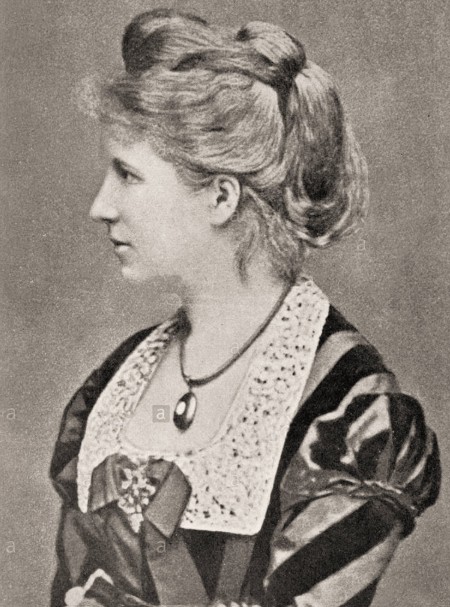
Elisabeth von Herzogenberg
Elisabeth von Stockhausen was a gifted musical child from a musical family (although her father wasn’t a professional musician, he had studied piano with Chopin).
When she was in her late teens, she began taking piano lessons from Brahms. He found her incredibly talented and incredibly beautiful. The 30-year-old Brahms, unnerved by his attraction, recommended that she study with another colleague instead.
A few years later, in 1868, Elisabeth married composer Heinrich von Herzogenberg. In 1872, the couple moved to Leipzig, where they became a part of the extended musical and social circle of both Clara Schumann and Johannes Brahms.
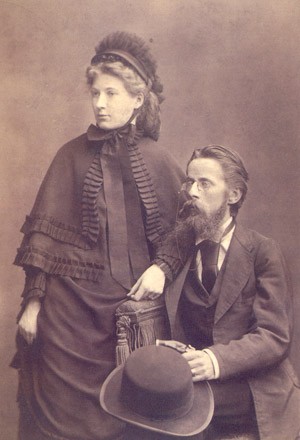
Elisabeth von Herzogenberg and her husband
The Herzogenbergs couldn’t have children, which distressed them both deeply. So instead of parenting, they channeled their nurturing energies into their joint musical friendships. Brahms was one of the beneficiaries.
During the 1870s and 1880s, sometimes the couple would invite Brahms over and have him play at the piano while Elisabeth cooked a meal for him. She’d intermittently appear at the door and mock-scold him, “Begin that movement again! That much you owe me.”
Since she was safely married and was therefore off-limits to him physically, Brahms felt safe becoming emotionally and creatively intimate with her. Eventually, he grew to trust Elisabeth’s opinions about his new works as much as Clara Schumann’s.
Brahms’s relationship with the Herzogenbergs allowed him to experience elements of a home life his artistic bachelor lifestyle didn’t allow, and he was always grateful. He was devastated when Elisabeth died young of heart disease in early 1892.
Alice Barbi (1858–1948)
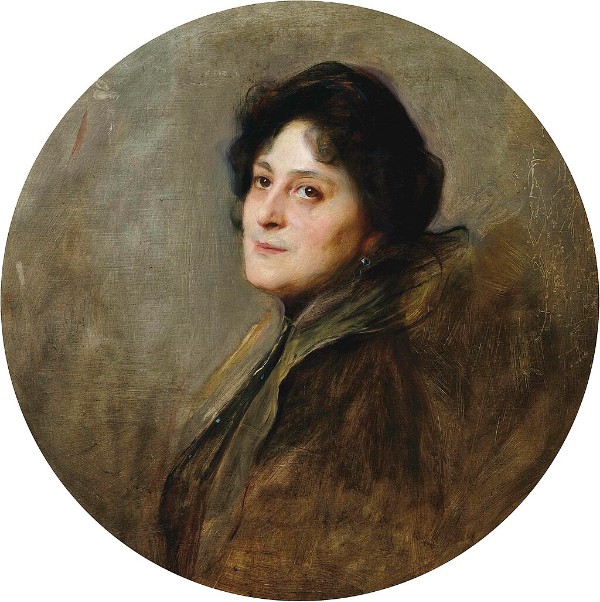
Alice Barbi
Alice Barbi was born in Italy in 1858, the year Brahms turned 25. She began her studies as a violinist but eventually transitioned to being a singer.
They became acquainted in Vienna in 1889, but it wasn’t until 1892 that Brahms actually heard her sing his music for the first time. The experience proved to be a revelation.
“Today I’ve heard my songs for the first time!” he said. (High praise from someone who had been romantically interested in so many singers over the years!) “If I were still young, I would now write love songs.”
The two began appearing publicly, seeming to flirt. One friend, critic Max Graf, wrote, “It was not difficult to see that Brahms was not merely being a polite host to Barbi; he was captivated by her.”
Apparently, Brahms told his friend Ignaz Brüll that he had thought about marrying Barbi, but the age difference and her desire for children proved to be the death knell for any potential romantic relationship.
Barbi married a Baltic-German nobleman in January of 1894. The month before, she and Brahms performed some of his songs in a farewell recital (she decided to retire from the stage after her marriage).
They performed four together, including “Der Tod, das ist die Kühle Nacht” (“Death is the Cold Night”) from his op. 96.
Alice Barbi is sometimes referred to as Brahms’s final love. If they had ever gotten married, the marriage would have been very short. Brahms died of cancer in 1897. Barbi, however, lived until 1948.
Brahms’s “Der Tod, das ist die Kühle Nacht” from 4 Lieder, Op. 96
Conclusion
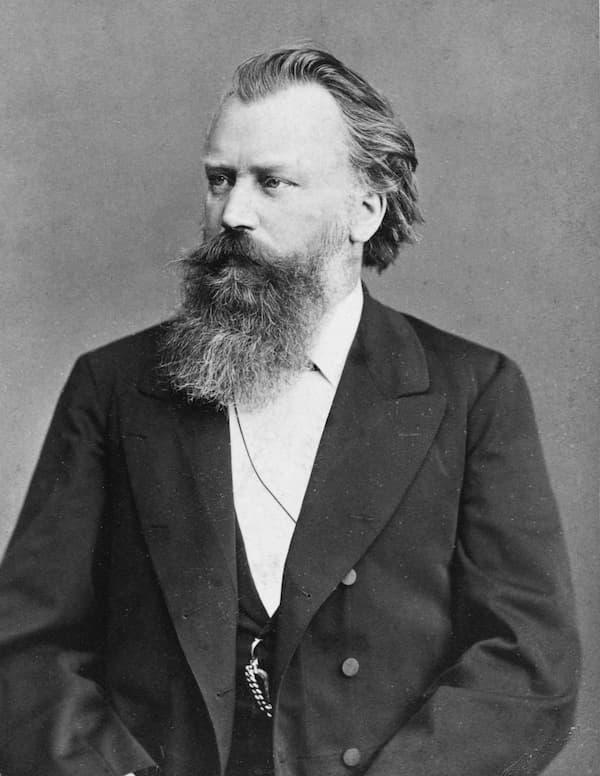
Johannes Brahms, c. 1885
In the end, most historians would agree that Johannes Brahms’s first love, Clara Schumann, was likely the great love of his life.
They shared an intense, creative, and emotional intimacy for nearly half a century, and he was never able to recreate that with any other woman.
Even though much of their relationship was conducted via letter, that doesn’t mean it was less impactful.
In fact, it may have been even more meaningful because the physical distance gave them both space to meditate on the music they were sharing with one another and allowed them each to have unique and independent musical experiences that they could then, in turn, share with one another.
Biographer Jan Swafford wrote of their final visit in 1895:
…Eugenie [Clara’s daughter] heard the sound of the piano from the music room. It was Bach, followed by two pieces from Brahms’s Opus 118, music he had written to sustain Clara, and which she loved. When the music stopped, Eugenie went into the room and found her mother at her writing table, her cheeks flushed and eyes shining, and Brahms sitting opposite her with tears in his eyes. Gently, he said to Eugenie, “Your mother has been playing most beautifully for me.”
After a moment, he asked Eugenie to get a particular volume of Beethoven’s Sonatas from the shelf. In it, he pointed out a place where Clara had long ago corrected a mistake that had appeared in every edition. “No other musician has an ear like that,” he said.
Brahms was devastated by Clara’s death in 1896. He died less than a year later.
For more of the best in classical music, sign up for our E-Newsletter





Your article is both tasteful and illuminating. People find it easy to put Brahms on the ubiquitous pedestal; you do an admiral job of humanizing an intensely complex and conflicted man.
Such passions and mood swings are so prevalent in Brahms’ music; thank you for illustrating, by including photographs and musical examples, the origins of his inspiration.