French composer Georges Bizet (1838–1875) started the trend among French composers for ‘childhood-related works’ with Jeux d’enfants (Children’s Games), his 1871 suite for two pianos – four hands.
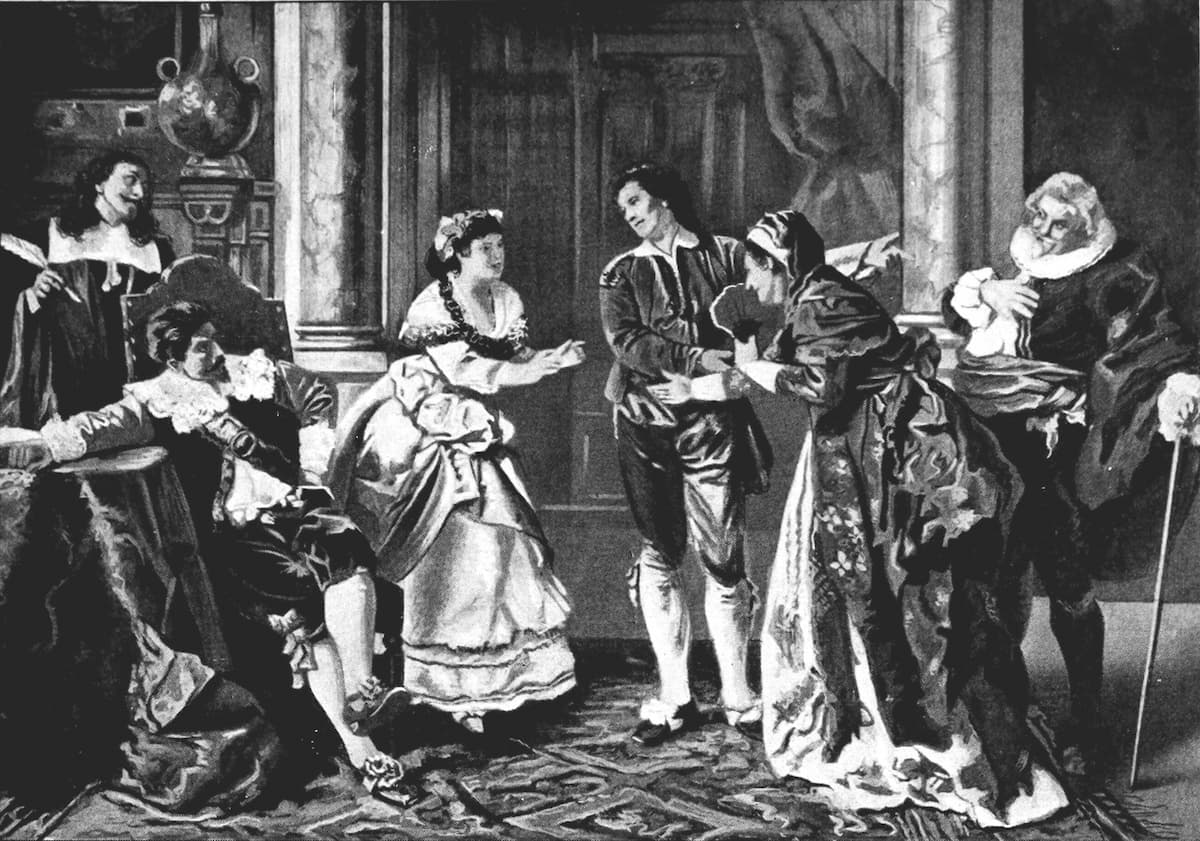
The final 12 pieces encompass all kinds of children’s games, some for a single child (the swing, the top, the doll) and others for more than one child playing (battledore and shuttlecock, Blind man’s buff, leap-frog), ending with two based on observations of grownups: Little husband, little wife and The ball.
He opens with that most wonderful version of flying that a child can have: The Swing. The low notes of the piano are the pushing energy, and the high notes are the flight. A middle-voice melody captures the child’s thoughts.
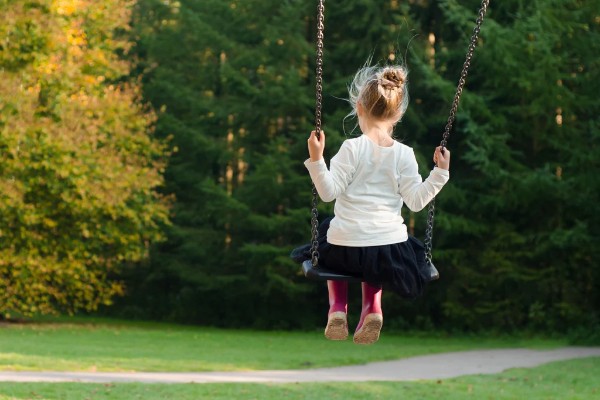
The Swing
Georges Bizet: Jeux d’enfants – No. 1. L’escarpolette (Beatriz Klien, piano; Walter Klien, piano)
The Spinning Top sets off with a wobble and a wiggle, and moves all over the floor before spinning to a stop. And then off it goes again, menacing the chair legs before falling over.
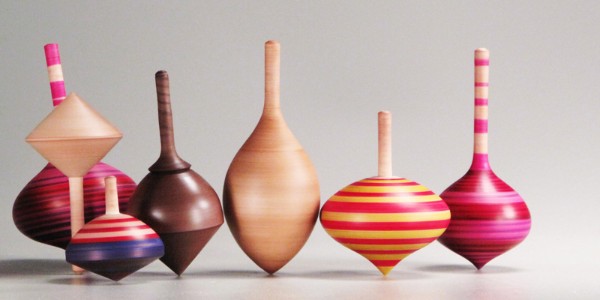
David Earle: Spinning tops (photo by Davidturnswood)
Georges Bizet: Jeux d’enfants – No. 2. La toupie (Beatriz Klien, piano; Walter Klien, piano)
In the lovely little lullaby, we have The doll. It’s carefully laid to sleep for its nap, just like its owner, who tells it a quiet story of love and regard before everyone falls asleep.
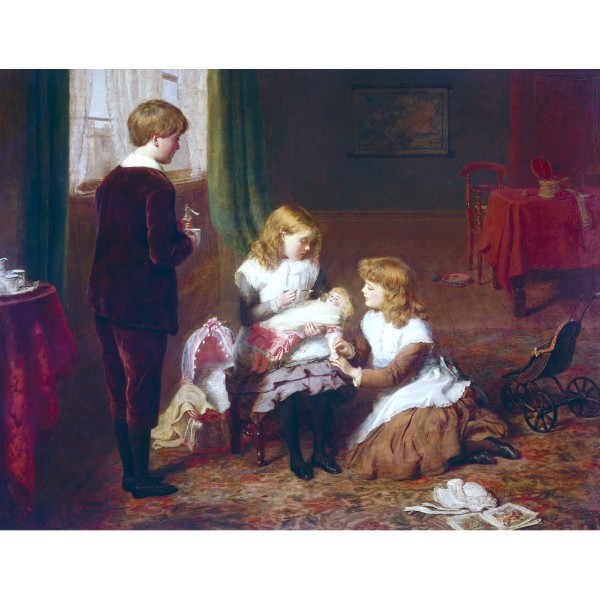
William Powell Frith: The Sick Doll
Georges Bizet: Jeux d’enfants – No. 3. La poupée (Beatriz Klien, piano; Walter Klien, piano)
Off go The Wooden Horses, galloping around the nursery before they’re sent outside to gallop around the yard. It’s clear that there are multiple horses in this race!
Georges Bizet: Jeux d’enfants – No. 4. Les chevaux de bois (Beatriz Klien, piano; Walter Klien, piano)
Battledore and Shuttlecock was a game that pre-dates our modern badminton. The small racquets (battledores) are used to hit the shuttlecock, made of cork and feathers. The music captures the relatively slow rise and fall of the shuttlecock, with increasing tension as the round comes to an end.
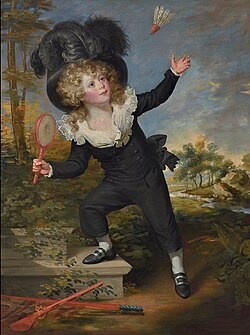
William Beechey: Kenneth Dixon playing with a shuttlecock, c. 1790 (Copenhagen: State Art Museum)
Georges Bizet: Jeux d’enfants – No. 5. Le volant (Beatriz Klien, piano; Walter Klien, piano)
Taking a march from his opera Ivan IV, Bizet converted it into a piece for children, full of their imagined pomp as they imitate the soldiers they see on the street.
Georges Bizet: Jeux d’enfants – No. 6. Trompette et tambour (Beatriz Klien, piano; Walter Klien, piano)
Pipes in hand, the children blow soap bubbles that fly and fall, stick together, and then POP!
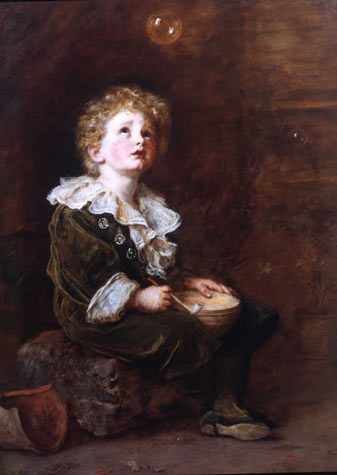
John Everett Millais: Bubbles, 1886 (Lady Lever Art Gallery)
Georges Bizet: Jeux d’enfants – No. 7. Les bulles de savon (Beatriz Klien, piano; Walter Klien, piano)
Requiring 5 players, Les quatre coins or Puss in the corner. The ‘puss’ in the centre tries to capture a corner from one of the other players as they try to change corners.
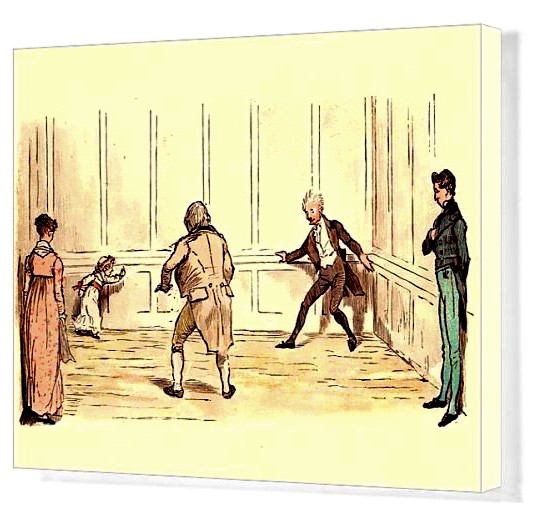
Randolph Caldecott: Puss in the Corner, 1885 (from Curmudgeons Christmas)
Georges Bizet: Jeux d’enfants – No. 8. Les quatre coins (Beatriz Klien, piano; Walter Klien, piano)
A similar seeking game, Colin-maillard (or Blind Man’s Buff) has the centre person blindfolded. All the other players run around the ‘blind man’ as he attempts to touch them and make them take his or her place. The game has been played in all time periods, from Ancient Greece to the court of Henry VIII to the Victorian era. A buff is a small push.
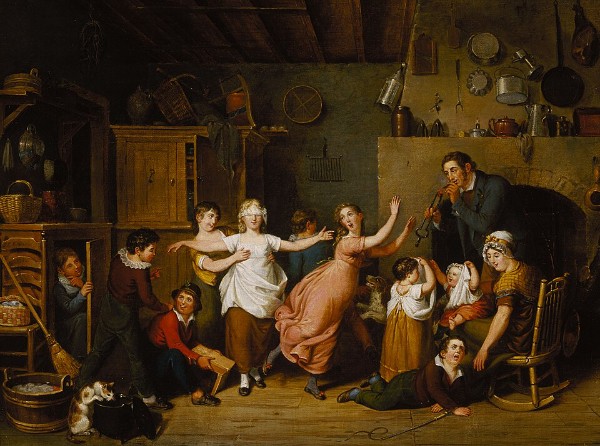
John Lewis Krimmel: Blind Man’s Buff, 1814 (Chicago: Terra Foundation for American Art)
Georges Bizet: Jeux d’enfants – No. 9. Colin-maillard (Beatriz Klien, piano; Walter Klien, piano)
Written as a caprice, Saute-mouton (or Leap-frog) has the children posing like frogs and jumping over each other.
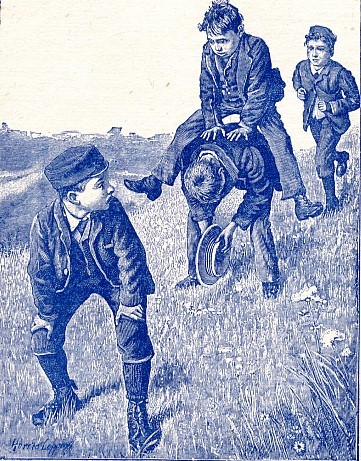
Children playing leap-frog, 1897
Georges Bizet: Jeux d’enfants – No. 10. Saute-mouton (Beatriz Klien, piano; Walter Klien, piano)
You can decide what kind of household is run by the Petit mari, petite femme! It all seems to end with a kiss, perhaps, though, only on the cheek.
Georges Bizet: Jeux d’enfants – No. 11. Petit mari, petite femme! (Beatriz Klien, piano; Walter Klien, piano)
The suite ends with a grand galop – the high-speed country dance that came into Parisian society in the 1820s. A forerunner of the polka, the dance was popular as the last dance of the evening.
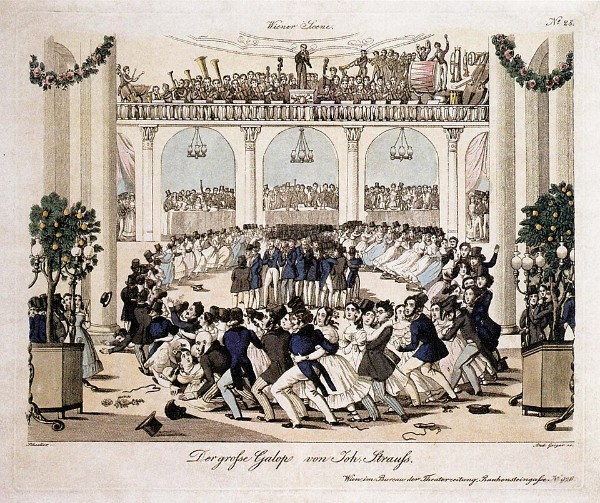
Johann Christian Schoeller / Andreas Geiger the Elder: The Great Galop of Johann Strauss, 1839
Georges Bizet: Jeux d’enfants – No. 12. Le bal (Beatriz Klien, piano; Walter Klien, piano)
By focusing on the activities of children, Bizet gave himself a wide-open field for showing the seriousness with which children played their games. Composers such as Debussy, Fauré, and Ravel created their own childrens’ worlds following Bizet.
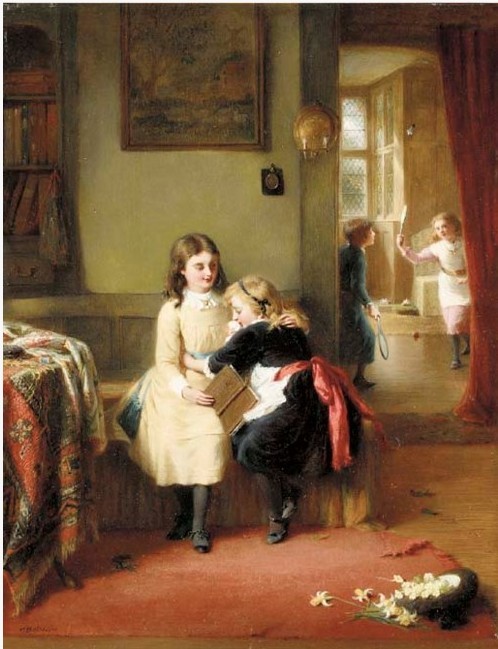
George Bernard O’Neill: Sympathy, 1888
What’s wonderful is that there’s not a hint of anything that makes fun of the children. They are focused and serious. At the same time, the vagaries of the environment and the actions of the children give Bizet opportunities to play with chromatic and enharmonic harmonies that would be more difficult to put across in a more serious piece.
For more of the best in classical music, sign up for our E-Newsletter