Two farewell-themed concerts took place at the Shanghai Concert Hall on 3 and 4 April. The first saw Mark Padmore and Dame Imogen Cooper perform Winterreise, Schubert’s bleak song cycle of departure. The following evening, Cooper gave a pre-retirement recital, pairing Schubert’s two sets of Impromptus with Beethoven’s Op. 33 Bagatelles.
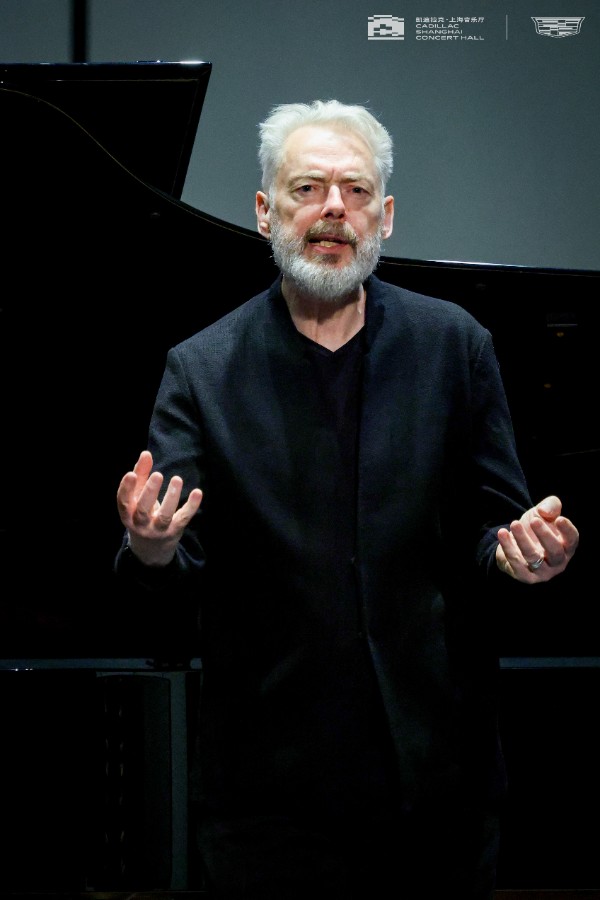
Mark Padmore © Cadillac Shanghai Concert Hall
Padmore’s Winterreise proved at once deeply personal and profoundly moving. His voice was not large, and had lost much of its former lustre; yet what it had shed in sheen, it had gained in character and expressive acuity. He did not “sing” with rich resonance and heavy legato, but adopted a “Sprechgesang” approach, inhabiting the text and moulding each word with astonishing flexibility of colour and inflection.
This yielded a startling immediacy. He might shape a phrase such as “Durstig ein das heisse Weh” in Wasserflut with ample resonance, for a moment of cathartic release; elsewhere, he stripped the voice bare, letting it dry and crack against words weighted with suffering. The final “elend” in Einsamkeit cut with sharpness; in Die Krähe, the bird’s name itself sounded like a crow’s rasping, grotesque cry. In the deceptive brightness of major-key songs such as Täuschung, shadows gathered in his inflections. Nowhere was his control of nuance more telling than in Der Wegweiser, where the repeated notes pressed insistently forward with accumulating intensity.
Franz Schubert: Winterreise, Op. 89, D. 911 – No. 12. Einsamkeit (Mark Padmore, tenor; Kristian Bezuidenhout, fortepiano)
Padmore’s interpretation placed keen emphasis on the melodic line’s tension. His articulation and breath resisted smoothness, rendering often precipitous emotions; moments of near-sforzando emphasis strike like a blunt blade of grief, reaching their emotional apex in Die Nebensonnen. One might well describe his performance as “dramatic”: he incorporated carefully-choreographed gestures into the musical fabric—most strikingly in Frühlingstraum, where the longing for “kissing” and “embracing” was physically enacted. One was reminded of the Evangelist in Bach’s Passions—a role he has long inhabited—in his narrative stance that recounted suffering with a voice steeped in compassion.
This was nowhere more arresting than in Das Wirtshaus. Beneath its chorale-like stillness—its transparent harmonies and solemn accompanying figures—lies an abyss of longing for release through death. When Padmore delivered the line “O unbarmherz’ge Schenke,/ Doch weisest du mich ab? ”, his voice recalled a Bachian plea for mercy—an aching supplication flickering with fragile hope.
Franz Schubert: Winterreise, Op. 89, D. 911 – No. 21. Das Wirtshaus (Mark Padmore, tenor; Kristian Bezuidenhout, fortepiano)
Cooper’s playing was integral to this atmosphere. In Das Wirtshaus, her sound was plain, deep, and luminous, as if drawn from some inner well. In the closing bars of Die Nebensonnen, she shaped a vast emotional arc through a dramatic swell from pianissimo to forte and back again, with unforced intensity. If Padmore painted in saturated colours, Cooper worked in washes of light: restrained, lucid, and unwavering in structure. She anchored the music with a steady rhythmic spine, while in songs such as Rast she responded sensitively to Padmore’s elasticity of tempo. One occasionally wished, however, for a sharper highlighting of harmonic tensions—for example, in Frühlingstraum—to intensify the expression of colours.
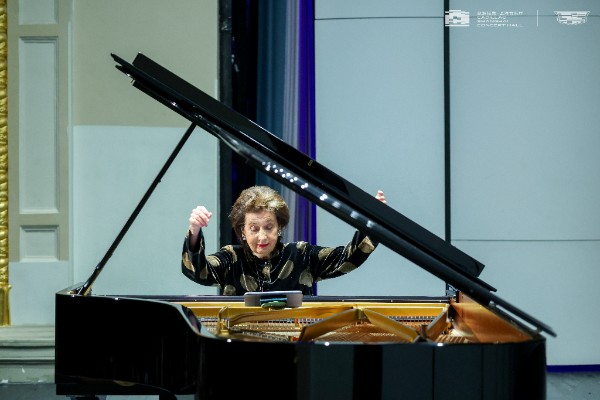
Dame Imogen Cooper © Cadillac Shanghai Concert Hall
At seventy-six, Cooper no longer commanded absolute control in every detail; yet what she offered instead feels more precious, especially in this era. Her playing, especially in the following evening’s recital, spoke with rare directness. There was no attempt to dazzle: her touch was measured, her phrasing unhurried, her tone warm and unforced. Every line was shaped with clarity, free from the slightest hint of artifice.
As the recital unfolded, she seemed to settle ever more deeply into the music. The opening of the D. 899 Impromptus carried a trace of stiffness, but by the fourth piece, the left hand sang with perfect legato, while the Trio took shape with supple shifts of colour and character. Beethoven’s Op. 33 Bagatelles, placed between the two Schubert sets, were lightly worn yet finely judged—inflected with a gentle Viennese wit, their rhythmic poise enlivened by a subtle flexibility.
In the D. 935 Impromptus of the second half, Cooper reached her highest level of expression across the two evenings. Schubert’s harmonies—at once simple and daring—were allowed to unfold with spacious inevitability, while even the smallest fragments of melody were made to sing. If moments of brilliance or propulsion were understated, they were replaced by elegance and inward glow. The theme of the second Impromptu spoke in a meditative manner, and in the fourth, her intricate passagework hovered with “floating” hands—a vestige, perhaps, of her early French training.
Franz Schubert: 4 Impromptus, Op. 142, D. 935 – No. 4 in F Minor (Imogen Cooper, piano)
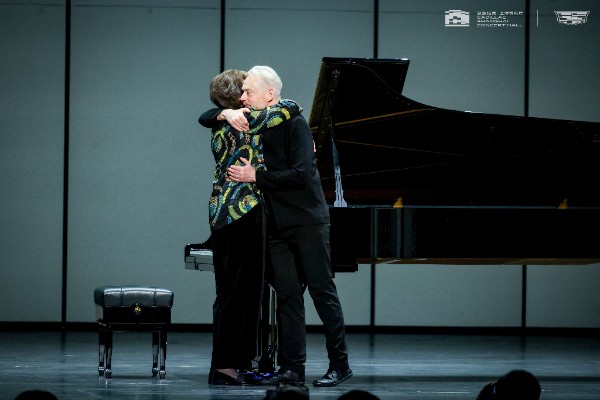
Dame Imogen Cooper and Mark Padmore © Cadillac Shanghai Concert Hall
Cooper’s encore, the Allegretto in C minor, was nothing short of exquisite. Within piano and pianissimo, she carved out a vast expressive landscape. It was playing of the highest class. It emerged as a farewell of rare intimacy—Schubert’s own parting gift, now quietly reclaimed. For her final appearance in China, Cooper invited Padmore back to the stage for one last collaboration: Schubert’s Frühlingsglaube. Across these two evenings, winter eventually yielded to spring—and in this final song, Padmore’s voice, at his most mellow, marked an evening to remember.
For more of the best in classical music, sign up for our E-Newsletter
Franz Schubert: Allegretto in C Minor, D. 915 (Imogen Cooper, piano)