Nineteenth-century piano giant Jan Paderewski called her “the most wonderful musician in the world.”
Helen Keller called her “the most accomplished deaf and blind person in the world.”
She was, to our knowledge, the first blind-deaf person to make a career as a professional classical musician.
And yet she’s been almost entirely forgotten today. Why?
Today, we’re looking at the extraordinary life story of pianist Helen May Martin.
Helen May Martin’s Family and Early Childhood
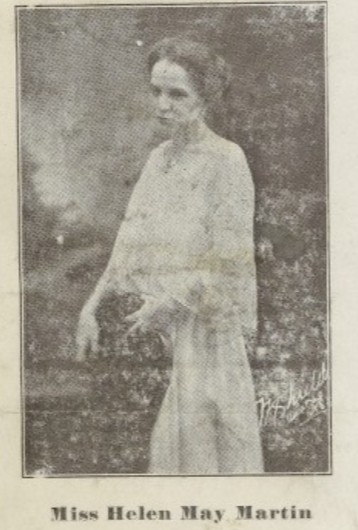
Helen May Martin
Helen May Martin was born on 18 December 1893 in Lincoln, Nebraska, in a three-story brick building facing the state capitol building.
Her father was a traveling salesman and devoted amateur pianist, while her mother was a schoolteacher and milliner.
When she was just a week old, she came down with a septic infection that reached her eyes and ears, but – fortunately – spared her life.
Despite her inability to see or hear, she demonstrated an early passion for music.
Her family noticed that when her father played the piano, a three-year-old Helen would touch it to feel the vibrations and beam. When the vibrations stopped, she frowned. But if her father began playing again, her big smile would return.
Her First Piano Studies
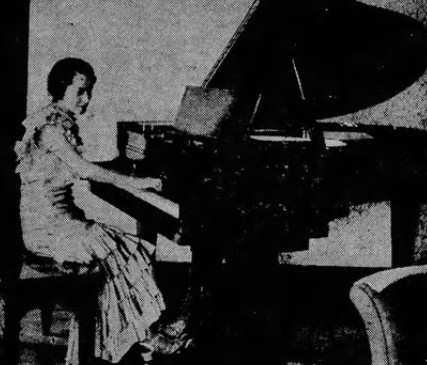
Helen May Martin
During her childhood, Helen was close to her extended family.
She spent time with her grandparents in a farmhouse outside of Brownville, Nebraska, a village on the Missouri River ninety miles southeast of Lincoln. While visiting, she would climb the local bluffs to connect with nature.
She also spent time with her cousins. They didn’t think that Helen’s blindness or deafness was any excuse to keep her from learning the same things they were learning, so Helen learned how to colour and sculpt right alongside them.
Helen was seven years old when they started official piano lessons. She obviously couldn’t see the keyboard or hear a note, but she learned how to play anyway.
Her mother was her first teacher. She taught Helen music theory – including the basics of rhythm and the whole-step/half-step pattern of scales – by using touchable objects like dried beans.
Attending the Olathe School for the Deaf
For high school, she applied to a state school for the deaf located in Olathe, Kansas, just outside of Kansas City, Missouri. The administrators were sceptical: they had never taught a child who was both deaf and blind.
However, the example of Helen Keller (who had been born thirteen years before Martin) was surely on their mind as they discussed the possibility of admitting her. Keller had recently – and famously – demonstrated the academic potential of deaf-blind students, and by the 1910s was an important author and activist.
Martin was accepted into the school and proceeded to become an academic star with an average grade of 97 per cent. She finished a nine-year course schedule in four years, graduating in 1917.
While living in Olathe, Helen’s recently widowed mother started a millinery shop, moving into a storefront that shared space with the local music store where Helen would play.
One day, a blind piano tuner heard Helen performing, and he urged both Helen and her mother to consider studying music even more seriously.
She began learning more music at the school, as well as taking additional lessons from a local piano teacher.
How Did Helen May Martin Play Piano?
How exactly did she play?
One article reported:
It’s simple. Notice how she keeps her left foot pressed against the front board of the piano.
In this way, she gets the vibrations which give her an idea of tone quality. That enables her to put expression into the music.
A wrong note causes a discord in the vibrations, and she quickly corrects it.
You see, she hears and enjoys music not through her ears, as you do, but through touch – that is, by means of the vibrations she receives through her foot.
She listens to others play by placing her hands on the instrument.
Helen May Martin’s Growing Fame
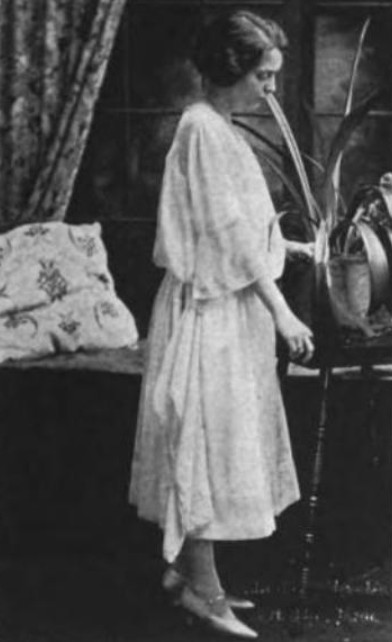
Helen May Martin
In 1923, the year she turned thirty, she gave her public debut at a church in Olathe. A critic from the Kansas City Star turned in a review that made it to the front page of the newspaper.
She was offered a scholarship to a conservatory in Wichita, Kansas, where she attended alongside traditional students. When she received a degree, her mother did, too, since she had translated instruction for her daughter into sign language.
She also traveled to Chicago and Cincinnati, where she studied under the Gorno brothers.
Helen learned music by memory with the help of her mother, asking for a story to accompany each piece to help her learn, remember, and interpret it.
When she received the gift of a custom radio equipped with special vibration technology, she was thrilled: she could now “listen” to other performers’ playing through her fingertips. She told an interviewer:
“Mr. Kent sent a wonderful radio specially made for me. It has a special attachment for carrying vibration which consists of an all-metal loudspeaker the size and appearance of a clock. It stands on the radio or can be moved to a nearby stool. I get the vibrations just as plain by placing my palm on its face… It helps in my own music, for just having my own playing makes it dull for me.”
Composer Z. Randall Stroope’s piece Hands, inspired by the life of Martin
Reports of Her Playing
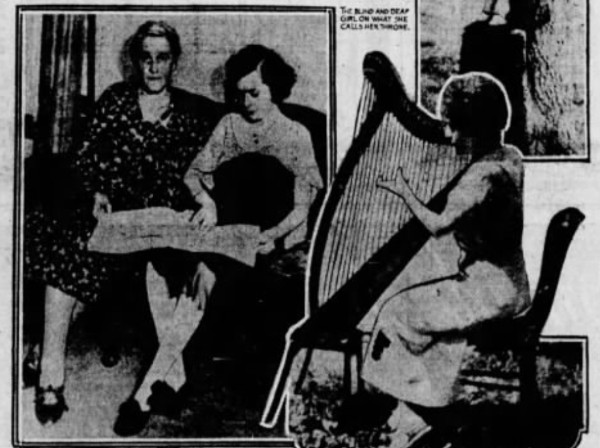
Helen May Martin
In 1928, an incredulous representative from the Etude magazine was sent to Kansas to see if the rumours about Helen’s abilities were actually true.
They sent a member of the faculty of the Cincinnati Conservatory to meet with Helen.
He reported back:
This morning I went to see Miss Helen May Martin, and do not hesitate to say she is remarkable. She played for me MacDowell’s “To a Wild Rose”, Chopin‘s Preludes in C minor and D flat major, and the first movement of Beethoven‘s “Moonlight Sonata” – all with [an] astonishing sense of rhythm…
What she does is quite extraordinary, and – here is the main point for me – apparently gives her great pleasure!
The Etude article continued:
There was nothing of the amateur musician about this girl’s masterful playing. There was everything of the artist about her playing Chopin’s Valse in A Minor so reverently. To each measure she gave beauty of tone and perfect technique – to the whole, fineness of feeling and interpretation of mood…
Chopin’s Waltz in A-Minor
According to other contemporary press accounts, she could also play Jan Paderewski’s “Minuet” (the trademark composition by the same pianist who called her “the most wonderful musician in the world”), Edward MacDowell’s “Iceberg”, and dozens of other pieces.
Helen May Martin Meets Helen Keller
Newsreel of Helen Keller experiencing music; Helen May Martin “listened” to music in a similar way
Helen May Martin eventually had the opportunity to meet her great inspiration, Helen Keller. She was beyond thrilled, writing:
“To know her personally seemed beyond even my wildest dreams. Her whole personality seemed love… I think she understood all the deeper feelings that I made no effort to express.”
Once, a reporter referred to Martin as a “second Helen Keller.” Keller herself was indignant at the comparison, saying:
“She is not a ‘second’ to me, for she has done what I could never do; she has made of herself an accomplished pianist and musician. She is the only deaf and blind musician. She is the most accomplished deaf and blind person in the world.”
It’s interesting to note that Helen Keller also enjoyed music by feeling vibrations, although she was not a professional performing musician like Martin was.
Martin’s Life Outside of Music
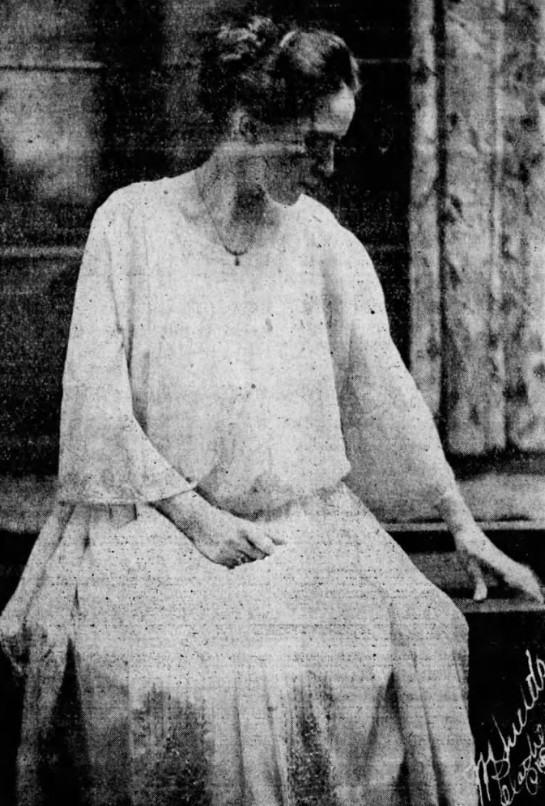
Helen May Martin
Helen Martin had a wide range of interests aside from music.
She could identify replicas of famous sculptures by touch. She taught herself French. She sewed. She baked. She studied fashion and chose the colour of her own clothes.
Her mother stayed at her side, always translating for her. Helen asked that her mother tell her what was going on around them, with special emphasis on whatever was beautiful.
Her mother was deeply grateful for the opportunity to become her daughter’s eyes and ears, and to be on constant lookout for beautiful things to tell Helen about.
Mother and daughter shared a near-psychic bond, as evidenced by this description from one of the family’s vacations to the Wisconsin Dells, where they took in the Northern Lights. Helen wrote:
“The night we were about to leave Devil’s Lake, we had a great thrill watching the Northern Lights – great shafts of rainbow colours in the sky, forming a mighty curtain hung in the form of an arch, the keystone of which touched the zenith, its two ends resting upon the eastern and western horizons. The curtain, never at rest, seemed to be moved by an unseen hand that shook it in waves of changing colour, the folds shifting rapidly up and down across the sky, making the colours merge, blue changing to crimson and purple in one vast kaleidoscope.”
Reporters were perpetually astonished at what Martin could accomplish, feel, and express. She told one via her mother, clearly a little exasperated but still gracious:
“Mother, tell him that I have ten eyes in my ten fingers. Tell him not to be amazed at what I do, but to think of the wonderful things done by blind persons all through the ages.”
Helen May Martin died 13 June 1947. She was fifty-three years old.
For more of the best in classical music, sign up for our E-Newsletter