When the poet Friedrich Rückert wrote his Liebesfrühling (Love’s Springtime) in 1821, he was courting his future wife, Luise Wiethaus-Fischer.
This complete collection of four hundred poems was first published in 1834, and from this most successful cycle of love poetry of the Biedermeier, Robert Schumann had famously composed “Widmung” (Dedication) as a wedding present for his bride, Clara, in 1840.
Robert Schumann: “Widmung”
Authorship and Union
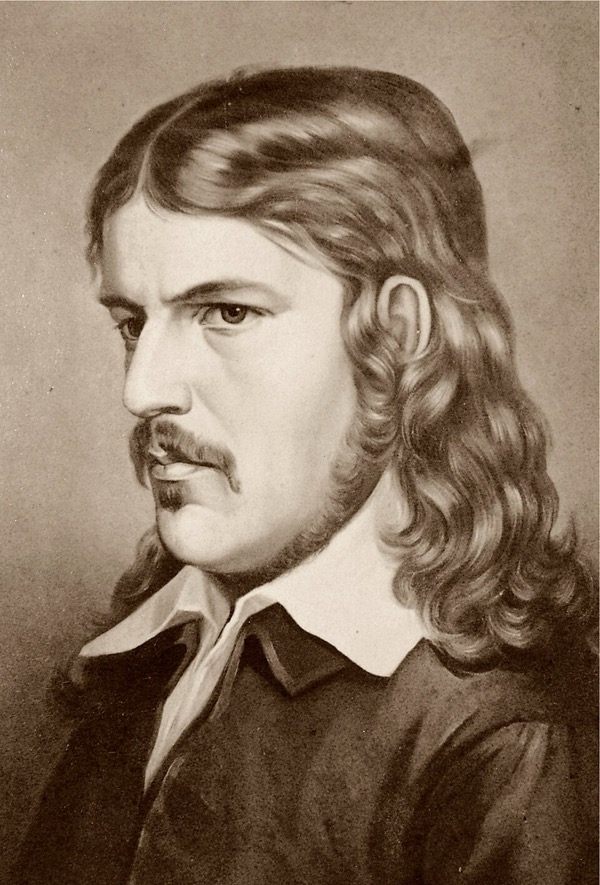
Friedrich Rückert
Rückert was one of Robert’s favourite poets, and once he had married his beloved Clara, they decided to collaborate on a number of settings from Liebesfrühling. In the end, Robert composed nine Rückert songs, and Clara eventually added three.
This collaboration was the artistic confirmation of a partnership, and Zwölf Gedichte aus F. Rückert’s Liebesfrühling was listed under the joint opus number Op. 37/12, without, however, identifying which song was composed by whom.
Robert Schumann, Clara Schumann: No. 1. Der Himmel hat eine Träne geweint (Christian Gerhaher, bass; Gerold Huber, piano)
Who Composed What?
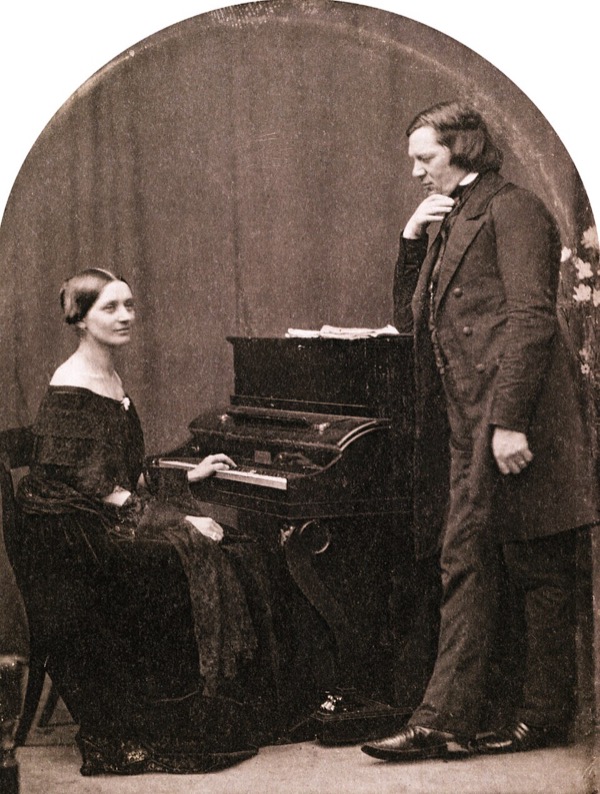
Robert and Clara Schumann, daguerreotype
It was nearly impossible for contemporary critics, performers and audiences to distinguish who had composed what, and some scholars assert that Robert must have helped her with hers, while others claim that Clara might have been as great a song composer as he.
To commemorate Clara Schumann‘s death on 20 May 1896, let’s revisit this remarkable collaboration. Will you be able to tell which songs belong to Clara and which ones to Robert?
Robert Schumann, Clara Schumann: No. 2. Er ist gekommen in Sturm und Regen (Sibylla Rubens, soprano; Gerold Huber, piano)
Love as Dialogue
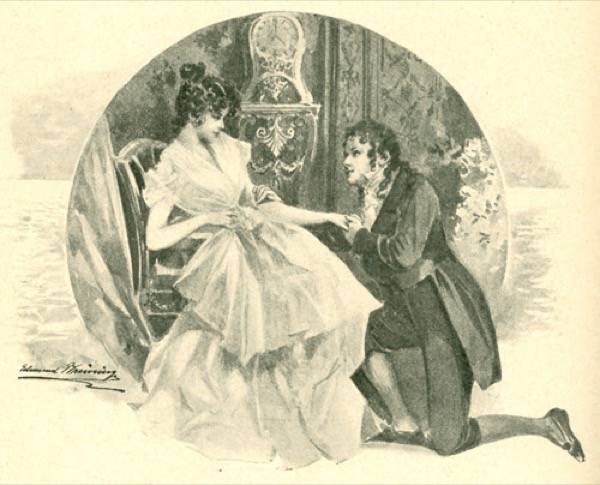
Liebesfrühling
Rückert’s poetry was a wonderful choice for the newly married couple, as the poet crafted his poetry from two distinct perspectives. The voice of the poet is the male protagonist, and the voice of the beloved is the female protagonist.
Schumann wrote to the publisher that the songs are related to each other as question and answer, and many commentators read them as a series of responses between male and female protagonists.
Robert Schumann, Clara Schumann: No. 3. O ihr Herren (Sibylla Rubens, soprano; Gerold Huber, piano)
Beyond Gender
Benedict Taylor, in his article “Self, Other, and Hermaphroditic Union in the Music of Robert and Clara Schumann”, writes, “The hermaphroditic subtext of the cycle goes well beyond this gendered narrative.”
“In fact, the whole work is suffused with verbal and musical blurring of gender and distinctions between self and other, resulting in a spiritual union of male and female personas at its close.” (Taylor, Zeitschrift for Musiktheorie, 2022)
Robert Schumann, Clara Schumann: No. 4. Liebst du um Schönheit (Sibylla Rubens, soprano; Gerold Huber, piano)
From Tear to Pearl
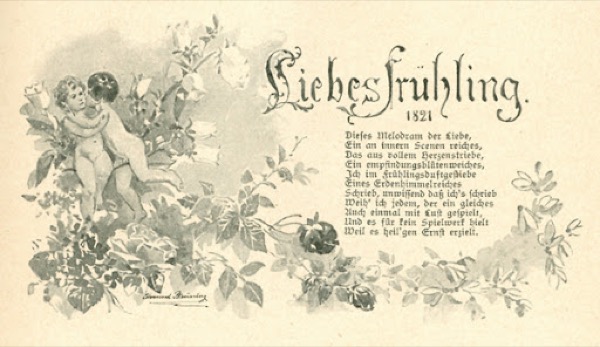
Friedrich Rückert: Liebesfrühling
Rückert’s poetry is full of vivid imagery and highly gendered symbolism. It is not surprising that the Schumanns strongly identified with the poet’s words. In the opening song, “Heaven wept a tear, which intended to lose itself in the sea.”
But the mussel came and enclosed it; “you shall now be my pearl.” A good many commentators have taken this line to mean that Robert would support his wife’s attempts at composition and that they will produce a musical offspring.
Robert Schumann, Clara Schumann: No. 5. Ich hab’ in mich gesogen (Christian Gerhaher, bass; Gerold Huber, piano)
From Allusion to Creation
A new theme appears in the piano accompaniment of the postlude. Apparently, an allusion to the popular Neapolitan aria “Caro mio ben,” might well be the “pearl” produced by the union.
Just a couple of weeks before starting this collaboration, Clara was pregnant for the first time, which might well tempt us to read an autobiographical reference in this opening song. In the event, it is the association between procreation and artistic creation that appears throughout this cycle.
Robert Schumann, Clara Schumann: No. 6. Liebste, was kann denn uns scheiden? (Sibylla Rubens, soprano; Christian Gerhaher, bass; Gerold Huber, piano)
When Paths Converge
In the second song, the male lover has come in storm and rain, and we are unsure if he took possession of her heart, or if she took possession of his. “Er ist gekommen,” thus compares the arrival of the beloved to a stormy deluge.
The lover has swept into the protagonist’s life, leaving them to wonder how they could have foreseen that their paths would merge. As the storm calms and spring returns, the beloved sets off on his paths once more. The protagonists, however, do not fear this absence because “he remains mine on any path.”
Robert Schumann, Clara Schumann: No. 7. Schön ist das Fest des Lenzes (Sibylla Rubens, soprano; Christian Gerhaher, bass; Gerold Huber, piano)
Two Visions of Love
“O ihr Herren,” is a playful and spirited warning to men about the irresistible power and mystery of women and love. This song provides a moment of lightness and teasing humour.
“Liebst du um Schönheit,” one of the cycle’s most beloved songs, unfolds as a call-and-response between the vocalist and the piano. It reflects a love that transcends the fleeting qualities of beauty and youth, suggesting that true affection is rooted in inner qualities and enduring emotions.
Robert Schumann, Clara Schumann: No. 8. Flügel! Flügel, um zu fliegen (Christian Gerhaher, bass; Gerold Huber, piano)
Subjectivity and Symmetry
In “Ich hab’ in mich gesogen,” the speaker absorbs the presence of his beloved so completely that love flows through every breath and thought. Inner emotion becomes inseparable from the surrounding world of nature and memory.
The first five songs contrast male and female subjects, and you might well have already guessed the songs written by Robert and those by Clara. Duets now form the sixth, seventh, and twelfth songs, which split the opus into near-symmetrical halves.
Robert Schumann, Clara Schumann: No. 9. Rose, Meer und Sonne (Christian Gerhaher, bass; Gerold Huber, piano)
From Echo to Equality
Two duets thus stand at the central position of the entire cycle. No. 6 is barely a duet, as the second voice only doubles the final phrase in thirds. Taylor writes, “this is the first stage in a larger movement towards the ever-greater integration between the two… her mirroring back his own words to him, might be thought of as fulfilling a crucial role in his own journey to full selfhood.” (Taylor, Zeitschrift for Musiktheorie, 2022)
In the seventh song, “Schön ist das Fest des Lenzes,” the two voices come together in almost equal status. The music is, for the most part, a canon, and this round dance offers a celebration of nature’s season of fertility. Both are singing as individual subjects, yet singing the same material.
Robert Schumann, Clara Schumann: No. 10. O Sonn’, o Meer, o Rose (Christian Gerhaher, bass; Gerold Huber, piano)
From Yearning to Certainty
The cycle now moves from restless yearning toward a more conclusive certainty. The next two songs dissolve the boundaries between human emotion and the natural world, and in “Warum willst du and’re fragen,” the emotional intensity becomes quieter and more intimate.
In the concluding duet “So wahr die Sonne scheinet,” the music is now truly balanced as the voices sing in parallel thirds in the initial stages. This culminates in the subjects’ mutual declaration of love.
Robert Schumann, Clara Schumann: No. 11. Warum willst du And’re fragen (Sibylla Rubens, soprano; Gerold Huber, piano)
From Duality to Unity
By the end of the work, the protagonists are not simply singing in parallel, but their lines merge into a composite entity. Mirroring of vocal lines, contrapuntal voice exchanges match the blurring and eventual identification of the “I” and “you” in Rückert’s text.
“Upon declaring their love and mutual recognition, the distinction between self and other has become annulled; two subjects have become one, and the cycle’s male and female protagonists have fused as one heart and one soul.” (Taylor, Zeitschrift for Musiktheorie, 2022)
The Song Returned
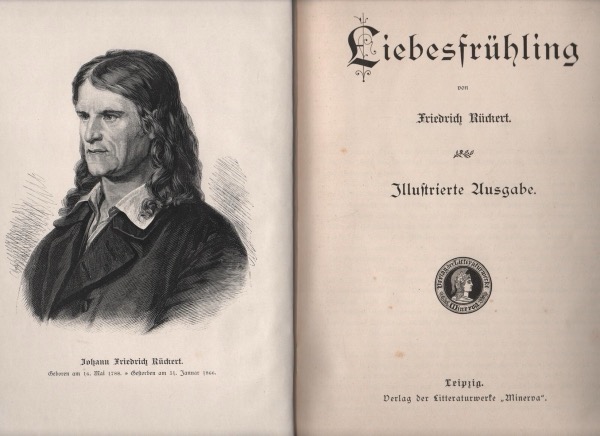
Friedrich Rückert: Liebesfrühling
Robert and Clara Schumann sent Friedrich Rückert a copy of their settings, and he replied with an ingenious ghazal.
Long it is, long
Since my love’s springtime song
At the urge of my heart
As it sprang,
The music died away in solitude.
It was at twenty years
I heard here and there
From the flock of birds
One that clearly
Piped a tune, that was from there.
And now even
Comes in the twenty-first year
A pair of birds,
First makes clear to me
That not a note was lost.
My songs
You sing again,
My feelings you sound again,
My emotions
You bring to life again,
My spring
You bring back again,
Me, how fair,
You make young again:
Take my thanks,
Since the world too,
As with me once,
Withholds it from you!
And may you win thanks
As I have achieved with mine.
Two Voices become Equals
In Liebesfrühling, Robert and Clara proceeded to an ultimate union that eventually overcame the distinction between self and other. In other words, the goal of each subject was the recognition of itself in and by the other.
By the end of the cycle, the female figure has grown into an equal partner. And in terms of setting the poetry, you probably already realised that No. 2, No. 4, and No. 11 were composed by Clara Schumann.
A Shared Artistic Voice
There are some stylistic differences between the two composers. While Robert writes with greater contrapuntal complexity and motivic development, Clara focuses on melodic concentration and emotional immediacy. Simplicity here does not mean weakness, but conscious expressive strength.
Above all, the Robert and Clara settings coexist seamlessly within this cycle. It was, after all, built on the idea of a shared artistic voice, and it represents a genuine creative partnership between two highly individual musical personalities.
For more of the best in classical music, sign up for our E-Newsletter
Robert Schumann, Clara Schumann: No. 12. So wahr die Sonne scheinet (Sibylla Rubens, soprano; Christian Gerhaher, bass; Gerold Huber, piano)