Sir András Schiff now rarely announces his recital programmes in advance; he reveals them on stage, or via a sheet of paper outside the hall after the concert, although what he plays is not unpredictable to those familiar with his recent appearances. Audience familiar with Schiff may also expect a remarkable scale: his programmes are invariably generous to the point of abundance. Such was the case in his three sold-out recitals of Bach, Beethoven, and Schubert at Shanghai Symphony Hall on 7, 9, and 11 April, each extending well beyond two and a half hours of piano playing, encores included. Schiff’s stamina is, as ever, beyond question.
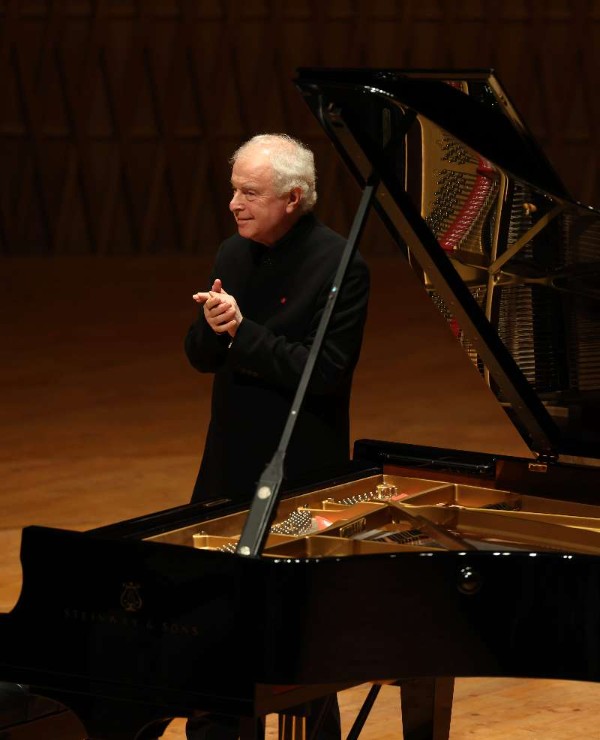
Sir András Schiff © Cai Leilei
I somehow want to draw a parallel between Schiff’s concerts and the Japanese notion of omakase (and, indeed, the pianist’s admiration for Japanese culture is well known). There is no fixed menu: the chef presents what he deems appropriate on the day. Schiff offered delicately crafted, lightly seasoned fare, imbued with a strong sense of occasion—almost ritualistic in its unfolding. In the Goldberg Variations, he inserted extended pauses after Variations 10, 15, and 22, carving structural divisions with a ceremonial deliberation. Even when disrupted by premature applause after the whole piece was finished, he remained motionless until the hall fell back into silence for another thirty seconds. The Goldberg Aria returned at the opening of the Beethoven recital, perhaps as an expression of his enduring devotion to Bach, or as a kind of palate cleanser before Beethoven’s richer harmonic world.
Johann Sebastian Bach: Goldberg Variations, BWV 988 – Variations 1-5 (András Schiff, piano)
Schiff’s craftsmanship remained astonishing. The evenness and refinement of his sound over such a vast span of music were deeply admirable, and his tonal identity instantly recognisable. Every note seemed weighed and judged, particularly in Bach, where extended semiquaver passages unfolded in pearly, rounded lines. The playful ornamentation in the outer movements of the Italian Concerto retained its charm, while the layered trills in Variations 10 and 14 of the Goldberg delighted the ear. At the close of the work, the final reprise of the Aria—barely ornamented—was moving for its sheer tonal beauty.
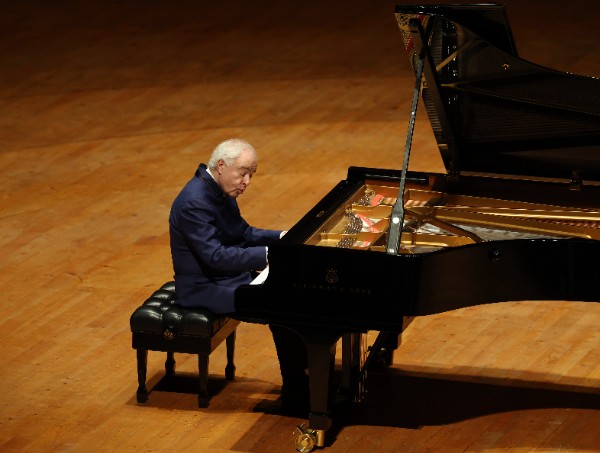
Sir András Schiff © Cai Leilei
With his exceptional control of legato and cantabile, Schiff allowed voices to emerge and converse within a linear texture. Inner and bass lines received particular care; indeed, the principal thematic line was not always foregrounded, sometimes yielding to the interplay of surrounding voices. This could, at times, expose moments of rhythmic imprecision or textural vagueness in the polyphonic fabric. His virtuosity was most striking in the chromatic lines of the D minor Fantasia and Fugue, and in Variations 14, 20, and 26 of the Goldberg, where he summoned remarkable dexterity and brilliance—especially in the upper registers. One was reminded, perhaps fancifully, of the intricate vegetable carvings of Japanese haute cuisine: exquisite in detail, if occasionally lacking in flavours compared with certain pianists.
Schiff’s interpretative stance was, in many respects, restrained. Passages that are often projected with a wider dynamic range or heightened colour were here treated with a composed, almost understated poise. This approach proved persuasive in Beethoven’s “Tempest” Sonata, where the underlying harmonic drama was sustained with architectural clarity across all three movements. Yet the final movement of Op. 109 felt curiously elusive: the structural coherence was impeccable, and the character of each variation clearly delineated, but it was such a reading that may leave many untouched. Schiff did not, however, entirely eschew expressive flexibility. The Adagissimo of the Capriccio on the Departure of a Beloved Brother was strikingly slow—arguably beyond what would be feasible on the harpsichord—while discreet ritardandi coloured the slow movement of the Italian Concerto.
Ludwig van Beethoven: Piano Sonata No. 30 in E Major, Op. 109 – III. Gesangvoll, mit innigster Empfindung: Andante molto cantabile ed espressivo (András Schiff, piano)
One might argue that, like Japanese cuisine, Schiff prioritises the intrinsic flavour of his musical “ingredients”, imposing little overt personality upon them—though a pervasive sense of control is never absent. In the Schubert recital, he rarely crossed the line of rational boundary: lyricism remained carefully contained within a steady rhythmic flow, with reserved rubato or inflection aimed at shaping the Schubertian rhetoric. This restraint may sound mannered for some. It proved more convincing in the beautifully shaped Rondo of D. 946 No. 2 than in the cool Impromptu in G-flat major (D. 899 No. 3), where darker undercurrents in the bass were suggested rather than fully realised. The Sonata in G major, D894, heard in the second half, found Schiff at his most compelling in Schubert. Here, his meticulous articulation and structural insight sustained a mellifluent narrative, particularly in the first and final movements, where the music was allowed to speak with eloquent inevitability.
Franz Schubert: Piano Sonata No. 18 in G Major, Op. 78, D. 894 (András Schiff, piano)
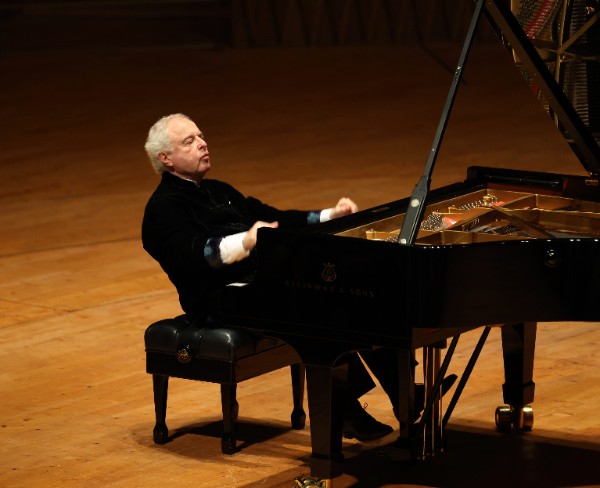
Sir András Schiff © Cai Leilei
In true omakase fashion, when the diner is not yet sated, a generous chef offers more—and an exceptionally generous one was Schiff. He gave four encores after the first recital, seven after the second (including the entire Italian Concerto), and no fewer than ten after the third. The audience responded with unrestrained enthusiasm. But one might ask: could one truly absorb so much? Perhaps, in Schiff’s case, the answer may be affirmative.
For more of the best in classical music, sign up for our E-Newsletter