
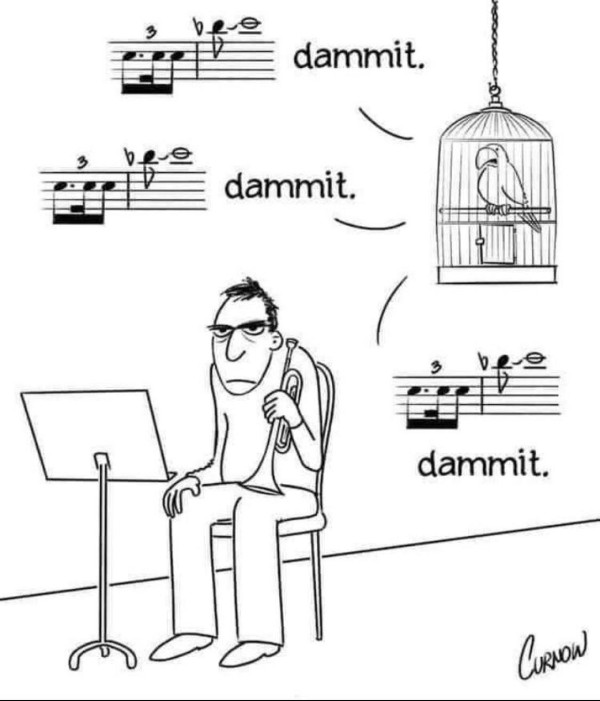
Let’s face it, trumpet players are stereotyped as confident, brash, adventurous, swaggering perfectionists driven by the obsession to excel at playing the highest notes. But they are so cool. With daring they can let rip brilliant sounds and attract attention despite sitting in the back row of the orchestra.
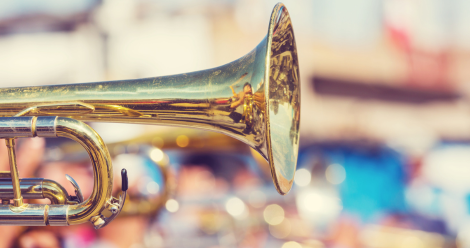
They come by it honestly. Trumpets have been used for centuries to herald royalty, to signal the military, and to lead parades. In the Bible, trumpets symbolise divine intervention or warning. No wonder they can be obnoxious. It reminds me of the joke:
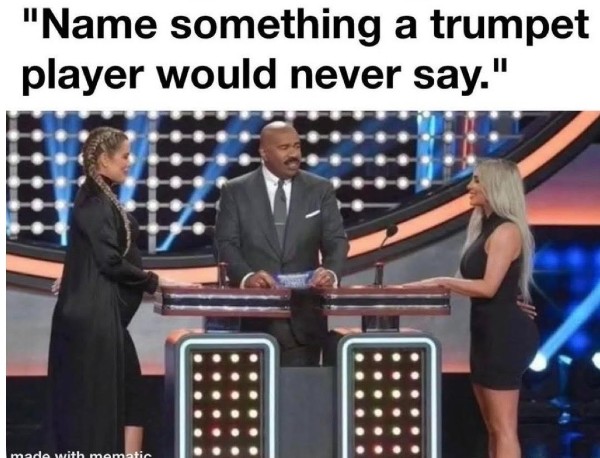
Name something a trumpet player would never say:
I prefer to play pianissimo there.
Sure, I’ll play 2nd trumpet.
Can I take that down an octave?
Wish I’d learned the tuba.
You’re right. I was playing too loud.
You take that solo.
I promise not to release the spit valve on the bassoonist’s head.
But seriously, their visibility makes playing the trumpet risky. Should they miss a note, there is no hiding the trumpet sound.
Some of my favourite moments in the orchestral literature that shine a light on the trumpets include the following pieces. And they do dazzle!
Modest Mussorgsky‘s Pictures at an Exhibition begins with the Promenade, depicting strolling through the art exhibit. We hear a soaring trumpet line accompanied by the other brass. It is regal and noble and returns several times in different guises, different keys with different instruments as we move through the gallery to see other works on display. The finale, The Great Gates of Kiev, gives us a sense of majesty and grandeur with the trumpets soaring above the entire orchestra. The climax is truly spine-tingling with layers of bells, cymbal crashes, and, of course, the entire orchestra.
Modest Petrovich Mussorgsky: Pictures at an Exhibition (orch. M. Ravel) – Promenade (Slovak Philharmonic Orchestra; Daniel Nazareth, cond.)
Modest Petrovich Mussorgsky: Pictures at an Exhibition (orch. M. Ravel) – X. The Great Gate of Kiev (Slovak Philharmonic Orchestra; Daniel Nazareth, cond.)
Gustav Mahler: Mahler’s Symphony No. 5 is one of the most nerve-wracking openings to a symphony. The trumpet starts totally alone with a triplet figure. It did happen once in our orchestra during a concert that a valve stuck, and the trumpet didn’t speak in the second bar. To our trumpet player’s credit, he stopped, fixed the offending valve and started over.
After a huge crescendo, there is a climax when the cymbals and other brass enter. But listen on. A gorgeous, understated melody enters in the strings, hushed and tender. The trumpet is again featured after this section. What a contrast, and it features such a huge range of emotions.
Gustav Mahler: Symphony No. 5 in C-Sharp Minor – I. Trauermarsch: In gemessenem Schritt – Streng – Wie ein Kondukt (London Symphony Orchestra; James DePreist, cond.)
Petrushka
Stravinsky: Petrushka. The trumpets are front and centre in this great work. Two of the most important solos for trumpet appear in this piece and on every audition. In Tableau Three: The Moor’s Room – Dance of the Ballerina – Waltz, the solo is lyrical, and it needs to sound fluid, light, and effortless, but towards the end of the movement, the trumpets are highlighted, getting nasty and edgy-sounding. I would think the more notorious and difficult solo is in Tableau 4 Wet Nurses Dance – Peasant with Bear – Gypsies and a Rake Vendor. It is extremely exposed, forte, and occurs at the very end of the piece, in fact, the last minute! After we are lulled by the woodwinds gently playing in pianissimo, alternating from one note to another, the two trumpets enter—adamant, strident, imperiously insistent. Let’s hear the solos individually before we listen to the entire movements.
The Berliner Philharmoniker perform Stravinsky’s Petrushka / Trumpet tutorial
Stravinsky – Petrouchka – Orchestral Trumpet excerpts – Daniel Leal Trumpet
Igor Stravinsky: Petrushka – Tableau 3: The Moor’s Room – Dance of the Ballerina – Waltz (Chicago Symphony Orchestra; Georg Solti, cond.)
Igor Stravinsky: Petrushka – Tableau 4: Wet Nurses’ Dance – Peasant with Bear – Gypsies and a Rake Vendor (Chicago Symphony Orchestra; Georg Solti, cond.)
Richard Strauss: Also sprach Zarathustra Op. 30. There’s a great story about this piece and the conductor Fritz Reiner. He could be merciless, irascible and mock the slightest imperfection. The opening itself is quite famous – also featuring the trumpets. But the lick in question comes later, is very exposed, and requires high precise playing. After a flurry of violins rising higher and higher in a scale passage, and after the flutes take over in waves of notes, the trumpet must enter fearlessly to play the famous leap from C to high C. During a recording of the work, Reiner kept going over and over the passage. The principal trumpet of the Chicago Symphony, Adolph (Bud) Herseth, asked if there was a problem, “I’m just checking to see if you will miss.” Herseth himself relates this famous incident in Conductor “Quips”.
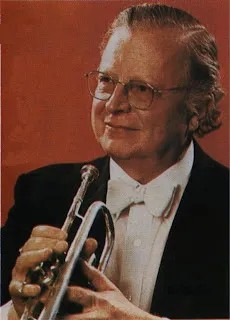
Adolph Herseth
Trumpet players work on this passage for years, until they can NOT miss it (hopefully.)
Some begin working on it at a very young age, like this wonderful young 12-year-old:
Strauss “Thus Spoke Zarathustra” by 12-year old trumpetist and orchestra
These passages are demonstrated here in this excerpt, beginning with the opening of the piece. The entire trumpet section plays the C, G, C, followed by the timpani beating feverishly. As the entire orchestra enters, it crescendos to a tremendous peak, cymbals crashing, and the organ lingering. The excerpt skips ahead to the exposed trumpet C to C leap played flawlessly, and finally, we hear a huge climax later in the piece where the trumpet again pierces the sonorities.
A little bit of Zarathustra
Now let’s hear these trumpet passages in context. This tone poem is a luscious, romantic piece that takes the listener on a journey through the philosophies of Nietzsche. In Also sprach Zarathustra, Strauss magnificently displays the gamut of orchestral colours. There are lovely, intimate movements too, featuring solo strings. The ending, in fact, is unusual in that after all the hoopla, it concludes slowly and softly with extremely high woodwinds—treacherous to play in tune, especially after 35 minutes of playing. It has been an amazing privilege to perform this brilliant piece.
Richard Strauss: Also sprach Zarathustra, Op. 30, TrV 176 (Bavarian Radio Symphony Orchestra; Ferdinand Leitner, cond.)
Herseth often used to say that the human voice is the greatest instrument. He felt his goal as a trumpet player should be to emulate the quality of the human voice as closely as possible. We, instrumentalists, agree.
For more of the best in classical music, sign up for our E-Newsletter






Thanks for educating me about this instrument, several pieces where it shines and some of the souls who perform with it. 😊