Féerie opera had its start in life with the operas of the late 18th century, where experiments with staging and stage effects led to operas that were set on the moon or had trips through the fairy kingdom. The plots were generally based on fairy tales, and magic often had a place. So it is with Corfiot composer Spyridon Samaras’ Flora mirabilis. The libretto was written by Ferdinando Fontana, who would go on to write the librettos for Samaras’s operas Medgè (1888) and Lionella (1891).
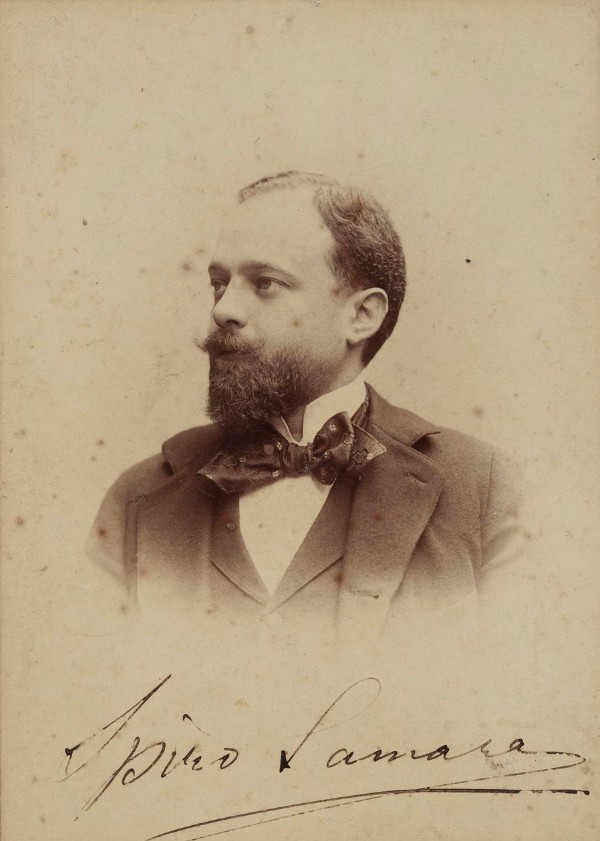
Spyridon Samaras, ca. 1894
Medieval Swedish Princess Lydia isn’t inclined to marry anyone. Her last suitor, Vilfrido, killed himself when she didn’t return his love. Now her father is urging that she look at Valdo, an orphan boy that he had adopted and trained as a knight, newly returned from 4 years at war. She declares that she’s perfectly happy with her life and doesn’t need anyone else in it. When Valdo pleads his suit, she gives him a challenge to change the snowfield outside her window into a field of flowers.
Valdo is taken aside by Count of Adelfiore, the unfortunate Vilfrido’s father. He can help with this little transformation problem, and his magical gnomes make the garden appear. Lydia must immediately admit Valdo as a suitor, and what’s more, she’s enchanted by the flowers to fall in love with him. Extravagant declarations are made, and, on the sidelines, Count of Adelfiore waits for the moment when the other half of the enchantment kicks in and Valdo falls OUT of love with Lydia. Now, Lydia is as bereft as Vilfrido was and feels equally suicidal. Lydia’s father goes to plead with Count Adelfiore to please release his daughter from his enchantment. He will, if Lydia causes the bush over Vilfrido’s grave to flower. She prays over the plant, it flowers, she’s released from her curse, Valdo loves her again, and it’s all a happy ending.
The role of Lydia was sung by soprano Vasiliki Karagianni; that of Valdo by tenor Yannis Christopoulos. Lydia’s father, Prince Cristiano of Örebro, was sung by bass-baritone Yiannis Yiannisis, and Vilfrido’s father, the conniving Count of Adelfiore, by Dionysis Sourbis. The rising Greek conductor Konstantinos Terzakis led the GNO orchestra.
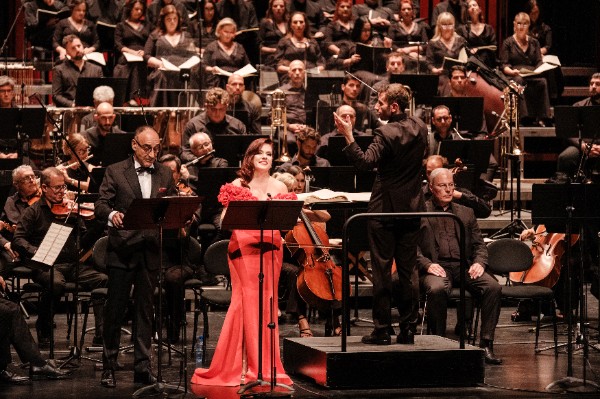
Lydia (Vasiliki Karagianni) and Valdo (Yannis Christopoulos), 2025 (Greek National Opera) (photo by Giannis Antonoglou)
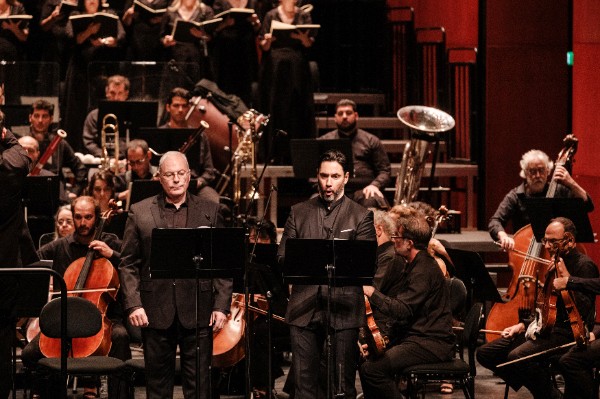
The 2 fathers: Prince Cristiano (Yiannis Yiannisis) and Count Adelfiore (Dionysis Sourbis), 2025 (Greek National Opera)
(photo by Giannis Antonoglou)
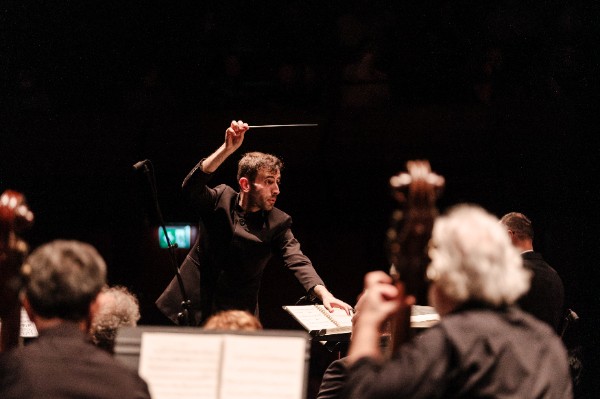
The conductor Konstantinos Terzakis, 2025 (Greek National Opera) (photo by Giannis Antonoglou)
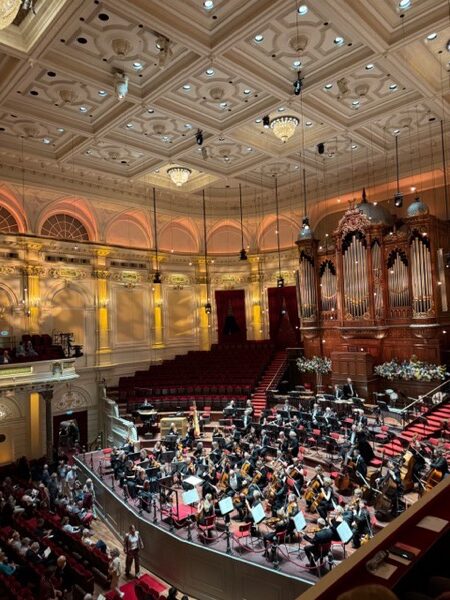
This was a concert performance, with the orchestra on stage, the four soloists in front, and the choir in the back. Unfortunately, the young conductor forgot the principal point of an opera: we’re here to hear the singing. From the very first note, the orchestra was too loud, burying the singers and even the chorus in an ocean of sound. It would have been better to have them back in the pit, where their sound is moderated. There’s nothing in the conductor’s biography to indicate that he’s ever conducted an opera before (although it does say that he excels in ‘operatic repertoire’, there are no operas or opera companies listed). This is of concern because he’s scheduled to be the conductor of the GNO’s upcoming Carmen in April 2026.
The only surviving version of the work was the piano-vocal score, where the orchestral part is reduced for the piano to play. All indications of orchestration vanish, as do any percussion parts. The opera was revived by the Greek National Opera in 1979 based on this piano edition, reorchestrated by the legendary conductor Odysseas Dimitriadis, who was also the conductor for the GNO performances.
About a decade ago, much of the original orchestral material was found in the archives of the Corfu Philharmonic Society and in 2016, a copy was given to the GNO. This formed the basis, along with some miscellaneous material for the separately performed dance scenes, for the 2025 restoration. The new editorial work was done by Yiannis Samprovalakis, musicologist and associate professor at the Ionian University, Corfu. The opera is still missing a few scenes, and Samprovalakis did not supply them, as this was a restoration of the extant parts and not a recomposition. Samprovalakis expressed his hope that more of the score would be found.
This fairy-melodrama was presented by the Greek National Opera in a concert performance, with a limited run of one performance. This was unfortunate for a number of reasons, the primary of which is that operas by the 19th-century Ionian school are rare on the ground and the particular details of the resurrection of this work make it worth more attention. The opera was a hit from its premiere in 1886, and travelled to theatres around Italy before being presented at La Scala in Milan in 1887. It was performed around the world (Cologne, Nice, and in Paraná and Córdoba, Argentina) before returning for a production in Turin in 1889. Its Greek premiere was in Corfu in 1889 and in Athens in 1906. The score, held by Samaras’ publisher, the Italian publishing house Casa Musicale Sonzogno in Milan, was destroyed in 1944 when the city was bombed.
The music very much reflected Samaras’ Paris training. He started his music studies with the Greek composer and virtuoso guitarist Spyridon Xyndas in Corfu. From 1875 to 1882, he was at the Athens Conservatory and went to Paris in 1882 to attend the Paris Conservatoire. There, he studied with Léo Delibes, Théodore Dubois, and Charles Gounod, and was a favourite of Jules Massenet.
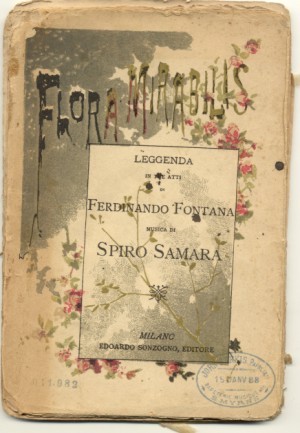
The libretto (Sonzogno, 1887)
His close association with the publisher Eduardo Sonzogno in Milan led rival publisher Casa Ricordi to attempt to sabotage the 1887 production at La Scala, with a missed note sending young soprano (not yet diva) Emma Calvé off the stage in tears, while Ricordi’s claque in the audience supplied the boos that emphasised her failure.
The music has a distinct French flavour, although the final triumphant chorus seems to conclude with the fervour of a Verdi ending. We’re in the land before verismo, and Samaras handles it well. We would say more about the vocal writing, but it was just too difficult to hear.
In addition to rethinking the sound of the orchestra, we would strongly urge GNO to consider the plight of the poor audience in a concert performance. There are no visual clues, such as the descent of the curtain, to tell us when acts are changing (Act II seemed to flow into Act III with no real pause on stage). Since the house is fully supplied with a surtitle system on the back of the chairs, consider using the technology to say things such as Overture, Act I, Dance of the Gnomes, Act II, Dance of the Flowers, etc. The two dances form extended orchestral breaks, and the audience has no clue as to what’s going on. Since opera is one of the earliest multimedia mediums where sound, light, and vision all have a role, more should be done to help the audience understand what they’re hearing when the visuals are all missing. Without those clues, the audience needs help.
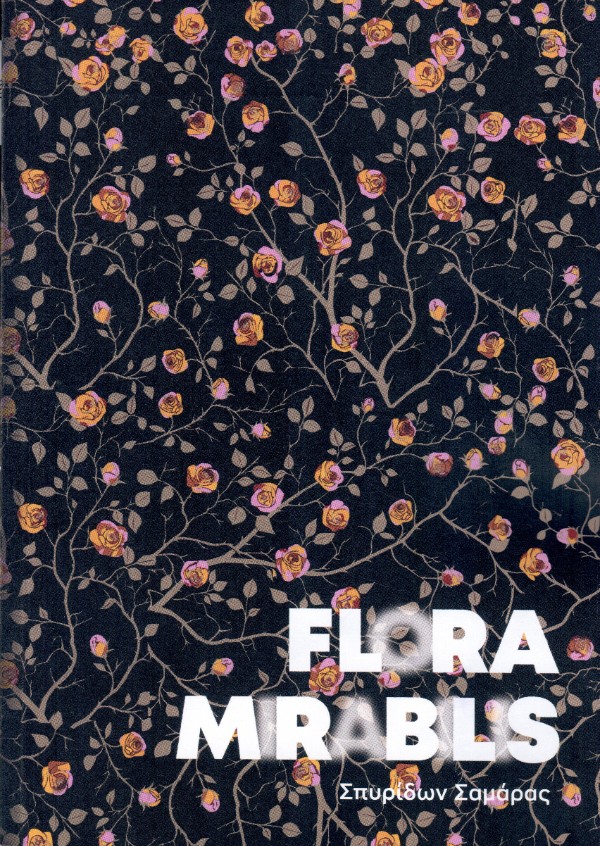
The Programme Book, 2025 (GNO)
The opera was sung in Italian, with surtitles in Greek and English. The Greek translation was based on the verse translation made in 1938 by the Greek scholar and translator Nikolaos Portriotis. Greek audience members were complaining about the archaic nature of the text, and the English wasn’t much better. When’s the last time you saw ‘Prithee’ and ‘anon’ in your modern translation? There were also mistranslations, such as using ‘spouse’ when ‘boyfriend’ was meant. Sitting where I could see both the English and the Greek surtitles, it seems that the Greek was far more dramatic, with frequent appeals to God (Ω Θεέ!) that were missing in the English. It felt like one more edit would have helped everyone.
There are some wonderful musical moments, such as the horn part that opens Act II. The horn melody passes to the woodwinds and then to the rest of the orchestra, but since this is where we should be in the magical garden, it’s perfect music. Some sections sound like trite 19th-century melodies, and at one part in Act II, we could be in any of those French pieces written in the Spanish style, but those points are rare. There is a plus in that Lydia’s mad scene lasts from Act II to Act III, which is far longer than most heroines get to be mad.
It would be wonderful to do this again and do it right. The singers were buried in their scores, rarely looking up. The soprano completely lost her way in Act III but gamely returned for a triumphal ending. The orchestra was too loud, and the conductor needed to go and sit in the hall and actually hear what was going on to tone down the sound. The story isn’t any sillier than any other 19th-century opera and has a great deal of fun built into it. When Valdo falls out of love with Lydia in the middle of their love scene and asks her what she’s doing on his chest, that could be one of the great pre–mad scene moments – far better than a forced marriage and walking down a staircase in a bloody dress with a dripping knife!
Since this was a world premiere of the restored score, there are no recordings, but we can leave you with Samaras’ most famous work, the Olympic hymn, written for the opening of the modern Olympics in Athens, Greece, in 1896.
For more of the best in classical music, sign up for our E-Newsletter