In June 1839, Robert Schumann famously wrote, “All my life I have regarded vocal music as inferior to instrumental music, and have never considered it great art.” Famous indeed, but not his last words on the subject. Only a couple of months later, in February 1840, he writes, “Oh Clara, what bliss it is to write songs. I can’t tell you how easy it has become for me… it is music of an entirely different kind which doesn’t have to pass through the fingers—far more melodious and direct.”
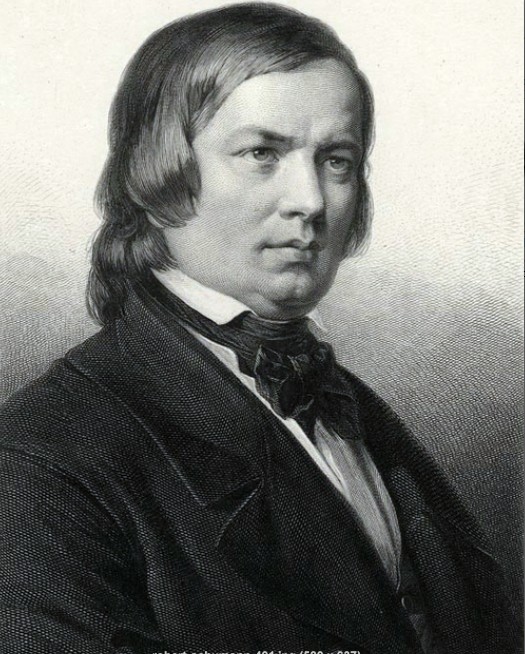
Robert Schumann
The primary catalyst for this significant shift from his earlier focus on piano compositions was undoubtedly Clara Wieck. Schumann had been in a prolonged legal battle with her father, who strongly opposed their union. The emotional intensity of this period, including the anticipation of marriage, also needed financial security.
Schumann needed a reliable source of income, and songs “were readily saleable in a flourishing and lucrative amateur domestic market.” After all, his piano works had acquired a reputation for strangeness and technical difficulty. In the event, during his “Year of Song” in 1840, Schumann composed over 130 songs for voice and piano.
Robert Schumann: Liederkreis, Op. 24, No. 1 “Morgens steh’ ich auf und frage” (Andri Björn Róbertsson, bass-baritone; Ástríður Alda Sigurðardóttir, piano)
Mirrors of the Mind: Heine and Schumann
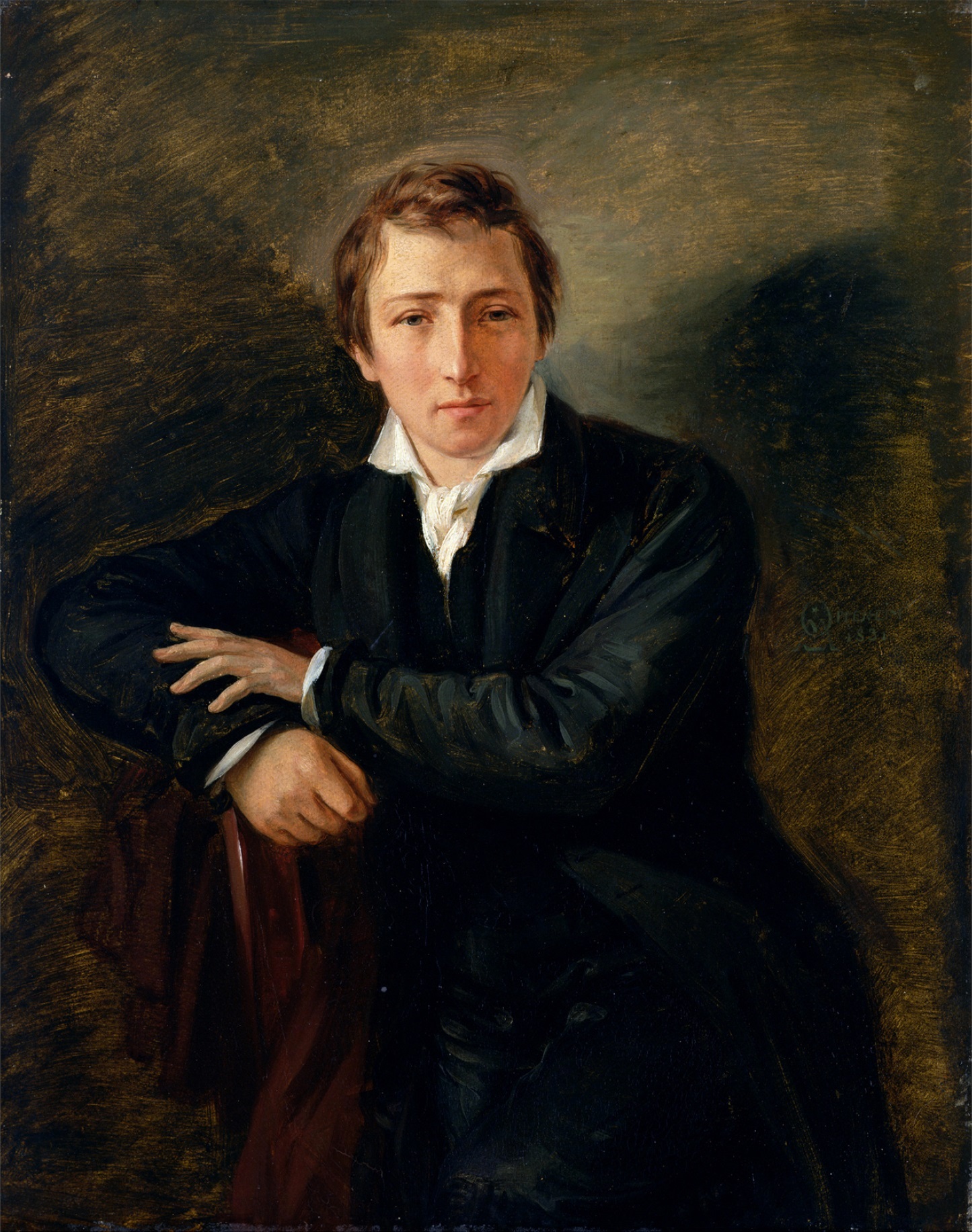
Moritz Daniel Oppenheim: Heinrich Heine
In 1840, Schumann turned most often to poems by Heinrich Heine (1797-1856). Heine’s poetry is characterised by lyrical beauty, psychological intensity, and the distinctive use of romantic irony, that tension between deep feeling and wry detachment. As a literary scholar writes, “Heine’s poetic voice is one of contradiction: yearning and scepticism, sincerity and irony, romanticism and its critique.”
This duality certainly appealed to Schumann, whose own music often straddles the line between emotional vulnerability and structural rigour. As such, Schumann was drawn to Heine’s Buch der Lieder (Book of Songs, 1827), a volume that encapsulated these tensions. The most popular music outcome of his relationship is Dichterliebe, Op. 49, with Schumann’s musical language mirroring Heine’s irony and emotional fluctuation.
Irony meets Romantic Fervour
Schumann’s interest in Heine went beyond textual settings, however. The fragmentary, psychologically nuanced structure of Heine’s poetry influenced Schumann’s broader musical thinking. As John Daverio argues, “Heine’s Lyrisches Intermezzo became a model for Schumann’s own compositional voice: the lyrical self was fractured, dramatised, and made the stage for a kind of inner theatre.”
In Schumann’s settings, the piano often plays the role of an unconscious or secondary narrator, hinting at emotional subtexts that the singer’s voice does not express outright. This technique aligns closely with Heine’s ironic detachment and multi-layered lyricism.
The connection between Heinrich Heine and Robert Schumann is not merely that of poet and composer but of a spiritual and artistic kinship. Schumann found in Heine’s poetry a mirror for his own emotional complexities and an outlet for exploring new musical expressions of psychological depth, irony, and introspection.
Robert Schumann: Liederkreis, Op. 24, No. 2 “Es treibt mich hin” (Andri Björn Róbertsson, bass-baritone; Ástríður Alda Sigurðardóttir, piano)
Liederkreis, Op. 24
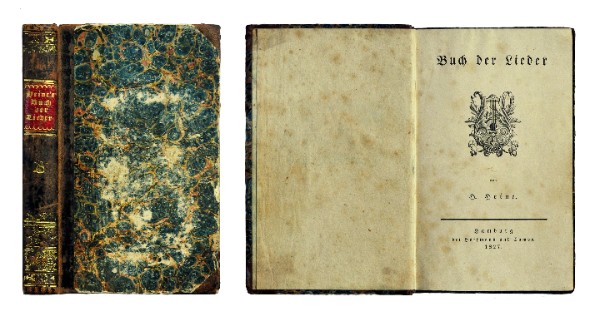
Heinrich Heine: Book of Songs, 1827
In his Liederkreis, Op. 24, composed in 1840, Schumann sets nine poems by Heine from his Junge Leiden collection. One of Schumann’s earliest song cycles, it is a significant contribution to the German Lied tradition, reflecting the romantic ear’s emphasis on emotional depth, introspection, and the fusion of poetry and music.
The cycle traces a loose narrative of love, longing, and eventual resignation, although it is perhaps less tightly structured.
Every morning I awake and ask
Every morning I awake and ask:
Will my sweetheart come today?
Every evening I lie down,
Complaining that she did not appear.
All night long with my grief
I lie sleepless, lie awake;
Dreaming, as if half asleep,
I wander through the day.
English translation © Richard Stokes
The opening poem, “Every morning I awake and ask,” captures the torment of unrequited love through a single day’s emotional cycle. Heine’s text is stark and direct, its simplicity amplifying the speaker’s obsessive longing and inevitable disappointment. The poem’s temporal structure mirrors the relentless repetition of hope and despair, with the speaker’s ritual highlighting the absurdity of the fixation.
Schumann’s musical setting deepens the poem’s emotional weight. The song opens with a gentle, flowing piano prelude, its arpeggiated chords and lilting rhythm evoking the fragile hope of morning. The vocal melody is lyrical yet restrained, with a rising contour that mirrors the speaker’s questioning and a descending line that sinks into despair.
The music turns restless in the night, while the piano’s sparse texture and dynamic shifts amplify the text’s emotional arc. The fading postlude leaves the listener with a sense of unresolved longing, setting the tone for the cycle’s exploration of love and loss.
Robert Schumann: Liederkreis, Op. 24, No. 3 “Ich wandelte unter den Bäumen” (Andri Björn Róbertsson, bass-baritone; Ástríður Alda Sigurðardóttir, piano)
Feverish Joy
I’m driven this way
I’m driven this way, driven that!
A few more hours, and I shall see her,
She, the fairest of the fair—
Faithful heart, why pound so hard?
But the Hours are a lazy breed!
They dawdle along and take their time,
Crawl yawningly on their way—
Get a move on, you lazy breed!
Raging haste drives me onward!
But the Horae can never have loved—
Cruelly and secretly in league,
They spitefully mock a lover’s haste.
English translation © Richard Stokes
Heine’s poem “I ‘m driven that way” portrays a frenzied, almost manic excitement driven by the speaker’s longing to see the beloved. The initial feverish joy is tinged with torment, as the fleeting moments of seeing the beloved only deepen the pain, leaving the speaker restless and unfulfilled. Conveying an obsessive, almost self-destructive passion, Heine’s characteristic irony emerges in the contrast between the speaker’s ecstatic anticipation and the inevitable suffering it brings.
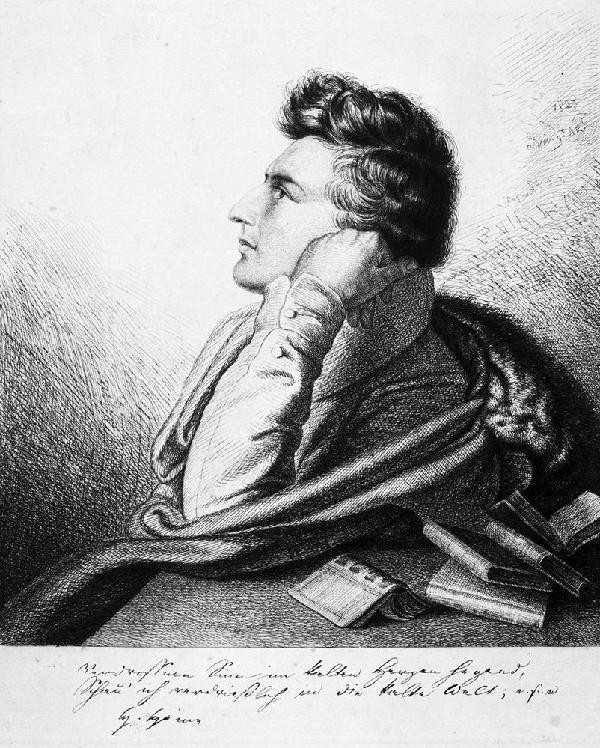
Heinrich Heine
Schumann’s musical setting captures this restless energy with striking intensity. The piano’s relentless, syncopated rhythms and cascading figures evoke a sense of urgency and inner chaos. The vocal line is equally restless, with short, fragmented phrases and rapid melodic leaps that reflect the speaker’s breathless excitement. The song concludes abruptly, with a terse piano postlude that leaves the listener unsettled.
In the context of Liederkreis, this song builds on the longing introduced in the opener. It escalates the emotional stakes from quiet hope and despair to frantic obsession. Schumann’s setting amplifies the text, transforming the poem’s restless energy into a visceral musical experience.
Robert Schumann: Liederkreis, Op. 24, No. 4 “Lieb’ Liebchen, leg’s Händchen auf’s Herze mein” (Andri Björn Róbertsson, bass-baritone; Ástríður Alda Sigurðardóttir, piano)
Romantic Communion
I wandered among the trees
I wandered among the trees,
Alone with my own grief,
But then old dreams returned once more
And stole into my heart.
Who taught you this little word,
You birds up there in the breeze?
Be silent! If my heart hears it,
My pain will return once more.
‘A young woman once passed by,
Who sang it again and again,
And so we birds snatched it up,
That lovely golden word.’
You should not tell me such things,
You little cunning birds,
You thought to steal my grief from me,
But I trust no one now.
English translation © Richard Stokes
“I wandered among the trees” depicts the speaker consumed by melancholy and longing for the unattainable beloved. The natural setting contrasts with the speaker’s inner turmoil, as he grapples with sorrowful thoughts and unanswered questions about their love. The tone is introspective, evoking a romantic communion with nature, as irony discloses the futility of seeking solace in an indifferent world.
The music enhances the poems’ contemplative mood. The piano gently accompanies a smooth and melodic line with almost folk-like simplicity. Schumann uses subtle chromatic touches and harmonic shifts to suggest the undercurrent of pain beneath the serene surface, particularly when the text references the speaker’s unanswered longing. The song ends with a soft, lingering piano postlude, leaving a sense of unresolved melancholy that connects to the broader narrative of the cycle.
The overall cycle has now shifted from frantic obsession to a quieter, more introspective sorrow. Heine’s blend of beauty and pain is crafting a poignant moment of reflection in the cycle’s exploration of unfulfilled love.
For more of the best in classical music, sign up for our E-Newsletter
Robert Schumann: Liederkreis, Op. 24, No. 5 “Schöne Wiege meiner Leiden” (Andri Björn Róbertsson, bass-baritone; Ástríður Alda Sigurðardóttir, piano)