Ten years ago, on 14 March 2016, one of the most significant figures of British postwar music, Sir Peter Maxwell Davies (1934-2016), died of leukaemia at the age of 81. His finest achievements “have a depth of symbolism and historical reference rarely encountered elsewhere in contemporary music.” (Warnaby/Jones, Peter Maxwell Davies)
He composed in a variety of styles and in every important genre, including opera and music theatre, ballet, symphonic works, fifteen concertos, song cycles, full-scale oratorios, music for children and young performers, and an impressive range of chamber works. This includes ten late string quartets commissioned by Naxos.
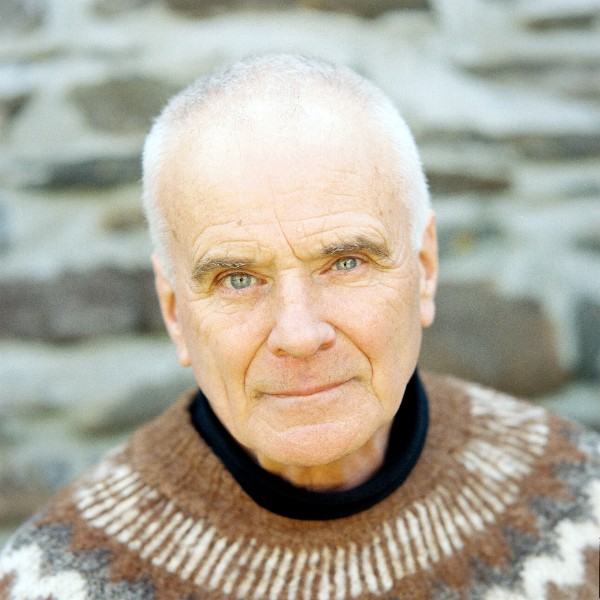
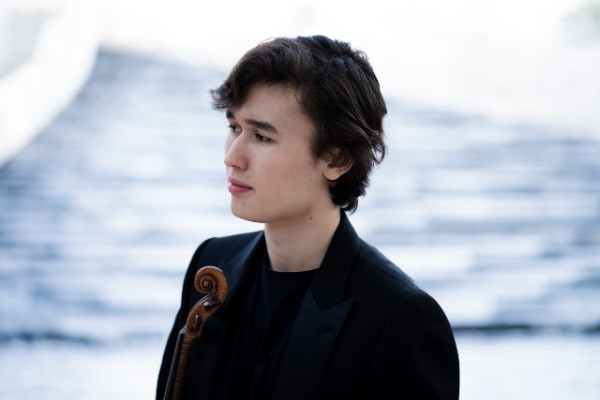
Sir Peter Maxwell Davies © Martin Lengemann
His works range from oft-performed expressionist scores to unfolding orchestral landscapes. “All these works dramatise deep tensions between rationality and instinct, and between institutional authority and the unclouded vision of the lonely creator.” (Hewett, Davies Obituary)
In tribute to his passing, let us briefly look at his life and some of his defining compositions.
Peter Maxwell Davies: Taverner, (excerpts)
Self-Taught Rebel
Peter Maxwell Davies was born on 8 September 1934 in Salford, Greater Manchester. His parents encouraged his musical aptitude, and early piano lessons also produced some juvenilia compositions.
As music was not a recognised academic subject at Leigh Grammar School, he pursued further studies independently, and in 1953, he enrolled for a joint course at the Royal Manchester College of Music and Manchester University.
University lectures failed to keep his attention, but he found his principal stimulus from his association with composers Alexander Goehr, Harrison Birtwistle, and the pianist John Ogdon and trumpeter Elgar Howarth.
This group would later become known as the “Manchester School,” as they shared a passion for medieval and renaissance music, Indian classical music, and the modernist pioneers ranging from Schoenberg to Stockhausen.
Peter Maxwell Davies: 5 Pieces (Ian Pace, piano)
Forging a Philosophy
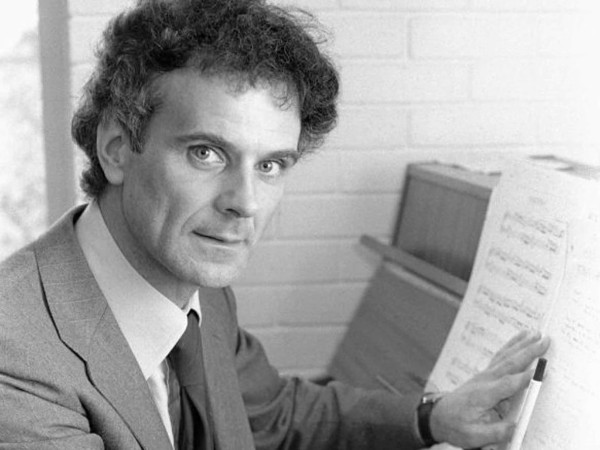
Sir Peter Maxwell Davies
The Trumpet Sonata Op. 1, Five Pieces for Piano Op. 2, and the Clarinet Sonata Op. 4 date from this period. In 1956, Davies also began to draft the libretto and some incipit sketches for his opera Taverner, and he spent a year studying with Goffredo Petrassi in Rome.
Upon his return, Davies became director of music at Cirencester Grammar School during the day, and in the evenings composed “pieces that earned him a reputation as Britain’s angry young man of modern music.” (Hewett, Davies Obituary) As such, he forged a creative philosophy that would define his entire output.
Davies strongly believed that music must be independent of mere stylistic fashion. It requires an authoritative foundation and strict constructive logic to ensure listener comprehension. Yet at the same time, his music fundamentally springs from the melodic line.
His signature sound features tense and highly dissonant contrapuntal strands, with the soundscapes remaining stubbornly linear. Etched with uncompromising directness in bold sonorities, every intervallic friction is laid bare.
Peter Maxwell Davies: Sonata for Trumpet and Piano, Op. 1
Turbulence to Reflection
A scholarship provided the opportunity to study at Princeton between 1962-4, with his principal teachers Sessions and Babbitt introducing him to set theory and the idea of combinatoriality.
Davies completed Taverner in Princeton, and he spent a year teaching at the University of Adelaide. When he founded the “Pierrot Players” with Birtwistle, his career entered its most turbulent phase.
Emotional violence breaks out unconstrained in Taverner and a number of expressionist works. In fact, these works have been described as the most naked revelation of emotional and mental distress in all classical music.
This stylistic upheaval was expressed through violent forms of parody that represented the most radical aspects of European modernism. Davies had come to a point of reckoning, and the “Pierrot Players” were renamed as the “Fires of London.” This group became his main focus for the next 17 years, as his efforts shifted to more reflective song cycles and works for instrumental ensemble.
Peter Maxwell Davies: Eight Songs for a Mad King
Creative Renewal
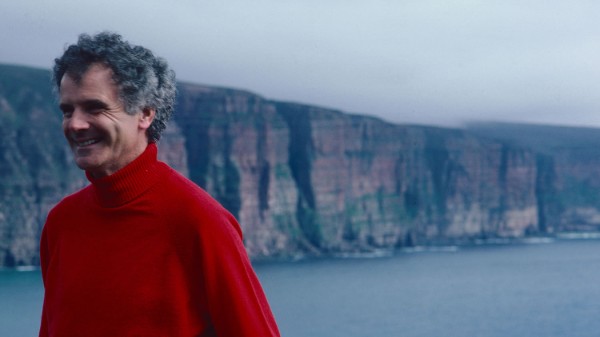
Sir Peter Maxwell Davies on the ferry to Orkney with the cliffs of Hoy pictured in the background
From the early 1970s, Davies spent extended periods in Orkney, eventually making it his permanent home. The elemental land- and seascapes, filtered through the poetry and prose of George Mackay Brown, reshaped Davies’ creative world.
He adopted a more contemplative and detached approach that placed less emphasis on innovation or experimentation. In essence, Davies found a sense of spirituality and historical continuity in his adopted home.
This deliberate anchoring in place, time, and myth offered inspiration and stability. It offered the clarity and timeless resonance that highlighted the stylistic shift from experimentation to meditative maturity.
It also inspired his first foray into the high grounds of the classical tradition, with his First Symphony emerging in 1976. Nine more symphonies would follow in what is described as one of the most significant and ambitious symphonic cycles since Shostakovich.
These works generally embody a Nordic sensibility based on transformational processes. “These processes were associated with pitch material, intervallic contours, and durational values, as well as larger structure.”
“Their influence could extend over the entire work, or over single movements or local events. Contrast was achieved by alternating different types of material, often associated with different magic squares, but equally important was the tension generated by the use of these procedures in the context of allusions to traditional forms.” (Warnaby/Jones, Peter Maxwell Davies)
Peter Maxwell Davies: Symphony No. 1, Op. 71
Extending the Frontier
Peter Maxwell Davies had transitioned from a provocateur to a respected establishment figure. He was active in education and formed conducting ties with the Royal Philharmonic Orchestra and Scottish Chamber Orchestra.
He was knighted in 1987 and appointed president of the Society for the Promotion of New Music in 1995. Davies was appointed Master of the Queen’s Music in 2004, and he spoke out against the erosion of classical music education in schools.
Between 2002 and 2007, Klaus Heymann of Naxos Records commissioned ten string quartets, with Davies issuing them at regular intervals over that period. This process has been likened to 19th-century novelists who would issue a book a chapter at a time.
Written specifically for the Maggini Quartet, these quartets feature purity of expression and intimate directness. “The importance of the Naxos Quartets lies above all in Maxwell Davies’s uncompromising determination to explore and extend musical form, to branch out into new, unexplored territory, and by processes of transformation to lead his music into new and fascinating directions, both melodic and harmonic.” (Dunnett, Peter Maxwell Davies)
Peter Maxwell Davies: Naxos Quartet No. 4, “Children’s Games” (Moderato) (Maggini Quartet, Ensemble)
Reshaping British Music
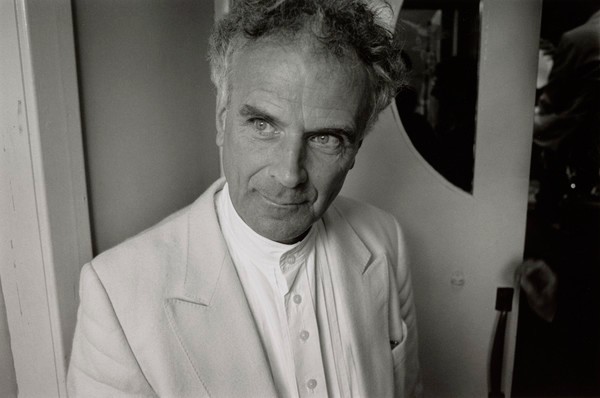
Sir Peter Maxwell Davies
Sir Peter Maxwell Davies left behind a highly significant body of works, comprising nearly 550 compositions. One of the most driven and hard-working composers of all time, he once declared that he would be “happy to be remembered by two tunes and a dictionary footnote.” (Davies, Selected Writings, 2017)
“His works, in spite of their diverse stylistic ‘masks’, display a remarkable technical fluency and underlying continuity, as well as a profound connection to, and engagement with, ‘the past’, which, fluctuating and interacting with the composer’s own predominantly modernist idiom, evokes in the listener a chain of historical resonances.” (Jones, The Man and The Music)
Throughout his professional life, Davies held wide-ranging interests across multiple fields beyond music, including architecture, literature, education, religion, politics and environmental issues. And he was certainly not shy in sharing them with the public.
He spoke Italian and German fluently and was an obsessive reader in these languages, as well as in French and English. Above all, his influence reshaped perceptions of contemporary classical music in Britain and beyond. He remains an inspiration for performers, educators, and listeners alike.
For more of the best in classical music, sign up for our E-Newsletter