Throughout music history, the viola has often been overshadowed by its flashier, smaller sibling, the violin. The viola hasn’t often appeared as a solo instrument, and when it has, its player has usually been a man.
However, not every viola soloist has been male. Over the decades, there have been incredible women violists, too.
Today, we’re looking at seven of the greatest women violists of all time.
Fanny Claus-Prins (1846–1877)
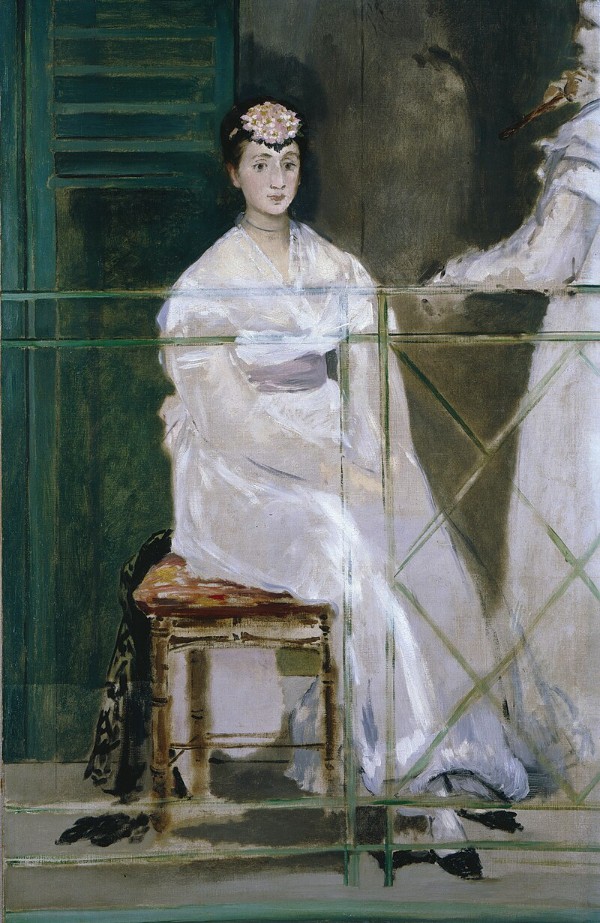
Fanny Claus-Prins
Fanny Claus-Prins was born in Besançon, France, in 1846. She studied at the Paris Conservatoire and graduated in 1863, the year she turned seventeen.
In 1866, at twenty, she founded an all-woman string quartet known as the Sainte-Cécile Quartet. This made her one of the first women violists in the field of chamber music.
However, despite her impressive musical accomplishments, we know Claus best for her appearance in art history.
She was friends with Suzanne Manet, wife of painter Édouard Manet, and a musician in her own right.
Between 1868-69, Claus appeared in Édouard Manet’s painting Le Balcon alongside artists Berthe Morisot and Jean Baptiste Antoine Guillemet.
In 1869, Claus married painter and engraver Pierre Prins, and the following year, she gave birth to a son.
She died of tuberculosis in the spring of 1877. She was just thirty years old. It’s tempting to imagine what else she might have done had she lived longer.
Rebecca Clarke (1886–1979)
Rebecca Clarke’s viola sonata
Rebecca Clarke was born in Harrow, England, in 1886. She began playing the violin and composing as a girl.
She enrolled at the Royal Conservatory of Music in 1903, but her father withdrew her after a harmony teacher proposed to her the year she turned seventeen.
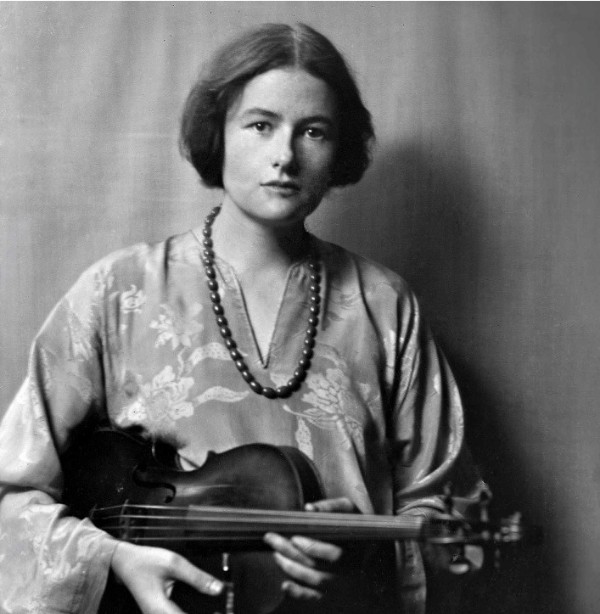
Rebecca Clarke
She then transferred to the Royal College of Music, where her composition teacher, Sir Charles Villiers Stanford, encouraged her to focus on the viola.
She joined the Queen’s Hall Orchestra in London in 1912, becoming one of the first professional female orchestral violists in Britain.
In 1919, she wrote a sonata for the viola. It became canonised by violists after its rediscovery in the 1970s.
Over the next few decades, Clarke traveled the world working as a performing musician. She composed sporadically, but not as often as she had as a younger woman. She struggled with self-esteem, depression, and work-balance issues.
“I can’t [compose] unless it’s the first thing I think of every morning when I wake and the last thing I think of every night before I go to sleep,” she once remarked.
She died in New York City in 1979 at the age of 93.
Lillian Fuchs (1901–1995)
Bach’s Cello Sonata No. 6, Movement 1, played by Lillian Fuchs
Lillian Fuchs was born into a musical family in New York City in 1901. Her brother Joseph became a violinist, and her brother Harry became a cellist.
She started playing piano as a child, then took up violin. She studied with Franz Kneisel, the one-time concertmaster of the Boston Symphony and the celebrated first violinist of the eponymous Kneisel String Quartet.
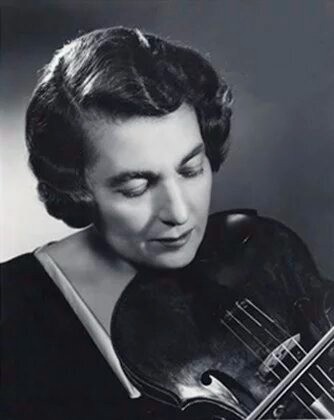
Lillian Fuchs
She made her debut in New York as a violinist in 1926, but, upon Kneisel’s recommendation, began performing on viola instead.
In the 1920s, she became a founding member of the Perolé Quartet, which she played with until 1942.
In 1947, composer Bohuslav Martinů wrote his Madrigals for violin and viola for the Fuchs siblings.
As an adult, she taught at a number of institutions, including Juilliard and the Manhattan School of Music, teaching chamber music to Isaac Stern, Pinchas Zukerman, and others.
Karen Tuttle (1920–2010)
Vaughan Williams’s Suite for Viola and Piano, Movement 1, as played by Karen Tuttle
Karen Tuttle was born in 1920 in Idaho in the United States. Both of her parents were amateur musicians; her father was a fiddler and her mother was a church choir director.
Karen dropped out of school in eighth grade to focus on learning the violin. She began touring the West Coast, but struggled with injury.
When she was 21, she saw violist William Primrose perform in-concert. She was fascinated by his relaxed setup and asked for lessons. He agreed to teach her if she’d switch to viola and enroll at the Curtis Institute.
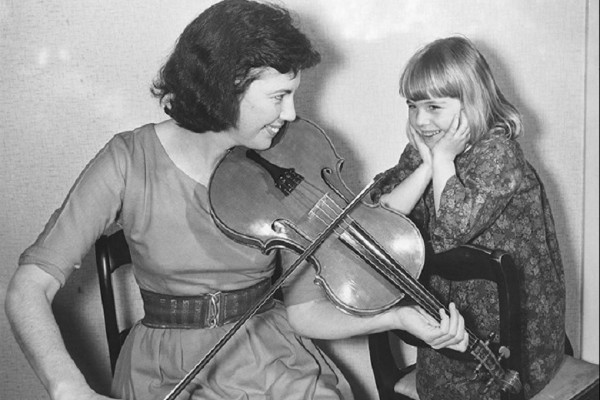
Karen Tuttle
Tuttle studied under Primrose until 1948, eventually becoming his teaching assistant.
After Primrose left the department a few years later, she took it over, teaching there until 1955. She became renowned for her emphasis on a relaxed and efficient setup.
In the 1950s, she became the first woman to join the NBC Symphony Orchestra. She also performed at a number of prestigious venues and festivals, including the Marlboro Music Festival, Pablo Casals Festival, and Carnegie Hall.
She developed an entire technique focusing on creating a relaxed and efficient setup, calling it the Karen Tuttle Coordination Technique. That technique is still taught today.
Her students included viola soloist Kim Kashkashian, as well as a number of the most important viola teachers in America.
She died in 2010 in Philadelphia.
Kim Kashkashian (b. 1952)
Britten’s Lachrymae, as played by Kim Kashkashian
Kim Kashkashian was born in Detroit, Michigan, into an Armenian-American family.
She began playing the violin when she was eight years old, then took up the viola at the Interlochen Arts Academy at the age of twelve.
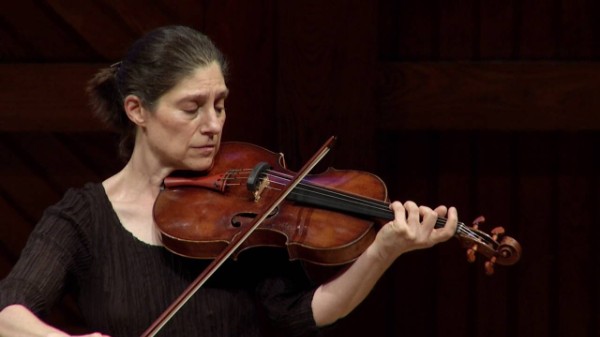
Kim Kashkashian
She went to college at the Peabody Conservatory in Baltimore, studying there with Karen Tuttle between 1970 and 1975.
During the 1980s, she taught at the New School of Music in Philadelphia, the Mannes School of Music in New York, and the Indiana University School of Music.
She has made a career specialising in contemporary music and chamber music.
Cynthia Phelps (b. 1954)
Schubert’s Arpeggione Sonata for Viola and Piano, Mvt. 2, as played by Cynthia Phelps
Cynthia Phelps was born in Los Angeles, California. She began learning the violin at the age of four, but ultimately decided she liked the sound of the viola better, switching instruments when she was eleven.
She earned her bachelor’s degree from the USC Thornton School of Music in 1978 and her master’s degree from the University of Michigan in 1984.
She was named the principal violist of the San Diego Symphony in 1985, then principal violist of the Minnesota Orchestra five months later.
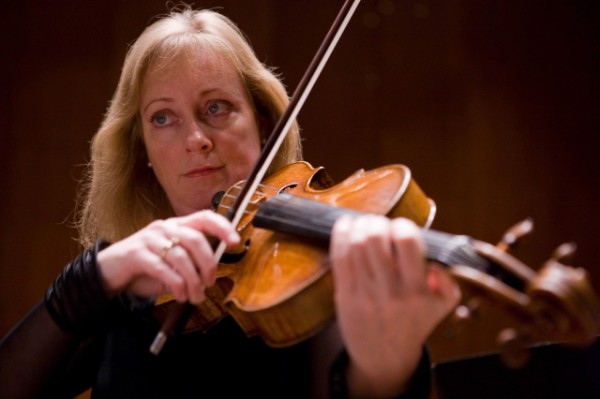
Cynthia Phelps
The New York Times wrote in a 1994 profile that during her time in Minnesota, she often traveled to play solo and chamber music repertoire. But after she had a daughter, she found it difficult to strike a work-life balance.
After seven years in Minnesota, she joined the New York Philharmonic so that she could be on the East Coast and travel less.
She has served as principal viola at the Philharmonic for thirty-plus years.
Tabea Zimmermann (b. 1966)
Bartók’s Bratschenkonzert, as played by Tabea Zimmermann
Tabea Zimmermann was born in Lahr, Germany, near the French and German border.
She began studying viola at the age of three and piano at five. As a teenager, she studied with Ulrich Koch and Sándor Végh.
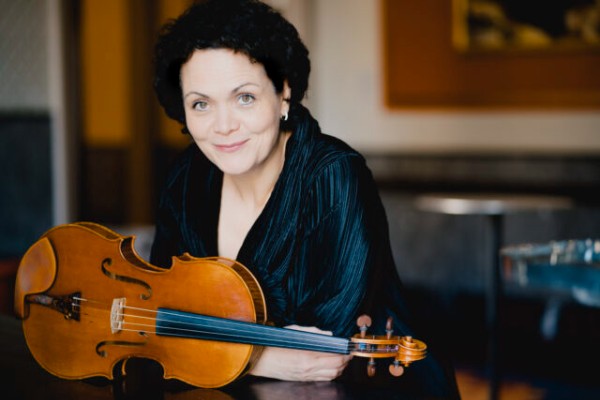
Tabea Zimmermann
She won first prizes at the Geneva International Music Competition in 1982, the Maurice Vieux International Viola Competition in 1983, and the Budapest International Music Competition in 1984.
In 1992, she made her debut with the Berlin Philharmonic.
Another career highlight came in 1994, when she performed Ligeti’s Viola Sonata, which was written for her specifically.
She is widely considered to be one of the greatest – maybe the greatest – violists active today.
Conclusion
Taken together, the trailblazing careers of these women helped to redefine what it means to be a violist.
Whether composing new works, championing contemporary music, or teaching the next generations of players to play without pain or injury, their impact has resonated far beyond the history books and concert hall.
For more of the best in classical music, sign up for our E-Newsletter