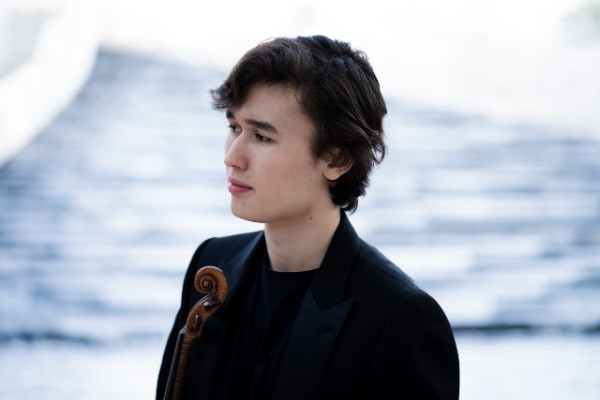
The music of Johann Sebastian Bach has played a central role in the illustrious career of Polish-Hungarian pianist Piotr Anderszewski. Born in Warsaw on 4 April 1969, Anderszewski spent part of his childhood in Paris, and then continued his studies at the Chopin Academy in Warsaw.
Anderszewski made his earliest commercial Bach recording in May 1996. It featured the English Suite No. 6 in D minor, BWV 811, alongside Beethoven’s Piano Sonata Op. 110 and the Variations Op. 27 by Anton Webern.
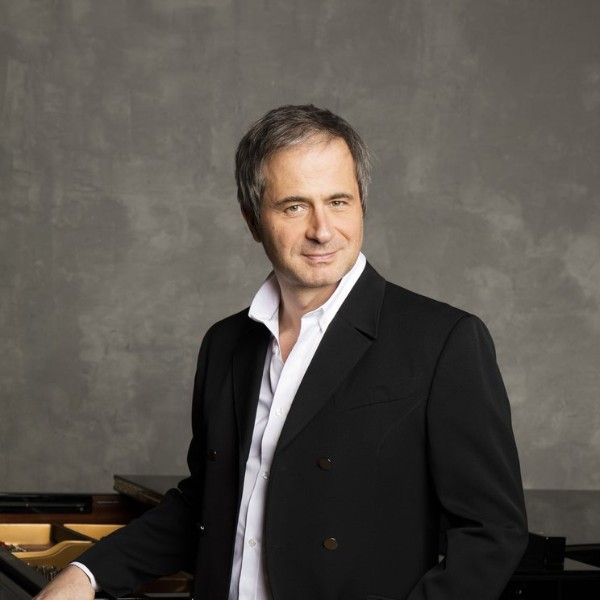
Piotr Anderszewski © Simon Fowler/Warner Classics
Rather than pursuing a strictly historically informed style, Anderszewski performs Bach on a modern piano using the sustaining pedal and freely varying dynamics and speed. To mark his birthday, let us explore some of his intensely personal interpretations of Bach’s keyboard music.
Johann Sebastian Bach: English Suite No. 3 in G Minor, BWV 808 (Piotr Anderszewski, piano)
Humility and Storytelling
Piotr Anderszewski
At the heart of Anderszewski’s interpretation of Bach is humility, curiosity, and a strong sense of storytelling. He describes the process as constantly surprising and precarious, likening it to “balancing on a very fine wire.”
There is no single key to unlock the music of Bach, as interpretation is not a fixed ideal but an ongoing and elusive quest. He has often spoken of retaining “this humility and earnestness in his approach to music.”
As he explained, “in Bach’s music, there is always a story, an emotional narrative. And that narrative changes over time. I had to work to re-appropriate Bach’s 6th Partita, which I hadn’t touched in nearly ten years… So many things happen in the space of a decade. I acquired so much music and so much experience… My point of view changed.” (Anderszewski, iplaythe piano.com)
Anderszewski freely admits that he doesn’t understand some partitas at all. “Partita No. 4, it is impossible; I have no idea what Bach was trying to say… I need a vision from beginning to end… Otherwise, I don’t have the courage to play.” (Anderszewski, ludwig-van.com)
Piotr Anderszewski performs Bach: English Suite No.6 in D minor, BWV 811
Ten Fingers and Many Voices
The challenges of playing Bach are not confined to details of interpretations; they are certainly technical as well. In a video interview for the Elbphilharmonie, he explains the central challenges of polyphony.
“You have three or four voices, but only two hands and only ten fingers. And each one of these voices is a character in its own right… Each voice is like a character, like a person. You have to have all these characters in your hands. It’s quite a challenge, really”
Elbphilharmonie | Piotr Anderszewski über die Herausforderungen in Bachs Musik
Anderszewski has not recorded the complete cycles of the Partitas, English Suites, and there are no commercial recordings of the Goldberg Variations, the Italian Concerto, or the Bach orchestral works beyond isolated live examples.
In the case of the Well-Tempered Clavier, Anderszewski has recorded a personal sequence from Book 2, but not in complete or standard order. Rather, he presents a curated and highly personal journey based on contrast or narrative flow.
Piotr Anderszewski performs Bach: Well-Tempered Clavier, Book 2, “Prelude and Fugue No. 16 in G minor”
Beyond Chromatic Order
As Anderszewski explains in the album notes for his 2021 Warner Classics recording of 12 selected preludes and fugues from Book 2, “I have long wondered to what extent Bach’s Wohltemperiertes Klavier is suitable for the concert platform.”
“Although they were deliberately published in a logical chromatic order, it seems to me that order is not one in which the pieces follow each other with an emotional, musical inevitability.”
“Looking beyond the contrapuntal science they display, I perceive these works as character pieces… I am convinced that in order to reveal all their architectural rigour and beauty, these distinct characters must be carried from the first voice introducing each fugue right through to the end of the piece, as implacably as possible.” (Anderszewski, Warner Classics)
Johann Sebastian Bach: The Well-Tempered Clavier, Book 2, BWV 870-893 (excerpts) – Prelude No. 22 in B-Flat Minor, BWV 891 (Piotr Anderszewski, piano)
Johann Sebastian Bach: The Well-Tempered Clavier, Book 2, BWV 870-893 (excerpts) – Fugue No. 22 in B-Flat Minor, BWV 891 (Piotr Anderszewski, piano)
Sophisticated Dialogue
Piotr Anderszewski
In his Bach interpretations, Piotr Anderszewski avoids dry historicism and overly romantic excesses. Instead, he creates performances that feel like living narratives. While fast movements are full of energy and excitement, slower movements blend expressive subtlety with reverence.
The majority of reviewers praise the lucidity and intelligence of his playing, emphasising his immaculate phrasing and minutely graduated range of tone. Critics agree that Anderszewski invites listeners into a sophisticated conversation with Bach’s music.
For more of the best in classical music, sign up for our E-Newsletter