In January, the Dutch cellist Pieter Wispelwey visited Shanghai and Guangzhou, performing all six of Bach’s Cello Suites. I had the pleasure of speaking with him and attending his Shanghai concerts at the Shanghai Concert Hall. Wispelwey’s interpretation is distinctive for its historically informed approach: a cellist who has recorded three complete sets of the Suites on period instruments, he nevertheless performed this cycle on a modern cello, guided by a strikingly radical “historically informed” mindset—one that may not suit every listener’s taste. For Wispelwey, the goal is not merely to “revive” the composer’s musical ideals by tracing historical origins, but to seek “expression,” and beyond expression. It is, unmistakably, an artistic adventure.
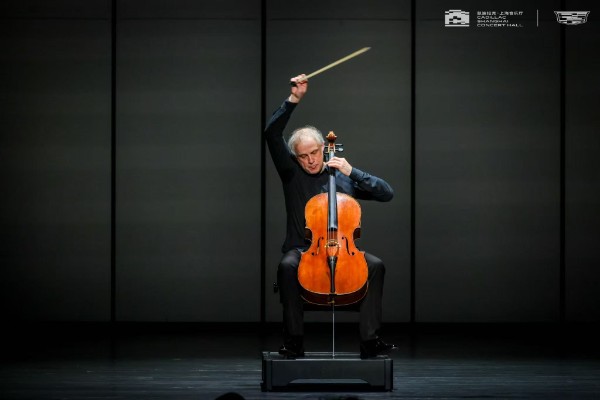
Pieter Wispelwey © Cadillac Shanghai Concert Hall
Bach at Home: Cello Suite No. 1 by Pieter Wispelwey
Unlike most, Wispelwey began learning the cello at the age of eight, on gut strings. His affinity for period instruments dates back to these early years, though he has never confined himself to the label of a “Baroque cellist.” (Indeed, he studied modern cello with Anner Bylsma, who is now primarily known for his early music performances.) For practical reasons, Wispelwey chose not to use period instruments on intercontinental tours: the Sixth Suite requires an additional five-string cello piccolo, which would significantly increase travel costs and logistical complexity. Beginning with a long transatlantic tour some twenty-five years ago, he therefore started performing Bach extensively on modern instruments. By studying the characteristics of period instruments and applying their playing techniques to modern ones, Wispelwey aims to make his interpretations on modern cello “not so remote from the language Bach requires.” As he put it, “After all, the gap between modern and Baroque cellos isn’t as large as that between the keyboards, which are completely different worlds!”
Pieter Wispelwey © Cadillac Shanghai Concert Hall
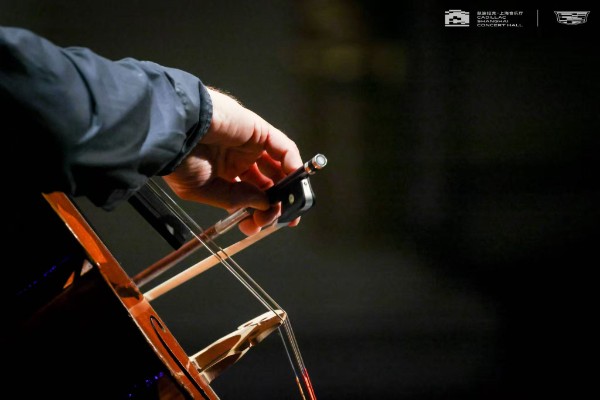
Central to this approach is Wispelwey’s attention to bowing. He pays particular care to imitating Baroque bow technique in order to achieve specific articulation effects—an approach that proved especially striking in his live Bach cycle. “Baroque bows have less hair and are lighter in weight, especially at the tip, allowing for faster bow speed. Gut strings produce rich ‘consonants’; the lively strings screech and scratch, and with the bow, one could therefore own a ‘vocabulary of consonants’. When playing on a modern instrument, one must imitate this to make the strings ‘alive’, so that the sound does not become ‘toothlessly’ smooth and homogenised.”
Johann Sebastian Bach: Cello Suite No. 2 in D Minor, BWV 1008 – III. Courante (Pieter Wispelwey, cello)
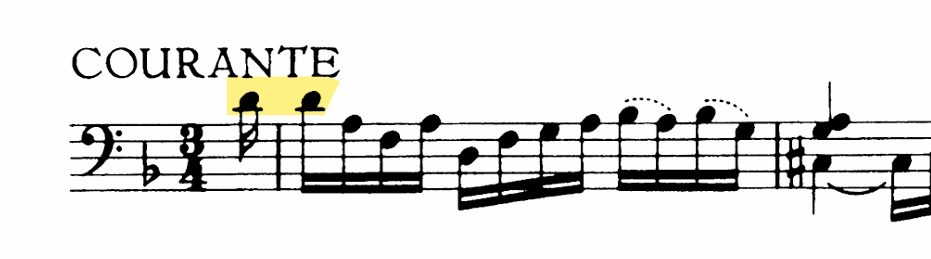
As an example, Wispelwey cited the opening long phrase of the Courante from the Second Suite. It begins with two notes of the same pitch (D4), the second D falling on a downbeat and creating momentum. “This figure needs sparks. On gut strings, this would be an electric moment, but steel strings tend to make things smoother. One must therefore resist that, and challenge the material to make it ‘lively’.”
Johann Sebastian Bach: Cello Suite No. 6 in D Major, BWV 1012 – I. Prélude (Pieter Wispelwey, cello)
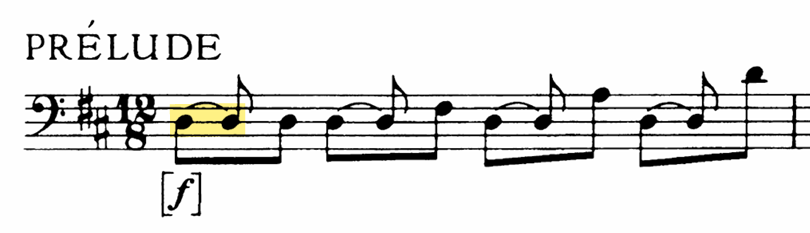
He also mentioned the opening figure of the Prelude from the Sixth Suite, where the cello plays the same pitch (D3) successively with a stopped finger and an open string, the stopped note on a downbeat and the open string on an upbeat, connected by a slur in the score. “How should these two notes ‘speak’? One must decide how much legato to use.” Wispelwey demonstrated various “speech” possibilities by humming the phrase under different articulation approaches. “Although these two notes are ‘the same’, they should not sound the same! There’s so much subtlety and fun in this small figure, if you know how gut strings work.”
Since the early-music revival, historically informed performance has often emphasised the “speech-like” quality of Baroque music. Wispelwey, however, insists on a duality: “Every single note speaks, yet every single note also sings.” While making the instrument “speak” is essential when performing Bach, it is equally important to “play with resonance”—to embrace the sensual warmth produced by the instrument’s natural resonance. “Even in a speech-like movement such as the fugal section in the Prelude of the Fifth Suite, those phrases also need moments of sensual pleasure brought by harmonic resonance and legato. Out of the contrasts between edges and beauty comes the meaning and life of music. If everything is smooth, then there is less expression.”
Johann Sebastian Bach: Cello Suite No. 5 in C Minor, BWV 1011 – I. Prelude (Pieter Wispelwey, baroque cello)
Wispelwey’s first recording of the Cello Suites dates back to 1990, a reading that was already strikingly pungent. After several decades and three complete recordings, he continues to explore ever finer details, probing more deeply into the music’s character. “My interpretation of these works did not undergo a whole lot of changes, because I have held strong convictions about this music very early on. But I try to sharpen my interpretation, and if it is super sharp already, then I modify it: perhaps, to give the music more edges, or to adjust colouring, or to shift the focus of the phrasing… etc.” Such changes, however, are guided by a single overarching principle. Like many of his musician colleagues, Wispelwey has increasingly come to realise that the essence of musical performance lies in “meaning” and “expression.” “Again, looking at the opening of the Courante from the Second Suite as an example, we could add accents, not just for excitement, but because we believe they are important in an expressive way.”
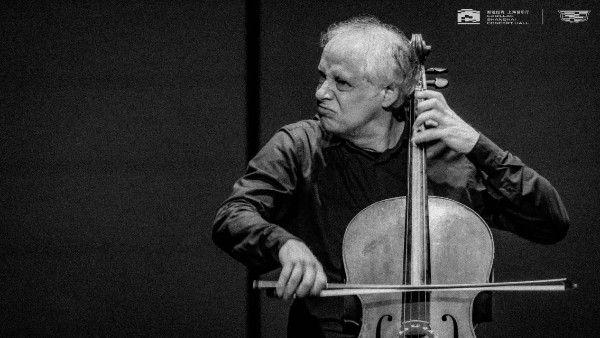
Pieter Wispelwey © Cadillac Shanghai Concert Hall
After Bach, Wispelwey performed movements from Britten’s Cello Suites as encores on two consecutive nights. Yet he does not perceive any strong connection between Britten’s “pseudo-Baroque suites” and Bach’s works beyond form and spirit. During our interview, he told me he had just completed his fourth recording of Britten’s Suites. His deep affection for, and profound knowledge of, these works were unmistakable. “Britten was one of the few performer-composers of the 20th century, with a wealth of legendary recordings. When I play the Britten, I feel that the composer speaks to me directly as a musician: ‘Crescendo here will be good, as I wrote.’ All the musical decisions that shape the interpretation are steered by Britten himself. He puts these simple but very appropriate suggestions in the score, like a lesson in music-making. Britten’s compositional mind was completely lucid and logical.”
Benjamin Britten: Suite for Solo Cello No. 2, Op. 80 (Pieter Wispelwey, cello)
Wispelwey elaborated further: “Like Bach, Britten had the whole Bible in mind while composing, not only for religious reasons, but as a reference to humanity and human suffering. Britten writes all those references directly down on paper.” He spoke with growing intensity about the expressive breadth of the Suites. “I realise more and more the richness of Britten’s suites: there is tenderness, violence, grandeur, and English wit. Different movements require different approaches. The Fugue from the Second Suite is full of pianissimi and pauses, being witty as well as mysterious; the following Scherzo, however, should be played as roughly as possible. The incredible eruption in the second half of the Passacaglia from the Third Suite, where the music becomes seriously tragic, should be played very expressively – I would not call that ‘romantic’. The Lamento from the First Suite is also about this expressiveness, and its phrasing should be in a way like performing Dowland lute song. There are movements where the passion is just huge – the Ciaccona from the Second Suite is a very festive, jubilant piece, and I think the jubilation works best when the articulation is as sharp as possible: it needs to be neat, but done with a lot of enthusiasm.”
Benjamin Britten: Suite for Solo Cello No. 1, Op. 72 – II. Lamento: Lento rubato (Pieter Wispelwey, cello)
Benjamin Britten: Suite for Solo Cello No. 2, Op. 80 – V. Ciaccona: Allegro (Pieter Wispelwey, cello)
Benjamin Britten: Suite for Solo Cello No. 3, Op. 87 – IX. Passacaglia: Lento solenne (Pieter Wispelwey, cello)
Britten’s Cello Suites were all written for Mstislav Rostropovich. Wispelwey, however, stated candidly that he has “never had warm feelings for Rostropovich,” while admitting that he has “always been surprised by Yo-Yo Ma,” whom he regards as a “fabulous musician” with “a big, big force.” A rather unexpected statement, I would say. The musician Wispelwey most admires, as he has repeatedly said in previous interviews, is the baritone Dietrich Fischer-Dieskau. He heard Fischer-Dieskau live five times at the Amsterdam Concertgebouw—experiences that remain, for him, the greatest concerts he has ever encountered. Fischer-Dieskau possessed an extraordinary stage presence, transforming the concert hall into a “spiritual space,” singing as if directly to each individual among the two thousand listeners. “His singing went beyond perfection, and beyond ‘expression’. As a listener, I became speechless.” Wispelwey added: “I have only had that experience with the choreographer Jiří Kylián (former director of the Nederlands Dans Theater). When music, or art, goes beyond its medium, we are uplifted by its greatness.”
For more of the best in classical music, sign up for our E-Newsletter