Who was the first woman conductor?
There are several candidates, but one of the best-known early ones was a woman from present-day Slovakia named Josephine Amann-Weinlich.
Over the course of her brief career, she founded multiple women’s orchestras, toured the world, and engaged in a spirited struggle to be taken seriously as an instrumentalist and a conductor.
Today, we’re looking at the life and career of Josephine Amann-Weinlich.
Josephine Weinlich’s Family
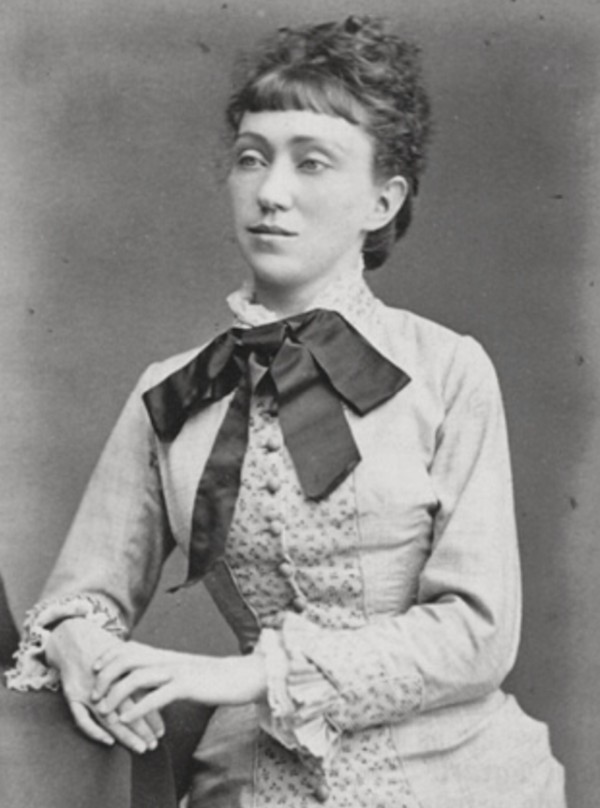
Josephine Weinlich © sophie-drinker-institut.de
Josephine Weinlich was born on 2 August 1848 in the small town of Dechtice in present-day Slovakia.
Her father, Franz, was a formerly wealthy ribbon manufacturer who lost a fortune during the Slovak Uprising of 1848-49.
In addition to Josephine, he had three other daughters: Karoline (born in 1850), Victoria Anna (born in 1852), and Elise (born in 1855).
When his girls were still young, Franz acquired a license that would enable them to perform as a folk music ensemble in Vienna.
Josephine Weinlich’s Early Career
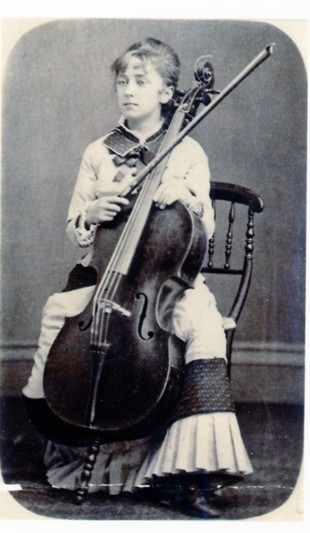
Elise Weinlich © sophie-drinker-institut.de
Josephine’s early musical training remains a mystery. There is no indication that she enrolled at the Vienna Conservatory, and although some sources claim that she studied with Clara Schumann, Josephine never studied in any sustained way with her.
Historians theorise that she may have learned the piano, violin, and other musical skills from her father.
Josephine’s earliest recorded Viennese performance occurred with her family in 1861, the year she turned thirteen.
Two years later, advertisements trumpeting performances by “Franz Weinlich and daughters” began to appear in Viennese newspapers.
In November 1865, the “Neue Fremden-Blatt” noted that the “last appearance of Josephine Weinlich” would take place on the seventeenth. From that point on, she no longer would appear with her family, suggesting some kind of quarrel or falling-out, or perhaps just an independent streak.
As a young adult, she worked with other vocal ensembles at various Viennese venues, albeit briefly.
Creating Her First Ladies’ Orchestra
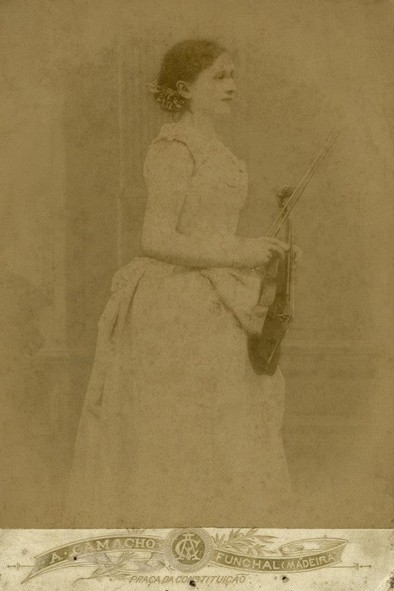
Josephine Weinlich © sophie-drinker-institut.de
Weinlich wanted to lead an ensemble of her own, so in 1867, she founded a ladies’ string quartet.
The group got its start playing private parties and engagements, but she had bigger plans for it. In May, she ran an advertisement searching for additional women musicians to hire:
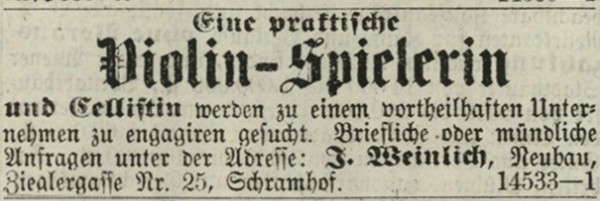
The advertisement © sophie-drinker-institut.de
“Violin player and cellist are sought to be engaged for a profitable venture.”
She found them. In August 1868, the ensemble played its debut performance at a beer hall. Josephine was just nineteen years old.
The press took note of the enterprising teenager. The “Signale für die musikalische Welt” (“Signals for the Musical World”) journal recorded that “A women’s orchestra is now giving concerts in Vienna under the direction of the conductor, Miss Josephine Weinlich.”
The orchestra’s forces were limited. They included three violins, a cello, a flute, a harp, a harmonium, and a piano. Josephine’s sisters, eighteen-year-old Karoline and thirteen-year-old Elise, played the flute and cello, respectively.
But soon other talented young women joined, granting them the valuable – and rare – chance to play orchestral music professionally.
The Orchestra’s First Tours
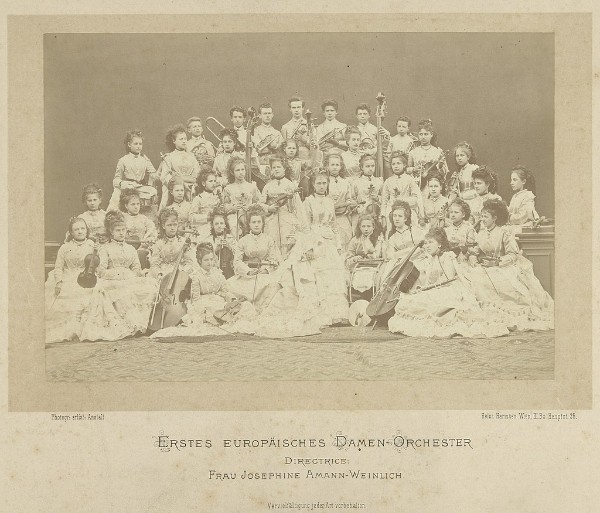
Josephine Weinlich’s orchestra © sophie-drinker-institut.de
In 1869, the orchestra traveled to Pest to perform. In May, they went to St. Petersburg, staying there for several triumphant months.
Both on their way there and on the way back, they performed in a variety of German and Austrian towns. In Prague, even more women joined the group. By the time they returned to Vienna, they had twelve regular members.
The ensemble went through a number of names, but probably the best-known today are the Weinlich’s Damen-Kapelle or the Vienna Women’s Orchestra.
Josephine Weinlich’s Marriage
On 10 January 1870, when she was twenty-one, Josephine Weinlich married Ebo Fortunatus Amann, who was also a musician and conductor.
Most women of the era would have dissolved their orchestra after marriage, or at least handed over control of it to someone else.
However, Weinlich not only stayed involved with the orchestra; she hired her new husband to help manage it.
She also had three children in the 1870s: Ebo, Romeo, and Elsa Antoinette. She took brief breaks to give birth to each, but always returned to the stage soon after.
Interestingly, she did not begin hyphenating her name as Amann-Weinlich until after 1873.
The Orchestra’s American Tour
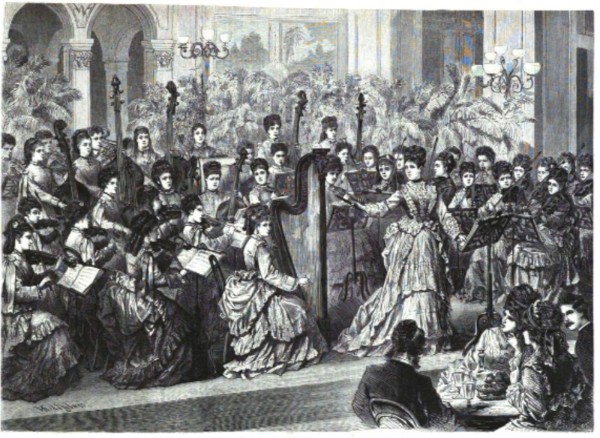
Josephine Weinlich with her orchestra in 1874 © Wikipedia Commons
In the late summer of 1871, Weinlich and the orchestra crossed the Atlantic to tour America.
They appeared at Steinway Hall in New York on 11 September. The orchestra members all wore beautiful white dresses (not even coloured ribbons were allowed in their hair), and they decorated the stage with bowers of flowers.
Reviews on this tour were generally positive, if focused heavily on the aesthetics of the ensemble and Weinlich herself, rather than the performance.
One critic in Brooklyn was at pains to point out that Weinlich became flushed as she conducted.
The New York Herald critic, at least, made an attempt to critique the music-making itself, noting that he missed a brass section.
Unfortunately, toward the end of the year, the orchestra became embroiled in some kind of dispute with their American manager, Frederick Rullmann. The women were forced to return home abruptly…and separately.
Re-forming the Orchestra
Weinlich didn’t let this setback stop her. After she returned to Vienna, she began advertising again for more women musicians to start a second orchestra.
“Miss Weinlich wants to increase the number of women to 42, a number that will enable her to compete successfully with our best men’s bands,” reported the Morgen-Post in December 1872.
A reconstituted orchestra appeared in 1873. Apparently, Weinlich agreed with the New York critic who had criticised the ensemble’s balance, because this new incarnation had thirty-three women musicians, along with seven boys who played clarinet, trumpet, trombone, and horn.
Weinlich also continued to grow as a conductor. There are multiple reviews from 1873 that praise her ability to handle her larger forces.
“Her glance is comprehensive, her arm vigorous; she knows all the music by heart…and conducts from memory,” The Musical Standard reported in 1873.
A Shot at Seriousness
The orchestra initially specialised in light music, like Strauss waltzes and other Viennese musical confections (including dance music by Weinlich herself).
Weinlich’s “Freie Gedanken” (“Free Thoughts”)
Freie Gedanken (Free Thoughts), Josefine Weinlich – Esther Abrami & Her Ensemble @ SCL Festival
However, in the 1870s, Weinlich became more and more interested in being seen as a serious musician heading a serious ensemble.
She even booked a concert at the Great Hall of the Musikverein: a very different stage from the beer hall ones she had begun her career on.
She was hampered in her attempt at seriousness by critics’ and audiences’ continued obsession with her and her musicians’ looks.
“Her swelling lips tenderly press the ‘mouth hole’ of the flute against her, but they spurn the attempt to coax the natural and ‘stifled’ tones out of the French horn with terrible gestures,” wrote the Neue Freie Presse in May 1873. (This same reviewer also referred to Weinlich herself as a “watchful housewife, excuse me, Director.”)
As long as the orchestra was a small novelty ensemble devoted primarily to dance music, reviews had been polite and even encouraging. However, the moment that Weinlich attempted to grow her orchestra in any way, the critics were always at hand to cut it down to size.
The Orchestra Fails, Again
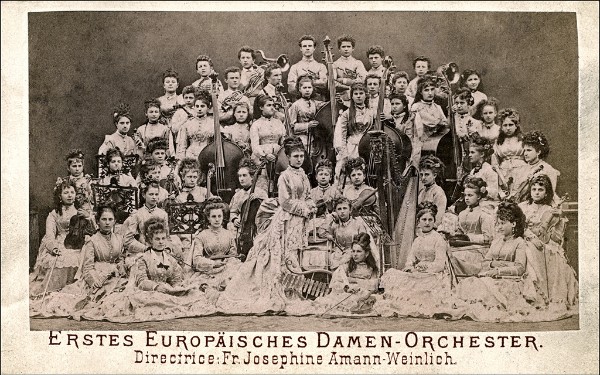
Josephine Weinlich’s orchestra © sophie-drinker-institut.de
Despite the new onslaught of criticism, the orchestra continued playing. They appeared at the Vienna World’s Fair over the summer of 1873.
After that, they made a series of appearances across Europe until the end of 1876, when the orchestra dissolved yet again.
Die Presse reported in December 1876 that Weinlich “no longer wanted to take part.” Apparently, the ladies’ famous white wardrobe had been pawned during a stop in Hanover.
At this time, Weinlich had a nineteen-month-old son and a seven-month-old daughter; perhaps this contributed to her inability to continue overseeing a major orchestra tour.
Cäcilien Quartet
However, she was unable to stay away from the stage for long.
By February 1878, she founded the Cäcilien Quartet, made up of members from the women’s orchestra, with her sister Elise on cello.
This quartet played “serious” music by Schumann and Mendelssohn, as well as works by Weinlich herself.
Unfortunately, the quartet was unable to sell enough tickets to justify its existence, and it too disbanded.
Life in Lisbon
By the end of 1878, Weinlich and her family (including her cellist sister Elise) left Vienna for Spain.
In 1879, they moved to Lisbon. Ebo began working at the opera, while Weinlich took up a conducting position with the municipal orchestra.
This is an interesting prospect to consider, as the orchestra would have been made of men, and the culture of the time would have made the idea of a woman conducting an all-male orchestra a laughable idea.
Unsurprisingly, she did not keep the job for long. More research needs to be done on the nature of her employment there.
After 1879, she appeared there as a guest conductor, while focusing primarily on a more traditional woman’s career: that of piano teacher.
In 1880, the supplies of the women’s orchestra – music stands, basses, drums, and sheet music collection – were auctioned off, presumably to pay off debts. The women’s orchestra days were officially over.
Her Final Role: Editor for the Musical Gazette
Her performance days might have been behind her, but she still wanted to be involved in the musical world.
Between 1884 and 1886, she began editing and publishing a music magazine called “Gazeta Musical: Jornal Illustrado, Theatros Musica e Bellas-Artes” (“Musical Gazette: Illustrated Newspaper, Music Theaters and Fine Arts”).
It is tempting to imagine what she might have accomplished had she lived longer. However, tragically, she fell ill with tuberculosis, and she died in January 1887 at the age of thirty-eight.
Josephine Amann-Weinlich’s Long-Lasting Legacy
Although largely forgotten today, Josephine Amann-Weinlich helped set the stage for the rise of both women orchestral musicians and women conductors.
By initially focusing on stereotypically feminine concerns – like her orchestra’s wardrobe, the flowery stage decorations, and her players’ youth and sex appeal – she had gently eased audiences across Europe and America into the idea of seeing women performing orchestral music…and later, the idea of women performing orchestral music with men.
Without this shift, our modern orchestras would look very different, and the lives of countless musicians and listeners would be the poorer for it.
For more of the best in classical music, sign up for our E-Newsletter