In the summer of 1976, the Bayreuth Festspielhaus, the cathedral of sound built by Richard Wagner himself, witnessed something extraordinary. The Green Hill had crowned Germanic sopranos for a century, including Lilli Lehmann, Kirsten Flagstad, and Astrid Varnay.
And then the daughter of a Welsh miner strode onto the stage as Brünnhilde. Dame Gwyneth Jones did not merely sing the Valkyrie; she detonated the myth that Wagner’s heroines required Teutonic blood to ignite.
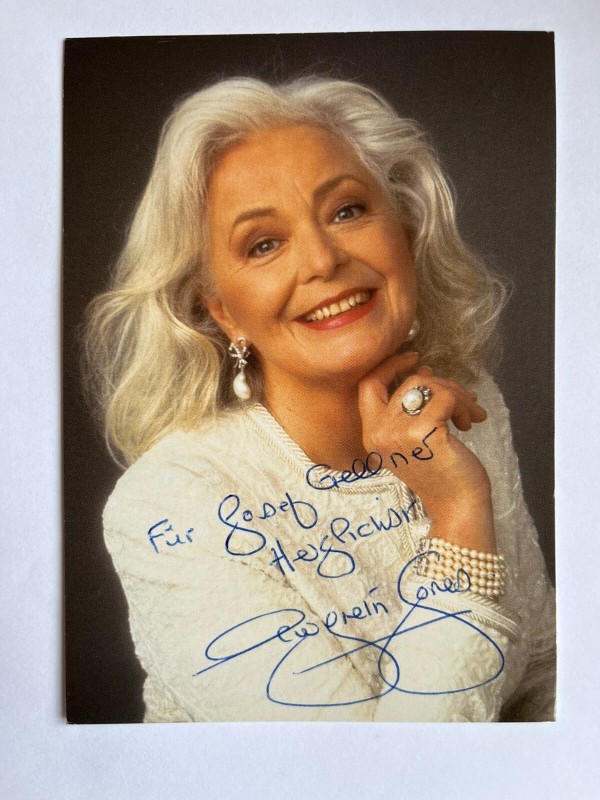
Gwyneth Jones
To celebrate her birthday on 7 November 1936, let’s have a look at how Jones shattered the glass ceiling by rewriting the rules to become opera’s ultimate rebel.
Gwyneth Jones sings Wagner: Twilights of the Gods, “Immolation Scene”
Defying the Wagnerian Bloodline
Richard Wagner himself fed the legend of the Wagnerian bloodline. In Opera and Drama of 1851, he insisted that only native speakers could embody his mythic roles. Herbert von Karajan agreed, and when he first heard the 25-year-old Jones in a Cardiff audition, he reportedly muttered, “Too British for Brünnhilde.”
However, Jones possessed a laser-focused dramatic soprano with a mezzo warmth in the middle and a top that crackled like lightning. Bloodline, as it turned out, was negotiable.
Her breakthrough arrived in 1966 at the Vienna State Opera. Wolfgang Sawallisch, risking scandal, cast the unknown Welshwoman opposite Birgit Nilsson’s Isolde in Tristan. Critics expected a footnote but witnessed a revelation.
Richard Wagner: Tristan und Isolde (excerpts) – Act III: Mild und leise, “Liebestod” (Gwyneth Jones, soprano; West German Radio Symphony Orchestra; Roberto Paternostro, cond.)
Centenary Ring at Bayreuth
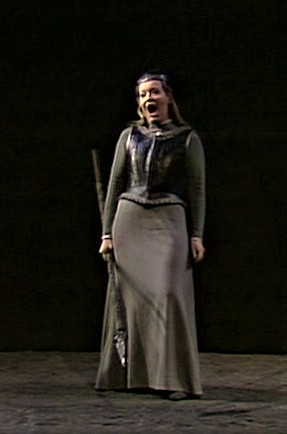
Gwyneth Jones as Brünnhilde in 1980
Bayreuth in the 1970s was less a festival than a fortress. The centenary Ring, directed by Patrice Chéreau and conducted by Pierre Boulez, aimed to drag Wagner into the industrial age, with smokestacks replacing Valhalla’s rainbow bridge. And Jones, at 39, became the production’s beating heart.
Rehearsals were brutal as Chéreau demanded that Brünnhilde crawl through ash in the Immolation Scene. Boulez insisted every orchestral swell be answered by vocal colour, not volume, and Jones delivered both.
The opening night of Die Walküre on 26 July 1976 remains legendary. Critics who had predicted a “foreign” accent heard instead a universal cry of rebirth. The Frankfurter Allgemeine declared, “The Welshwoman has conquered the Green Hill without a single German vowel in her arsenal.”
Richard Wagner: Die Walküre – Act II Scene 4: Siegmund! Sieh auf mich! (Brünnhilde, Siegmund) (Gwyneth Jones, soprano; Peter Hofmann, tenor; Bayreuth Festival Orchestra; Pierre Boulez, cond.)
Richard Wagner: Die Walküre – Act II Scene 4: Du sahest der Walküre sehrenden Blick (Brünnhilde) (Gwyneth Jones, soprano; Peter Hofmann, tenor; Bayreuth Festival Orchestra; Pierre Boulez, cond.)
Smashing Opera’s Glass Ceiling
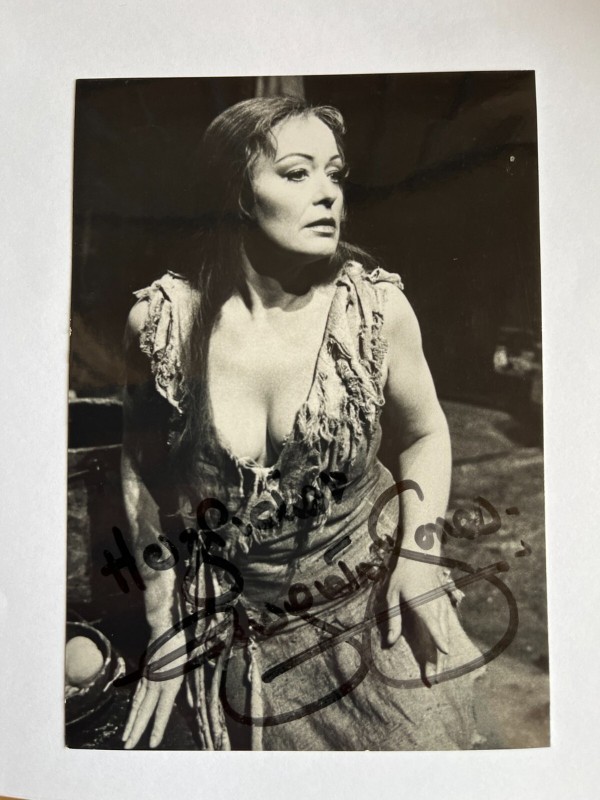
Gwyneth Jones
Artistic triumph, however, was only half the battle. The 1960s opera world remained a gentleman’s club. Female singers were expected to smile through sexist staging, accept lower fees, and endure conductors’ wandering hands. Jones refused.
Jones walked out mid-rehearsal during a Covent Garden Don Giovanni, and the Royal Opera quietly raised her fee to match her male co-star. Word spread, and younger sopranos like Hildegard Behrens and Jeannine Altmeyer cited Jones as the first to weaponise “no.”
When Deutsche Grammophon proposed a Ring studio recording in 1975, the label wanted an all-Germanic cast. Jones threatened to withdraw unless the Valkyries reflected the modern world. The resulting ensemble included Swedish, American, and British voices, and the set sold 400,000 copies.
Gwyneth Jones sings Wagner: The Valkyrie “Act III excerpt”
Kicking Down Valhalla’s Gates
Most dramatic sopranos flame out by 50, but Jones’ burned brighter. She sang “Senta” at Bayreuth in 1982 and subsequent Ring Cycles at the Met under James Levine. Critics noted the voice had settled lower, the middle register now a burnished mahogany. Yet the top still flashed with the clarity of her thirties.
Her final Brünnhilde came in 2006 at the Royal Opera House, aged 69. The production was minimalist, with a bare stage and a single spotlight. The audience ovation lasted fourteen minutes, and roses carpeted the stage ankle-deep.
Today, Wagner casting sheets read like the United Nations. Every non-Germanic Brünnhilde owes a debt to the Welsh pioneer who proved that fire needs no passport. Masterclasses now study her 1976 Bayreuth footage frame by frame to trace the arc from defiance to tenderness.
Jones did not ask permission to enter Wagner’s Valhalla. She simply kicked the gates off their hinges and invited every woman to follow.
For more of the best in classical music, sign up for our E-Newsletter