In a piano sonata for four hands dedicated to her father, American composer Judith Lang Zaimont (b. 1945) created a dance world of the US from over a century of music.
In her youth, she studied with Rosina Lhevinne at Juilliard Preparatory from the age of 13. Still a teenager, she and her younger sister Doris became a professional duo-piano team and toured the US, performing on stage and on radio.
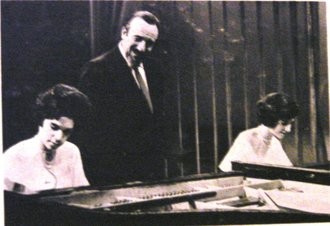
Judith (l) and Doris (r) with TV presenter Mitch Miller
Starting at age 11, Judith was also a composer and won composition competitions from age 12.
Doris went on to become an opera conductor and was appointed Artistic Director of Opera Connecticut in 2005.
Judith graduated from Queen’s College, CUNY, and went on to attend Columbia University, studying with Otto Luening and Jack Beeson. In 1971, she was awarded the Debussy Fellowship of the Alliance Française for a year’s study of Orchestration with André Jolivet in Paris (1971-72).
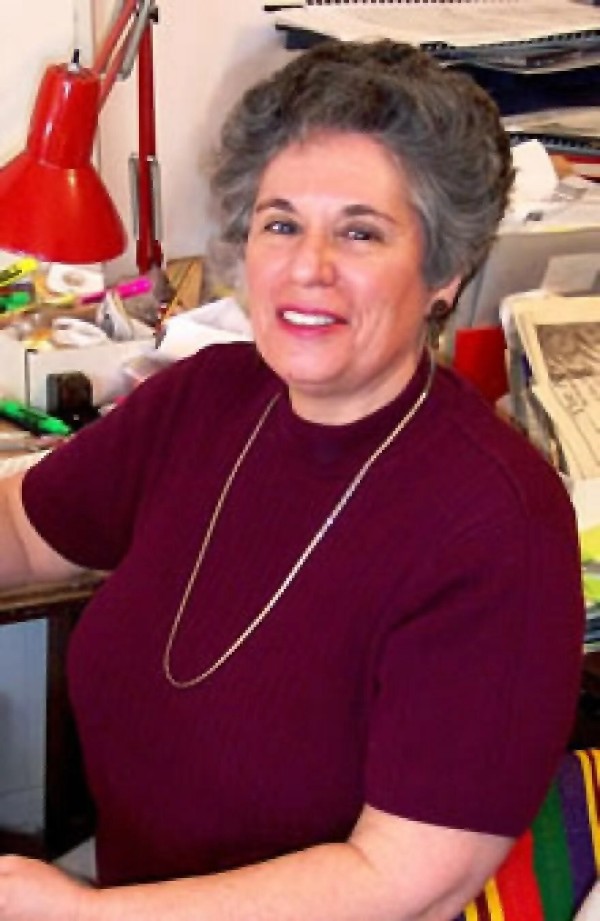
Judith Lang Zaimont
It was during her study years in Paris that she created her piano sonata for piano four-hands. Her homesickness was cured by creating a piece of what she calls ‘American parlour music’, to be played with her sister Doris. They were no longer a piano duo, but who would be the better partner? The work is dedicated to their father, who ‘enjoyed and danced to music like this in his younger years’.
In her Snazzy Sonata, Zaimont followed standard sonata structure: Sonata-Allegro first movement, a song-form second movement, scherzo and trio, and a sonata-form last movement. At the same time, she wanted each movement to reflect a different decade of dance music.
The first movement starts us off in the 1920s with a two-step that’s very close to ragtime.
Judith Lang Zaimont: Snazzy Sonata – I. Moderate Two-Step (Judith Lang Zaimont, piano; Doris L. Kosloff, piano)
Jumping forward to the 1930s, a languorous melody in the beguine rhythm. Like a slow rhumba, the dance form came from the islands of Guadeloupe and Martinique. The dance was popularised when Cole Porter’s 1935 song ‘Begin the Beguine’ became a hit.
Because of their long experience as duo-pianists, Zaimont included passages where the two players’ hands have to cross over and under for some added flair.
Judith Lang Zaimont: Snazzy Sonata – II. Lazy Beguine (Judith Lang Zaimont, piano; Doris L. Kosloff, piano)
The Bebop movement takes us to the 1940s. A syncopated scherzo and a walking bass trio combine to put us firmly in the jazz era.
Judith Lang Zaimont: Snazzy Sonata – III. Bebop scherzo (Judith Lang Zaimont, piano; Doris L. Kosloff, piano)
The final movement, despite its rather 19th-century title, is more like the overture to a Broadway musical: connected musical sections that lead us through the storyline of what’s to come. The waltz rhythm sweeps us along with quotations from Tchaikovsky’s Waltz of the Flowers from The Nutcracker and from Harry Dacre’s Daisy Bell (Bicycle Built for Two).
Judith Lang Zaimont: Snazzy Sonata – IV. Grand valse brillante (Judith Lang Zaimont, piano; Doris L. Kosloff, piano)
In her work for a piano built for two, Zaimont gives us an infectious musical tour that covers decades of dance music and musical styles. It’s wonderful to hear a performer with such knowledge of four-hand piano music let loose!
For more of the best in classical music, sign up for our E-Newsletter