Music lovers aren’t very familiar with her name, but Countess Anna Maria Erdődy was one of the most devoted and influential patrons in Ludwig van Beethoven’s life.
Today, we’re looking at the countess’s early (doomed) marriage, the health troubles that plagued her, her devotion to Beethoven’s music, the masterworks she inspired, and how she impacted Beethoven’s decision to remain in Vienna, where he wrote his greatest works.
Anna Maria Erdődy’s Early Life and Marriage
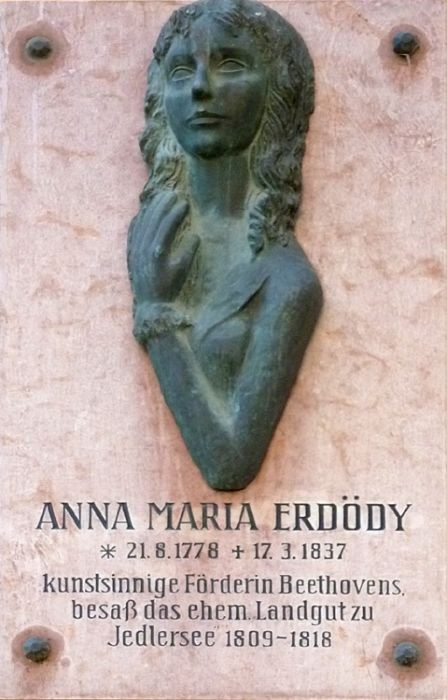
Countess Anna Maria Erdődy
Anna Maria Erdődy was born Anna Maria von Niczky on 8 September 1779 in the town of Arad, which is in Romania today, but was in the Kingdom of Hungary then. She went by the first name of Marie.
We don’t know for sure, but it seems almost certain that she studied music as a child, given her later fluency at the piano.
On 6 June 1796, at the age of sixteen, she married 25-year-old Count Péter Erdődy. The marriage made her a countess.
The couple had three children together: Marie in 1799, Friederike in 1801, and Auguste in 1802.
Unfortunately, the countess suffered some health crisis after her first pregnancy. It impaired her mobility and made her feet swell, and she spent a great deal of time in bed.
When she did manage to move around, she would shuffle from piano to piano in her drawing room.
Moving to Vienna and Meeting Beethoven
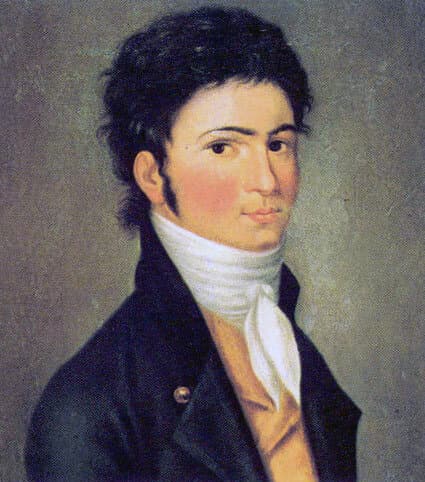
Beethoven as a teenager
Around 1803, when she was in her mid-twenties, the couple moved to Vienna. It seems likely that she made Beethoven’s acquaintance around this time.
She found great solace and escape in Beethoven’s music. One observer wrote about how attentively she would listen when Beethoven played or improvised at her salons.
Johann Friedrich Reichardt wrote a letter describing the countess as a “very small, pretty, delicate lady” with a warm and friendly personality, despite her health troubles.
By 1805, her marriage had fallen apart, and her husband left her, possibly due to her health troubles. She began living apart from the count.
She would eventually create a household with Johann Xaver Brauchle, a man four years her junior who worked as her secretary and the music teacher of her children.
Beethoven Moving In, and How She Kept Him in Vienna
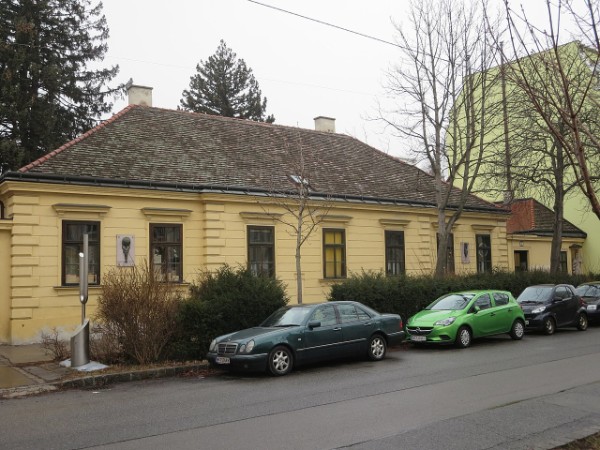
Countess Anna Maria Erdődy’s summer house
In 1808, Beethoven, who was always moving from apartment to apartment, moved into an extra suite of rooms in the countess’s mansion on the Krugerstrasse in Vienna.
Although no evidence exists that his relationship with her was ever romantic, he clearly felt emotionally close to her, going so far as to nickname her his “Beichtvater” (i.e., “Father Confessor”).
However, their happy arrangement was threatened in the autumn of 1808. Jérôme Bonaparte, Napoleon’s brother, asked Beethoven to take a job as Kapellmeister in the town of Cassel, Germany.
This position would remove the financial uncertainty that was part of working as a freelance musician in Vienna.
However, a few members of the Viennese aristocracy hated the idea of Beethoven leaving for provincial Cassel. Several joined forces to formally offer him 4000 florins a year to stay in Vienna and continue performing and composing for them. The countess helped make the arrangement.
It’s a long story as to what ultimately happened with that collection, but it did ultimately keep him from leaving Vienna.
Read more about his time living in the countess’s home: “Krugerstraße 10”.
A Quarrel and the Ghost Trio
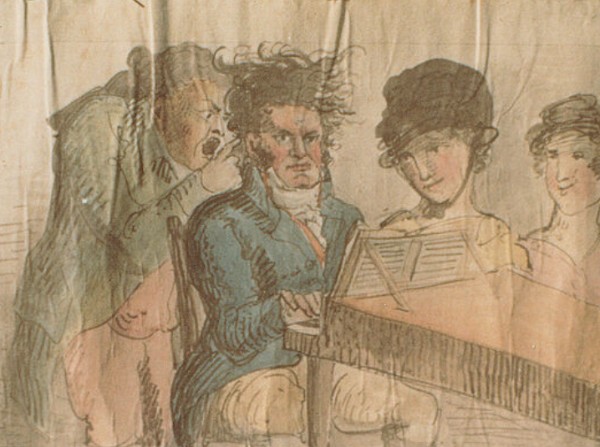
Ludwig van Beethoven, Countess Anna Maria Erdődy and Dorothea von Ertmann
Their friendship was strained in early 1809 when Beethoven became embroiled in drama surrounding the servants in her household. He ended up moving out.
Despite any quarrel they may have had, he still clearly appreciated and respected her, because that summer he published two piano trios (his op. 70) that had been written while staying with her.
The first piano trio is known today as the Ghost Trio, one of the most popular piano trios ever written.
Beethoven’s Piano Trio, Op. 70, no. 1
The second has no nickname, but is known for its second movement allegretto in double variation form.
Beethoven’s Piano Trio, Op. 70, No. 2
A Reunion and the Cello Sonatas
It appears that they may have fallen somewhat out of touch between 1810 and 1815. It’s unclear whether the servant situation or another conflict led to the breach.
However, in 1815, they renewed their correspondence, and Beethoven came to visit her at her villa.
It is believed that he wrote his fourth and fifth cello sonatas there, works that he ended up dedicating to her.
Beethoven’s Cello Sonata No. 4
Although the roles of the instruments in sonatas were evolving around this time, in Beethoven’s day, these were described as sonatas for piano and cello, not the other way around. Dedicating the sonatas to the countess can be read as evidence of Beethoven’s regard for her as both a patron and a pianist.
It is believed the cello part was meant for Joseph Linke, who worked as a tutor to the Erdődy children.
These works were first published in 1817 without a dedication, but when a second edition appeared in 1819, they were both dedicated to the countess.
Beethoven’s Cello Sonata No. 5
Tragedy and Legal Struggles
Tragedy struck in the late 1810s. The countess’s youngest son, Auguste, died in 1816, and his older brother, Friederike, died in 1819.
Beethoven offered his heartfelt condolences in a letter. For New Year’s 1820, he sent a brief and playful New Year’s Canon – now known as the “Glück zum neuen Jahr” (“Happy New Year”), WoO 176 – and sent it to her.
Beethoven’s Glück zum neuen Jahr (Happy New Year), WoO 176
It appears that some scandal occurred in 1820, when the countess and Brauchle were accused of physically abusing her daughter, Marie. From there, a police investigation was apparently carried out, and shockingly, questions were raised about how Auguste had died.
Some historians have theorised that the countess’s sister-in-law may have launched a baseless attack, attempting to lure the countess’s daughter Marie into a marriage with her son, and the countess’s love interest Johann Xaver Brauchle into a relationship with her.
In 1820, the countess left Vienna, either because she was banished by authorities or because she wanted to get away from the gossip.
She relocated to Munich, and Johann Xaver Brauchle followed her.
Her Death and the Fate of Her Beethoven Letters
In 1824, Johann Xaver Brauchle married a much younger woman named Elise Dressler, who was a harpist and music teacher.
Beethoven died in 1827. No letters survive to the countess after her move to Munich.
As for the countess, she died in 1837 at the age of 58.
She left her Beethoven correspondence to Brauchle. Unfortunately, in 1838, Brauchle died, too, and his young widow, Elise, ended up with custody of the letters. Elise later claimed she had burned them.
Luckily, copies had been made and were circulated among early Beethoven scholars. They’ve been passed down from generation to generation ever since, along with the compositions she helped inspire.
For more of the best in classical music, sign up for our E-Newsletter