Did you know there is an amazing one-of-a-kind museum in Shanghai, China? The museum, located in Hongkou, is the historical site where European Jews took refuge during World War II. The exhibits highlight the Jewish refugee experience as well as daily interactions with their Chinese neighbours, each helping the other through adversity.
Established in 2007, the former synagogue in Shanghai, Ohel Moshe Synagogue, was converted into the Shanghai Jewish Refugees Museum. After an ambitious three-year expansion and renovation project, the museum reopened in December 2020. Through advanced technology, visitors can experience the history of Jewish refugees in Shanghai. Within their 4,000-square-meter space, the museum boasts scenario reconstruction, interactive multimedia, innovative displays, and houses 1,000 exhibits, including artefacts such as a wedding dress, wedding certificates, travel documents, work permits, and video and personal testimonies. It also features a section about how Jewish classical musicians brought classical music to Shanghai, fostering a new generation of Chinese classical musicians.
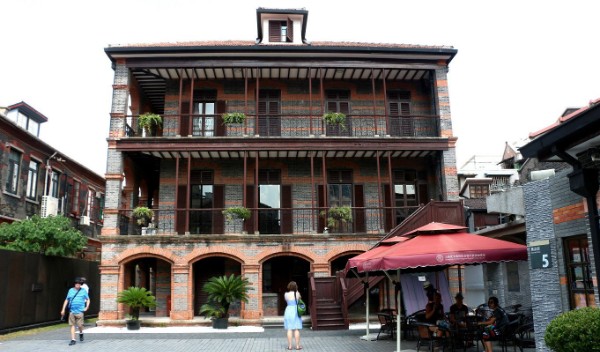
Shanghai Jewish Refugees Museum
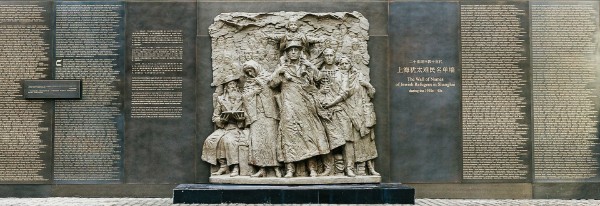
Shanghai Jewish Refugees Museum
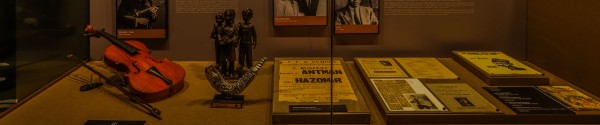
Shanghai Jewish Refugees Museum artifacts
In the late 1930s, the Nazis intensified persecution of German and Austrian Jews. Terrified Jewish people scrambled to leave Europe as the noose tightened, but many countries in the West ruthlessly regulated visas for refugees. Rumours circulated: there was one place refugees could escape to without an entry visa: Shanghai. It became the place of last resort.
The Chinese port had long been open to immigrants. Much of the city was divided and controlled not only by the Chinese, but also by the Japanese, the British and the French. In the 1800s, two rival Jewish families, the Sassoons and the Kadoories, established dynasties and lucrative businesses, bringing electricity to millions of people in Hong Kong and helping to shape the city. They are also remembered for joining forces to help the 18,000 Jewish refugees who made the 5,000-mile arduous trek from Europe to freedom in Shanghai.
Still, before they could embark, the Jews of Europe had another obstacle—they had to obtain an exit visa. When thirty-two countries met in Evian, France, and denied entry to the Jews, the Chinese Consul General in Vienna, Dr Ho Feng-Shan, became a hero, stamping papers by the thousands.
Despite Jewish relief organisations scrambling to help, the refugees lived in overcrowded conditions and squalor, as did Chinese families.
The refugees tried as best they could to recreate the community they had left in Europe. They represented people from all walks of life, including artists, medical professionals, lawyers, teachers, and musicians. Despite not finding work in their professions, they quickly organised schools to educate the children, created sports and cultural activities, and established newspapers and magazines.
Victor Kadoorie opened the first floor of one of his buildings to refugees, where “each was given blankets, bedsheets, a tin dish, a cup, and a spoon. He installed a kitchen in the basement to provide 1,800 meals a day, and he turned one of his factories into a dormitory….”*
In 1939, Horace Kadoorie created the Shanghai Jewish Youth Association School, hiring teachers from Shanghai’s English-speaking residents and from the refugee community, including “a Jewish refugee Lucie Hartwich, who’d been a principal of a school in Berlin.” * Using a guitar that the family owned, music classes could begin.
Several of the refugees were amateur or professional musicians. Jewish musicians from Germany, Austria, and Russia joined or formed musical groups and filled the positions in the Shanghai Symphony during the war years. In fact, 70- 80% of the orchestra was Jewish during that time. Amateur theatre groups formed too, producing, for example, Bertolt Brecht’s Threepenny Opera, with its jazz-infused score by Kurt Weill.
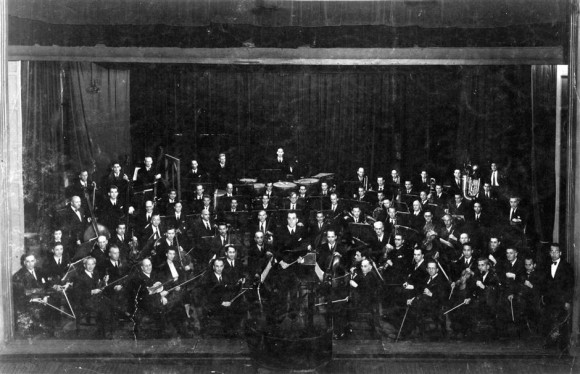
The Jewish refugee musicians in Shanghai in 1942
NT Live: The Threepenny Opera
In February 1943, as if things weren’t difficult enough, the Japanese occupiers forced the thousands of stateless Jewish refugees into Hongkou, where tens of thousands of impoverished Chinese were already living—an isolated area of less than 3 square kilometres. Like Nazi ghettos of Europe, 10 people were squeezed into a room, with only outdoor toilets and filthy alleyways. Japanese soldiers stood guard as exiting required a permit, and food rations were drastically cut. Surviving was a struggle. Nonetheless, the musicians continued to offer private lessons to Chinese children.
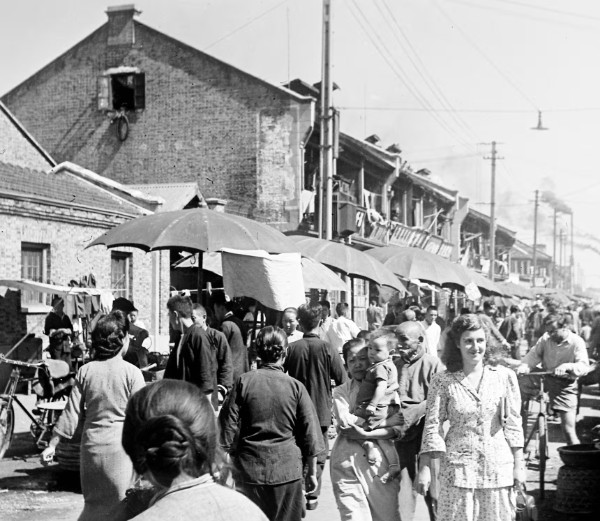
Jewish refugees and their Chinese neighbors at a market in Hongkou
Some of the musicians taught at the Shanghai Conservatory of Music. Ferdinand Adler (1903 – 1952) was one of these teachers, a Hungarian-Jewish violinist born in the Austro-Hungarian Empire. Adler had studied in Budapest and Vienna and later became the concertmaster of the Bad Ischl orchestra, led by Austro-Hungarian composer of operettas Franz Lehár, known especially for his The Merry Widow.
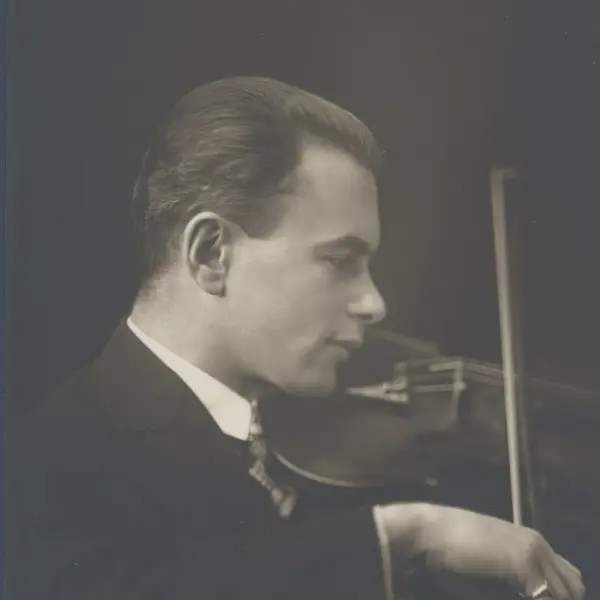
Ferdinand Adler
Franz Lehár: Wiener Frauen (Viennese Women) – Overture (Franz Lehár Orchestra; Marius Burkert, cond.)
In 1932, Adler married a Catholic wife and converted to Catholicism, but after Austria was annexed by Nazi Germany in 1938, Adler was sent to Dachau Concentration Camp. His wife was somehow able to procure Chinese visas, freed Adler, and in 1939, they fled to Shanghai.
During the eight years Adler was exiled to Shanghai, he attempted to continue his music career. He first played in bars, nightclubs and a band. Soon, he became the concertmaster of the Shanghai Municipal Orchestra (the predecessor of today’s Shanghai Symphony Orchestra).
The Glory and Dream of Asia’s Oldest Orchestra
Adler’s performances as a soloist and as a chamber musician were inspiring to both the Chinese and Jewish children languishing in the restricted settlement. When he became professor of the Nanjing State Conservatory of Music and the Changzhou State Conservatory Junior Program, his influence motivated several of his Chinese students to become professional musicians.
In 1945, with the goal of developing professional musicians for China’s national symphony, the State Conservatory of Music Junior Program selected Sheng Mingliang and his younger brother Sheng Mingyao to be among the first cohort of students. The Junior Program moved to Changzhou, which enabled the recruitment of several foreign instructors from the Shanghai Municipal Orchestra, including Adler. Sheng was able to study with Adler until the latter left China in 1947. Sheng Mingliang and Sheng Mingyao became founding members of the Central Philharmonic Society, and they worked until they retired in the 1990s. (The orchestra was renamed the China National Symphony.)
Another student of Jewish refugees, Wu Wenjun, the piano accompanist at the Central Philharmonic Society in Beijing for three decades, studied piano in Shanghai with Berlin native Gerard Pincus.
Years later, Wenjun and Sheng Fang Sheng’s son decided to trace his roots. He was astonished and moved by the history of the Jewish refugee musicians who were exiled in Shanghai during the war years, particularly when he learned about his parents’ teachers. Sheng founded The Adler Project, to honour Adler, the other instructors, and the Chinese students. They represent subsequent generations of Chinese musicians who have inherited a remarkable legacy. People like Adler facilitated the establishment of a classical music tradition in China.
Bright Sheng: Suzhou Overture (Suzhou Symphony Orchestra; Bright Sheng, cond.)
After the end of World War II, many of the Jewish refugees left Shanghai and immigrated to the United States, Australia, Israel and other countries to reunite with their families or seek a better life. Despite their departure, they still maintained close contact with the city of Shanghai. The Jewish refugees felt tremendous gratitude to China for saving their lives. But some chose to stay and to establish roots in China.
The long-term outcomes of the Shanghai Jewish Refugees Museum cannot be underestimated. Descendants such as Michael Kadoorie and others make pilgrimages to the museum. (Kadoorie is the chairman of CLP Holdings Limited and The Hongkong and Shanghai Hotels Limited.) As the grandson of Elly Kadoorie, the founder of China Light & Power Company, and the nephew of Horace Kadoorie, who enabled the education of Jewish children, their visit to the Shanghai Jewish Refugees Museum has been a significant experience for them.
Another musician spawned from the refugees, Horacio Schafer, the principal violist of the São Paulo Symphony Orchestra of Brazil, was able to sneak away from the orchestra’s China tour concert schedule to trace his own roots. His first stop was the Shanghai Refugees Museum. It had been his dream to be able to reconnect with his parents’ history there. His mother, who was from Berlin, Germany, and his father, who was born in Poland, desperate to escape Europe during WWII, were among the 18,000 people fortunate enough to have obtained a visa to China.
Others have put the remarkable history to music. Creator-composer of the Shanghai Sonatas, Xiang “Sean” Goa, has created a ground-breaking musical that combines musical theatre, live classical music, and visual art to fulfill his dedication to bringing music to young audiences. The musical the Shanghai Sonatas is based on the memoirs of the refugees who found sanctuary in Shanghai and who were able to survive the war through their music-making. (Read more at “Shanghai Sonatas: Hope Not Hate”.)
Shanghai Sonatas plot trailer 1-23-23
A remarkable new work entitled Émigré, a 90-minute oratorio composed by Aaron Zigman, was performed and premiered by the New York Philharmonic in 2024, bringing this historical story to the public. Part opera drama, part musical theatre, incorporating full orchestra, chorus, and seven soloists, it resonates with our own times. This impressive and beautiful work deserves to be featured on its own in our next article.
Further reading:
*The Last Kings of Shanghai by Jonathan Kaufman
The Sound of Exile by Tang Yating (professor emeritus at the Shanghai Conservatory of Music)
https://www.theadlerproject.com/post/my-family-violin
https://exilarte.org/en/nachlaesse/ferdinand-adler
For more of the best in classical music, sign up for our E-Newsletter