Designed for performances during times when the majority of public performance spaces were closed for religious reasons, including the weeks leading up to Easter, the first concert series in existence was founded in March 1725. The Concert Spirituel was a mix of sacred music and virtuosic instrumental pieces. It was the most important concert organisation in the 18th century.
At the first concert, on 18 March 1725 (Easter was on 16 April that year), included performances of motets by Michel Delalande (a French composer in the service of King Louis XIV) and Corelli’s Christmas Concerto.
Arcangelo Corelli: Concerto Grosso in G Minor, Op. 6, No. 8, “Christmas Concerto” – IV. Allegro – Pastorale: Largo (Academy of Ancient Music; Christopher Hogwood, cond.)
The first concerts were organised by Anne Dannican Philidor, brother of the composer François-André Philidor, but he was unsuccessful, going bankrupt in 2 years. The idea was good, though, and it was taken up by Pierre Simart and Jean-Joseph Mouret, the latter a composer best known today for the signature tune for Masterpiece theatre on PBS. They ran it from 1728 to 1733 before failing again. They had expanded the idea to include a series of ‘French Concerts’, but still couldn’t make it work.
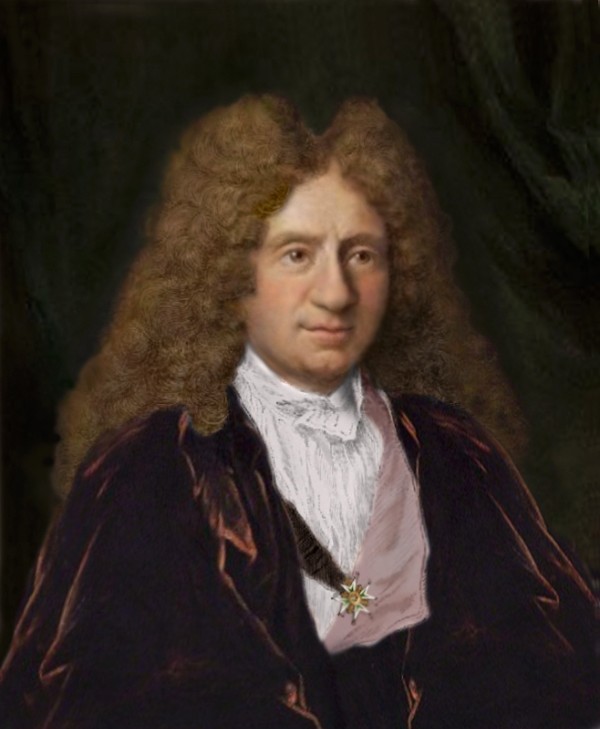
Michel-Richard Delalande, 1722
The Concerts Spirituel was then taken over by the Académie Royale de Musique (1734–1748) with an emphasis on the music of French composers, including Michel-Richard Delalande, Mouret, and Jean-Joseph de Mondonville, all of whom were in the circles around the royal court. What had caused the earlier entrepreneurs to fail was the necessity to pay for a license fee for a royal privilege that allowed them to put on ‘public concerts of sacred music’, an exception to the exclusive right to public performance of music held by the Paris Opéra. The Académie Royale de Musique didn’t have to pay that fee, so the series could finally make money.
In 1748, two new people, Joseph-Nicolas-Pancrace Royer and Gabriel Capperan, took over the series, paid the privilege fee, and ran it successfully from 1748 to 1762. They redecorated the concert hall, enlarged the size of the orchestra and chorus and added the most famous Italian singers to their forces, and the series made their fortunes. French oratorios were added to the concert repertoire and proved popular.
A new manager, Antoine Dauvergne, took over the series and added a motet competition. He also expanded the virtuoso performer list beyond the string players to include wind players. Dauvergne, a royal functionary, got bored with it all, and the Académie found new people to run it: violinist Pierre Gaviniès, violinist Simon Le Duc, and composer François Joseph Gossec. They ran it until 1777 when its last director, the singer and composer Joseph Legros, took it over.
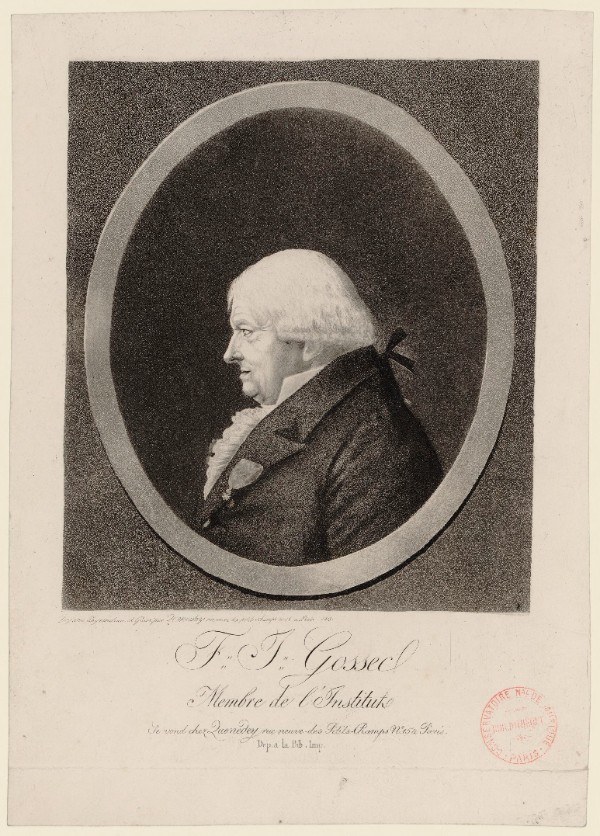
Edme Quenedey: François-Joseph Gossec, 1813 (Gallica: btv1b8420420r)
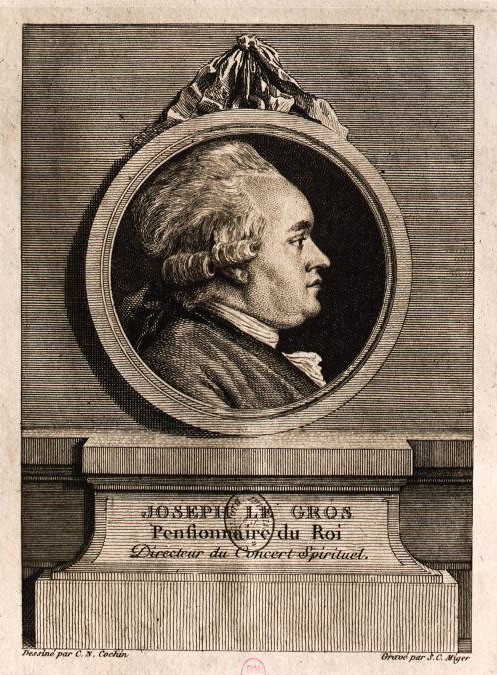
Charles-Nicolas Cochin: Joseph Le Gros, 1777 (Gallica: btv1b8421839j)
This cello concerto by Jean-Louis Duport was played in the concert series. When the work was published in 1785, it was advertised on the front page of the music that it had been played at the Concert Spirituel.
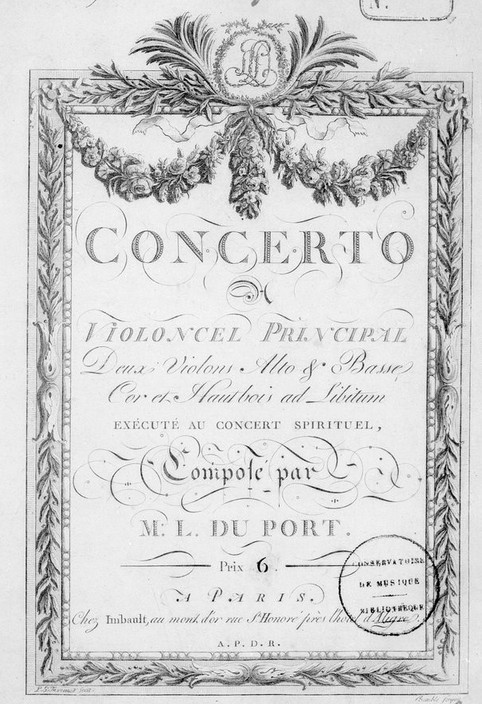
Duport: Cello Concerto title page (cropped), 1785 (Gallica: btv1b9081627j)
Jean-Louis Duport: Cello Concerto No. 2 in G Major: II. Romance (cadenza by F. Lodéon) (Frédéric Lodéon, cello; Xavier Gagnepain, cello; Ensemble Orchestral de Paris; Jean-Pierre Wallez, cond.)
Legros was an important director. He reviewed the repertoire being played and brought it up to date: the old 17th-century grand motets were replaced with new works by J.C. Bach and Mozart. He commissioned Mozart’s Symphony No. 31 in D major, K. 297, for the Concert Spirituel and saw to it that Haydn’s symphonies were on nearly every program.
The French Revolution in 1790 marked the end of the first round of the Concert Spirituel.
The concerts were associated with royalty, and their audience was made up of well-to-do bourgeois, the lower aristocracy, and foreign visitors.
Jean-Philippe Rameau: Les Indes galantes (arr. for chamber ensemble) (excerpts) – Air pour les Esclaves affricains (Le Concert des Nations, Ensemble; Jordi Savall, cond.)
The idea lived on in France with occasional concerts under the title during the Napoleonic era. After the fall of Napoléon, the Théâtre-Italien and Académie Royale de Musique gave concerts during Holy Week, but not on other religious holidays. In 1805, at the initiative of the Théâtre Italien, sacred music concerts were resumed, around the same time, the Gregorian calendar replaced the Revolutionary Calendar of Napoléon.
Eventually, the Concert Spirituel became part of the Société des Concerts du Conservatoire after 1828 and remained there throughout the 19th century.
Once established, the concerts were held in the Salle des Cent Suisses (Hall of the Hundred Swiss Guards) in the Tuileries Palace, the Paris residence of most French monarchs from the 16th to the 19th century.
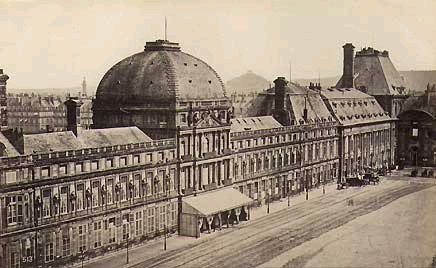
The Tuileries Palace in 1865. The concerts were held on the 2nd floor of the central pavilion.
In 1784, the concerts were moved to the opera house in the Tuileries Palace, and, in 1790, when the royal family was confined in the Palace, it moved to a Paris theatre.
The Concerts Spirituel were public, ticketed concerts and an innovation of their day. An important point about the concerts is that they were not ‘performances for their own sake’ but designed purely to substitute for the Opéra, closed on religious holidays. Initially, their repertoire was limited to religious and instrumental music, with French music being totally denied to them by their license. Eventually, the repertoire expanded to include French cantatas and other vocal works. As politics became more important in France than religion, the concerts lost their audience, but this lasted only about a decade.
For more of the best in classical music, sign up for our E-Newsletter