As the weather draws in and our friends in northern countries report SNOW, we were looking for some good snow music.
Georgy Sviridov (1915–1998) was born in Kursk, about 100 miles north of Ukraine, and after starting his musical studies in Kursk, moved to Leningrad to study at the city’s Central Music Tekhnikum from 1932 to 1936.
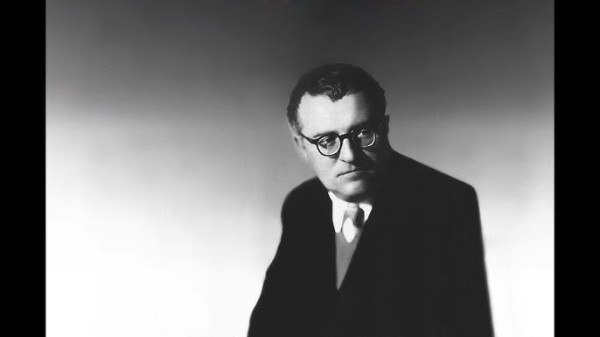
Georgy Sviridov
In 1936, he started studying at the Leningrad Conservatory under Shostakovich, remaining until 1941, when the city came under siege for 872 days by the German army. He moved to Moscow in 1956 and lived there for the rest of his life. As a favoured composer of the Soviet Union, he was awarded the Lenin Prize and the titles of National Artist of the Soviet Union and Hero of Socialist Labour. He followed Shostakovich as head of the Composer’s Union from 1968 to 1973.
Sviridov wrote in all genres, from film and incidental music to symphonies. His choral writing for both small ensembles and large-scale forces was another side to his character.
In 1965, he composed Snow is Falling, a ‘small cantata’, setting three poems of Boris Pasternak. Although he set his poetry to music late in his career, Sviridov found a companion spirit in Pasternak’s poetry. The poet is present in many of Pasternak’s poems, ‘whether contemplating the role of the creator, or urging himself to keep writing, … , and this evidently appealed to Sviridov’.
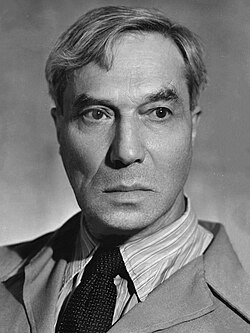
Boris Pasternak, 1958
Three poems of Pasternak, Snow is Falling from 1956, and Soul and Night from 1957, are used in Sviridov’s cantata, Snow is Falling. The rhythms are simple and repetitive (as is so much of the poetry), and the progressions vary between modal and harmonic.
The music starts softly and repeats ‘snow is falling’. The sopranos and altos sing on just one note, and the orchestra moves between just two chords. As the piece progresses, it gradually grows more insistent, with a flute for the bird that twitters around. As the ground gradually becomes white, there are only a few things to show what was there before. The geraniums cling on in the window box and at the street corners, and leaves peek out at the crossroads. The poet uses unusual analogies to describe the snowfall and its effect: they are sky parachutes, the sky creeps down from the attic, and ‘snow is falling, all is lost’, where even the passersby are left covered in white.

Geraniums in the snow
Georgy Vasil’yevich Sviridov: Sneg idyot (Snow is Falling) – Snow is Falling (Rimsky-Korsakov College of Music Female Choir; St. Petersburg Radio and Television Children’s Choir; St. Petersburg State Symphony Orchestra; Yuri Serov, cond.)
The second poem, Soul, was written by Pasternak in 1957 and examines the state of his soul. He finished writing his great novel, Doctor Zhivago, in 1957, only to have it promptly banned in the Soviet Union. In Soul, he quietly mourns those who have been ‘hounded down’. They live in his verses and, silently, in his soul.
As a contrast with the first movement, the writing becomes almost chant-like, with an emphasis on the low orchestral voices (strings, with the clarinet and flutes at the bottom of their register).
Georgy Vasil’yevich Sviridov: Sneg idyot (Snow is Falling) – Soul (Rimsky-Korsakov College of Music Female Choir; St. Petersburg Radio and Television Children’s Choir; St. Petersburg State Symphony Orchestra; Yuri Serov, cond.)
Night, also written in 1957, describes Night’s arrival in the world – in his dark shrouds, he spreads his shadow as he swallows up everything from a jet plane to a draper’s marks on cloth. He looks in the window of a garret and over an entire planet. He closes advocating ‘Don’t rest from art’s creation, |To sleep do not succumb’, a cue for the restless artists. Sviridov picks up a cue from the poem’s last line, ‘For time’s incarceration | Must endless beat its drum’, to set up the unceasing drum beat throughout. Set for boys’ choir with a light and springing tune that runs counter to the dark message of the text, as Night advances over the world as we know it.
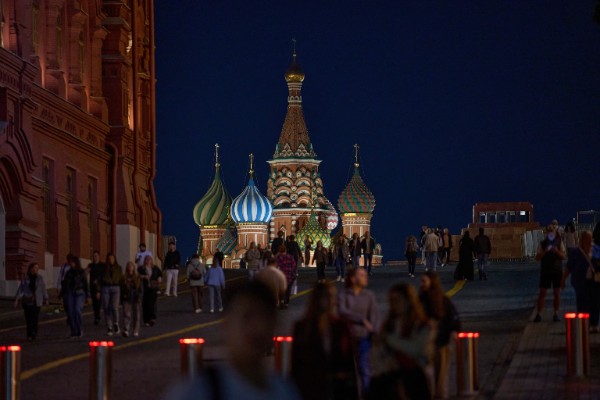
Night in Moscow
Georgy Vasil’yevich Sviridov: Sneg idyot (Snow is Falling) – Night (Rimsky-Korsakov College of Music Female Choir; St. Petersburg Radio and Television Children’s Choir; St. Petersburg State Symphony Orchestra; Yuri Serov, cond.)
We can feel the snow falling, gradually covering the world; we can hear the soul’s contemplation of the memories it holds; and although the text is sombre, the musical setting of Night nearly has us dancing, perhaps as a way of keeping the artist from falling asleep and missing everything in the world.
For more of the best in classical music, sign up for our E-Newsletter