Leoš Janáček (1854–1928) had a full opera career in the Czech lands, but his music languished in Western Europe until certain conductors took him and promoted his music. One of those conductors was Charles Mackerras (1925–2010), whose championing of Janáček’s music led to his inclusion on many new concert stages.
Mackerras was awarded a British Council scholarship to study in Prague, and he arrived there in September 1947. He and his new wife, the clarinettist Judy Wilkins, started studying Czech, and he started his conducting lessons under Václav Talich. Charles and Judy discovered Janáček, first with the opera Káťa Kabanová, a month after their arrival. After that, they sought out Janáček wherever they could find him so that after a year, he had seen nearly all of Janáček’s opera, many in multiple productions.
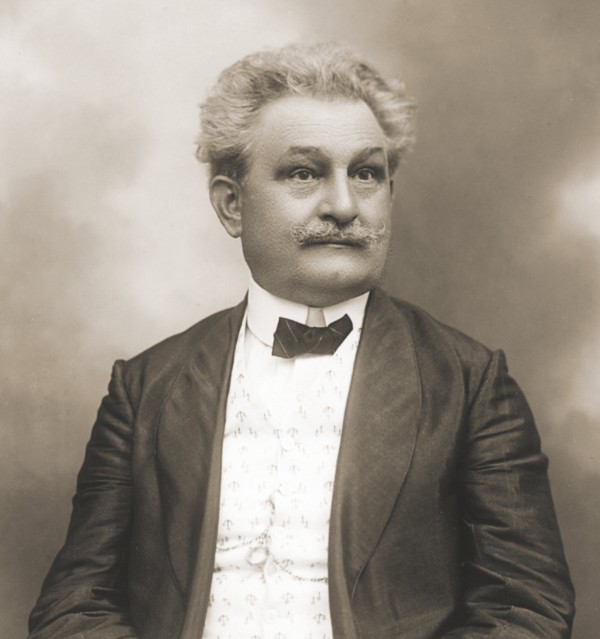
Leoš Janáček, 1914
When he returned to London, Mackerras began to promote Janáček’s operas, starting with a production of Káťa Kabanová in 1951. His advocacy was such that these works became an established part of the repertoire. From Káťa Kabanová to Cunning Little Vixen (his favourite), he brought Janáček’s works to England. The works puzzled the critics, and it took repeated performances for them to understand Janáček’s musical world.

Derek Allen: Charles Mackerras, 1954 (National Portrait gallery: NPG x24111)
The work that was the turning point was the comedy The Makropulos Affair. The 1964 production, restored on this CD set, was sung in English at Sadler’s Wells, and it caught the public’s imagination in a new way.
Leoš Janáček: The Makropulos Affair – Prelude
For Mackerras, this 1964 production was his first shot at conducting the entire opera. Helped by his deep and comprehensive knowledge of Janáček’s music, Mackerras was an outstanding conductor, finding the dramatic arc in each act.
There were six performances in 1964, and this recording comes from the fourth performance – a perfect time where the cast is at ease with the music and hasn’t yet tired of the repetition.
Our heroine, Emilia Marty, is a mere 337 years old and a celebrated singer. The case of Gregor v. Prus, which has been running for nearly a century, could be solved if they could find the will. Emilia tells them where to find it in the Prus mansion. The will is found, and attached to it is an alchemical formula. The formula was developed by our heroine’s alchemist father and was tested on her…back in the sixteenth century. It truly was a formula for longevity, and over time, Elina Makropulos has become Eugenia Montez, Ekaterina Myshkin, Ellian McGregor, and now Emilia Marty. She seeks the formula because the potion is wearing off, and she’d like another 300 years. As a singer, the longer her career, the better…. She offers the formula to her student Kristina so that she can also become a great artist, but Kristina burns the parchment, and Elina collapses, with her last cathartic line: ‘Ha ha! The end of immortality!’.
Mackerras’ triumphant production brought Janáček a new audience, and although The Makropulos Affair hasn’t been on stages as much as Janáček’s other operas, such as Jenůfa, Káťa Kabanová, or The Cunning Little Vixen.
The one-hour-long production is joined on the recording with an English-language performance of The Diary of One Who Disappeared, sung by Richard Lewis (1914–1990) as Jan and Maureen Forrester (1930–2010) as Zefka, the gypsy girl he’s in love with. This recording was made in 1956 for the BBC Third Programme. The pianist was Ernest Lush.
Leoš Janáček: The Diary of One Who Disappeared – One Day I met a Gypsy Girl
We’re now used to productions of Janáček’s operas in Czech, and this recording gives us a chance to go back in time to when they were still new on the Western European stage. Marie Collier, soprano, was called ‘one of the outstanding exponents of the role’ with one reviewer saying ‘it is only rarely that a singer is as perfectly matched to an opera part’ as Collier was to Emilia Marty.
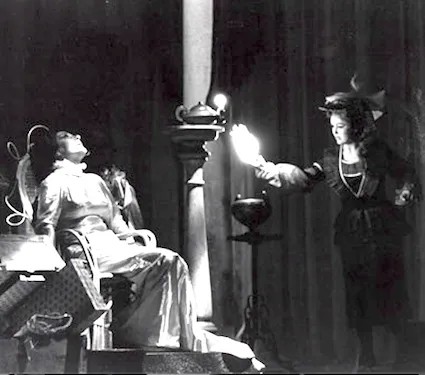
Marie Collier as Emilia Marty as the formula is burned, 1966 (San Francisco Opera)
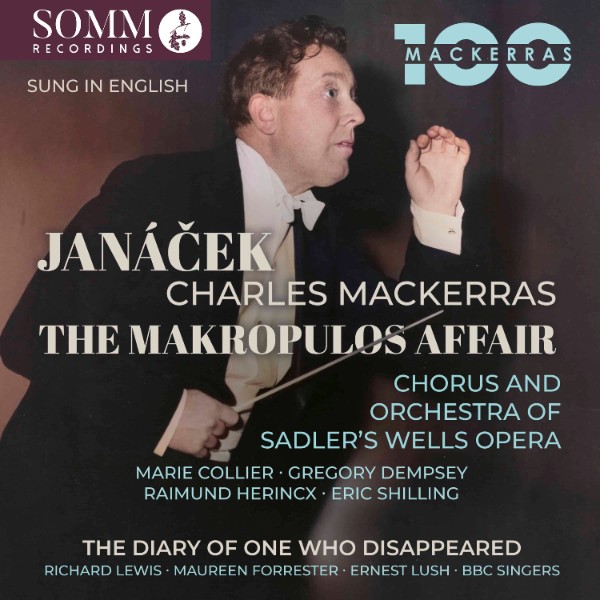
Leoš Janáček: The Makropulos Affair & The Diary of the One Who Disappeared
Marie Collier, Gregory Dempsey, Raimund Herincx, Eric Shilling, Chorus and Orchestra of Sadler’s Wells Opera, Charles Mackerras, cond.
SOMM Recording Ariadne 5044-2
Official Website
For more of the best in classical music, sign up for our E-Newsletter