As a mythological character, Hercules is one who has always captured our attention. Famed for his strength and for his adventures around the known world, he’s caught the attention of writers and musicians for centuries.
The stories and feats of the Greek hero Heracles, son of Jupiter and the mortal Alcmena, were taken over by the Romans to be their hero Hercules. From his birth, he had adventures. The jealous wife of Zeus, Juno, sent serpents to kill the infant in his cradle, but he killed them, one in each hand.
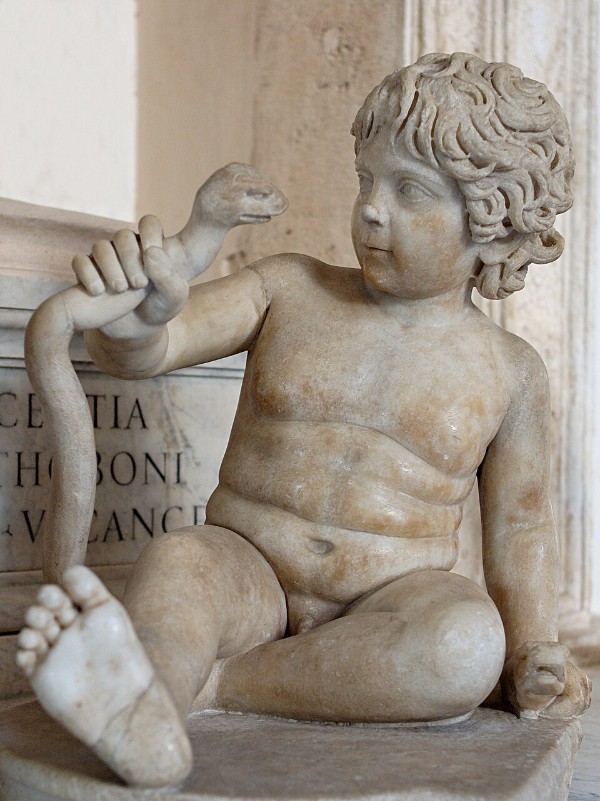
The infant Hercules defeats a snake, 2nd century (Rome: Capitoline Museums) (photo by Marie-Lan Nguyen)
Hercules was viewed as a figure of virtue and strength, with the ability to overcome early desires and vices. He was famed for the 12 Labours he accomplished for King Eurystheus, whom he served for 10 years after he went mad and killed his wife and child. In his decade of service to the King, he had to accomplish the following tasks:
- Slaying the Nemean lion
- Slaying the nine-headed Lernaean Hydra
- Capturing the Ceryneian Hind
- Capturing the Erymanthian Boar
- Cleaning the Augean stables in a single day
- Slaying the Stymphalian birds
- Capturing the Cretan Bull
- Stealing the Mares of Diomedes
- Obtaining the belt of Hippolyta, queen of the Amazons
- Obtaining the cattle of the three-bodied giant Geryon
- Stealing three of the golden apples of the Hesperides
- Capturing and bringing back Cerberus
Each of the Labours involved killing or capturing a monster (or, for no. 5, accomplishing a monster-sized job). Succeeding at each of the Labours involved not only strength but also cleverness. He skinned the Nemean lion by using one of its claws, as his regular knife was too dull. After pursuing it for a year, he captured the Ceryneian hind when it was asleep. He cleaned the Augean stables by redirecting a river. He captured Cerberus by draping him over his back. Each time he reported back to King Eurystheus, the king grew increasingly afraid of what he had unleashed and so finally declared the Labours as completed.
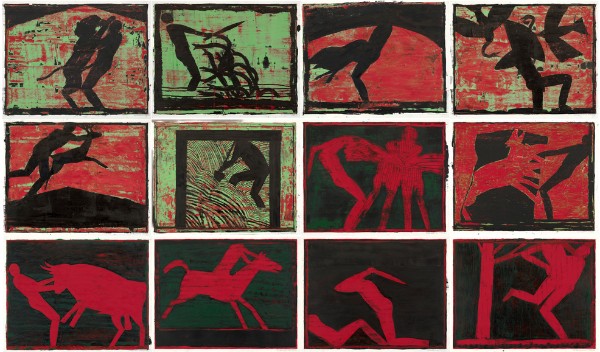
Michael Spafford: 12 Labours of Hercules, 2005
In his etching of Hercules, shown with his club and wearing the skin of the Nemean lion, we can see some of his other labours in the background, including capturing the Cretan Bull and his defeat of Antaeus (part of Labour 11).
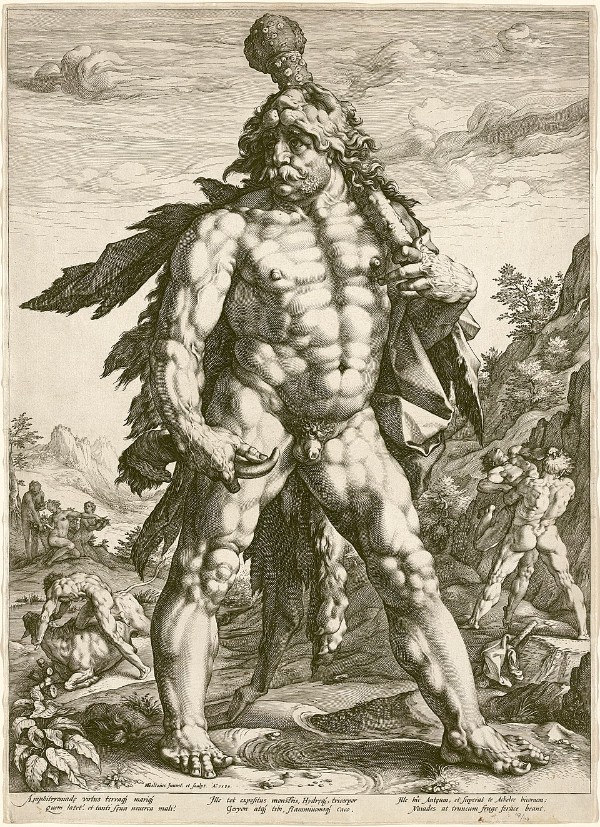
Hendrik Goltzius: The Giant Hercules, 1589 (Washington: The National Gallery of Art)
In his symphonic poem La Jeunesse d’Hercule (The Youth of Hercules) of 1877, Camille Saint-Saëns (1835–1921) used the idea of Hercules as a virtuous figure as the basis for his work. After a mysterious opening, the work goes on to offer a contrast between pleasure and virtue. The first theme, noble and stately, contrasts with the more assertive and passionate second theme. After descending into a wild bacchanal, we return to virtue as Hercules rejects such debauchery. In the end, virtue triumphs over pleasure in a grand finale.
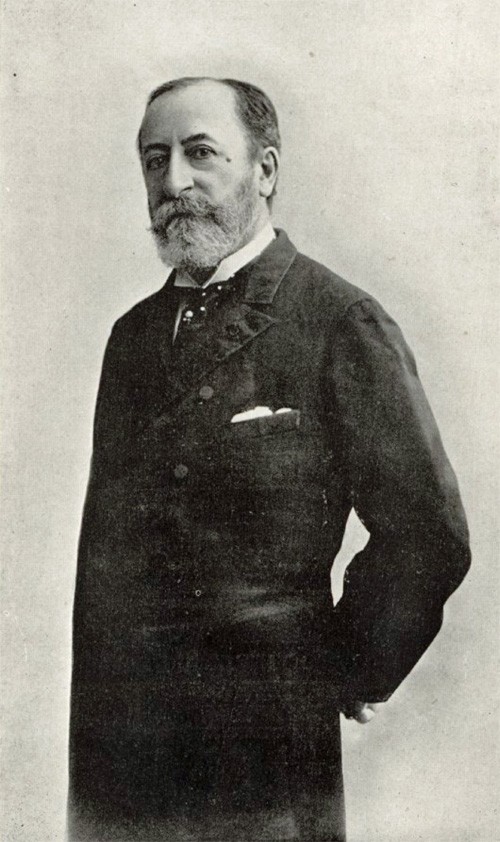
Charles Reutlinger: Saint-Saëns, ca 1880 (Bibliothèque nationale de France, département Musique)
Saint-Saëns provided the following synopsis of the work: ‘The story tells how, at his birth, Hercules saw before him two courses of action, that of pleasure and that of virtue. Indifferent to the seduction of Nymphs and Bacchantes, he chose the path of struggle and combat, at the end of which he had a glimpse, through the flames of the funeral pyre, of the reward of immortality.’
Camille Saint-Saëns: La Jeunesse d’Hercule, Op. 50 (Lille National Orchestra; Jun Märkl, cond.)
Even though Hercules is known much more for his actions, Saint-Saëns explores the inner man. Despite having to fight for his life from the time he was a child, he is able to sublimate his strength into a strong moral core. His choice to eschew voluptuousness for a life of combat grants him, in the end, immortality by being placed in the stars.
For more of the best in classical music, sign up for our E-Newsletter