As the first issue of a 5-year contract with Da Vinci Classics, pianist Hyewon Chang appears on Schubert Piano Sonata, Vol. 1, where she plays Piano Sonatas dating from 1817, 1819, and 1828.

Hyewon Chang
By choosing these three sonatas, Chang has given us an overview of Schubert’s output, starting with his early piano sonata from 1817, catching his first important sonata from 1819, and ending with his last one from 1828.
Franz Schubert (1797–1828) was engaged with the piano sonata throughout his entire composing career. He wrote his first piano sonata in 1815 (D.154), of which only a fragment is extant, and gradually built up his compositional abilities until he stopped leaving fragmentary works (with not all of the planned four movements completed).
Scholars writing about the Piano Sonata in A flat major, D. 557, are still debating whether it’s complete in 3 movements or if he had intended a 4-movement work. We have 3 movements, and the final movement does have a feeling of finality. However, since this is a work in A flat major and the final movement is in E flat major (the dominant), room is open for the question of completeness. It was highly unusual at this time for a work to end in a key other than the tonic, but it’s not entirely unknown in other Schubert works from this time period.
Schubert’s autograph score is incomplete, ending shortly after the beginning of the 3rd movement, but a contemporary full score has been found and was used as the basis for the work’s first publication in the Schubert Collected Works edition of 1888.
The work is light and effervescent and very much full of Schubert’s melodic imaginings.
Franz Schubert: Piano Sonata in A flat major – D. 557, III. Allegro
Also in 1817, the same year this work was written, Schubert wrote his Piano Sonata in B major, D. 575, which is a true 4-movement piano sonata.
In the summer of 1819, Schubert composed his Piano Sonata in A major, D. 664. Nicknamed the ‘Little A major’ to differentiate it from the 1828 sonata in the same key, D. 664 keeps to the same light nature as D. 557. The work was dedicated to the 18-year-old Josephine von Koller of Steyr in Upper Austria, whom he considered ‘a good pianist’ and ‘very pretty’ according to his letter to his brother Ferdinand.
This is considered Schubert’s first successful piano sonata. All three movements are in sonata form, signalling Schubert’s conquering of the form for himself, rather than following Beethoven’s examples.
The last three of Schubert’s piano sonatas (D. 958, D. 959, and D. 960) are grouped together as his last major works for solo piano. Although written in the last months of his life, they weren’t published until a decade later. Even following their publication, they failed to catch popular taste and fell into obscurity. In the 20th century, however, once we started assessing Schubert for himself and not as a shadow of Beethoven, the works were re-examined on their own terms, and Schubert’s distinctive style came to the fore. No longer considered sub-par Beethoven, Schubert’s final piano sonatas are now recognised for their depth of emotional expression.
The final piano sonata may be the most familiar on this recording. In many ways, it speaks to Schubert’s future. In the first movement, the exposition moves through an exceptional three keys, the development section takes up different themes from the exposition, rather than just the principal one, and the coda has fragmentary returns to the first theme.
The second movement moves to the tonally remote key of C sharp minor and carries this through the movement, even when the coda takes us to C sharp major.
The Scherzo movement is a proper dancing piece with the tempo indication of Allegro vivace con delicatezza, and that is how Chang delivers it – with a dancing delicacy.
The final movement, Allegro ma non troppo, moving to Presto, starts with an unusual pause on octave Gs. The constant iteration of the pause on the octave Gs gives an unusual sound to this movement, pausing and then pushing the melodies forward.
Franz Schubert: Piano Sonata in B-flat Major, D. 960 – IV. Allegro ma non troppo–Presto
This recording is a joy to hear. We go from baby Schubert to improved Schubert to final Schubert, master of the piano sonata. With the example of Beethoven always hanging over him, Schubert was finally forced to find his own way through the genre and in this recording, the examples chosen beautifully illustrate this.
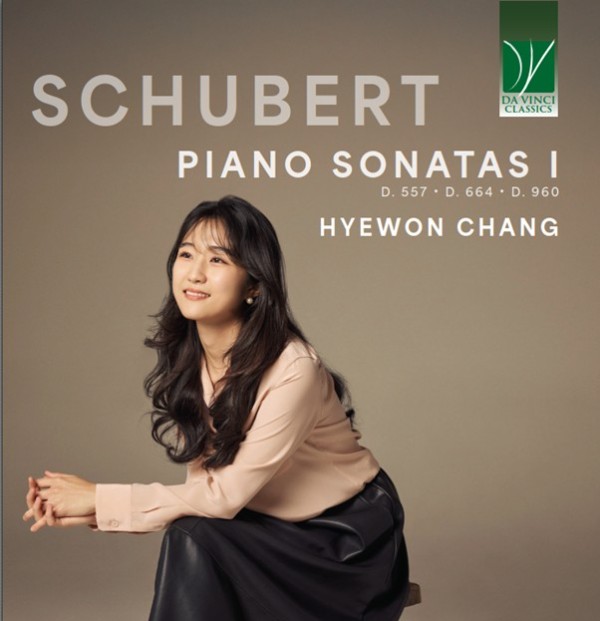
Franz Schubert: Piano Sonatas I
Hyewon Chang, piano
DaVinci Classics C01120
For more of the best in classical music, sign up for our E-Newsletter