Inspirations Behind Dan Welcher’s String Quartet No. 3, “Cassatt”
American painter and printmaker Mary Cassatt (1844–1926) was born outside Pittsburgh, Pennsylvania, but made her career in France and was one of the few women in the Impressionist circle, joined by Marie Bracquemond and Berthe Morisot.
When Cassatt started studying at the Pennsylvania Academy of the Fine Arts at the age of 15, it was the start of both an art and social education. Feminism led to her lifelong advocacy of equal rights for men and women. Limits to women’s art education, such as no use of live models until they were older and the use of plaster casts as their model source, led her away from the PAFA to study on her own, and, eventually, moving to Paris when she was 22.
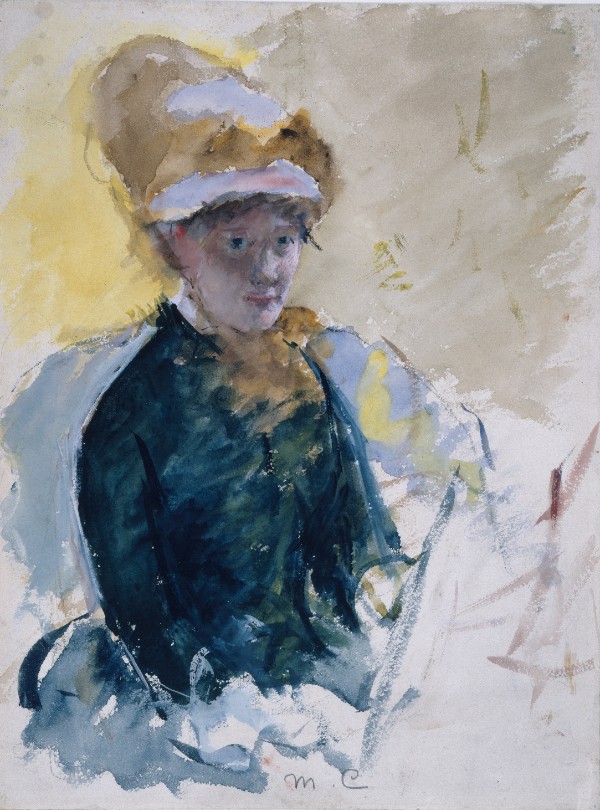
Mary Cassatt: Self-portrait, ca 1880 (Washington, DC: National Portrait Gallery)
Sexism in France prevented women from studying at the École des Beaux-Arts, but she could study with teachers from the school. She also used the Louvre as her source for art subjects, where it also served as a place for women artists to gather, since cafés were also closed to women.
American composer Dan Welcher chose three paintings by Cassatt as the inspiration for his third string quartet.
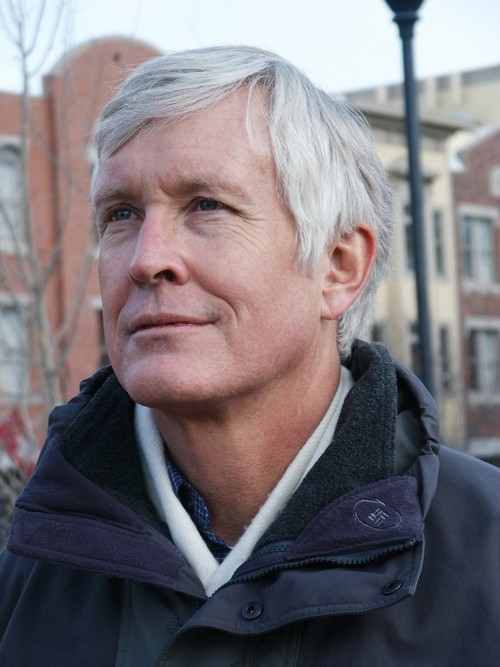
Dan Welcher
The first comes from 1872, when Cassatt was painting a work for an exhibition at the Esposizione di belle arti in Milan. Bacchante depicts one of the mythical wild women who celebrated the Dionysian rites (remember that a group of Bacchantes killed Orpheus when he ascended, Eurydice-less, from his trip to Hades). This early work shows many of the elements that she would later abandon.
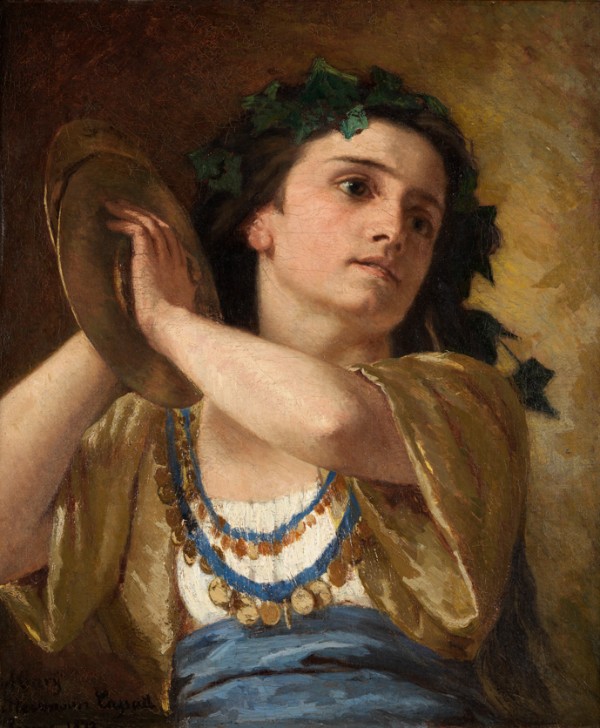
Mary Cassatt: Bacchante, 1872 (Philadelphia Academy of Fine Arts)
Cassatt’s image, of a young girl with a dark-complexion and black hair, playing cymbals. The vine leaves in her hair are testimony to her wildness, and the necklaces of coins are her saved money for the future. She’s a normal girl who has run away to become a follower of Bacchus.
Although painted for an Italian exhibition, the painting shows the influence not only of Italian Renaissance painters such as Correggio but also Spanish Baroque painting. Shortly after this period of creating ‘academic’-style work to satisfy French tastes, she abandoned it for more realistic scenes of modern life. She was joined in this by many of her French colleagues: open-air painting became more popular, as did scenes from cafés and music halls.
Welcher creates a theme that carries through all the movements of the string quartet based on the painter’s name: MARY CASSATT. For this movement, based on the painting, Welcher starts with Mary’s Theme and then turns it into a Spanish/Italian–style theme, using the Spanish-style music of Ravel and Falla as his musical reference points. The slow opening gives way to an “alla Spagnola”–style fast triple metre.
Dan Welcher: String Quartet No. 3, “Cassatt” – I. Introduction – The Bacchante (1872) (Cassatt String Quartet, Ensemble)
From Cassatt’s middle period comes At The Opera or In the Loge (the work is known by both titles). Our subject, seated in an upper circle, is intently looking at something that is not on the stage. Since we’re not certain of where she is in the hall, we can’t tell if she’s looking at another box or a specific person in another box. Note the man to her right, who is definitely not looking at the stage either, leaning out of his box to look, perhaps, at our opera goer or perhaps the women half-shown in the next box with exposed arms, or perhaps us, the invisible other viewer.
The painting is only 4 years after Bacchante, but you can immediately note the change in style. Cassatt’s authority and originality come to the fore.
This was the first of Cassatt’s Impressionist works to be shown in the US, appearing in Boston, where the critics praised it, adding that Cassatt’s painting ‘surpassed the strength of most men.’ The image, originally titled At the Française – A Sketch, depicts a woman at the Comédie Française. The linked viewers, you’re watching her while the man in the right box watches her (or perhaps you), creates a circle of mysterious inspiration. While most Impressionist paintings from the theatre in similar circumstances place the woman at the centre, this one puts her on the right side and doesn’t reveal what is so fascinating to her.
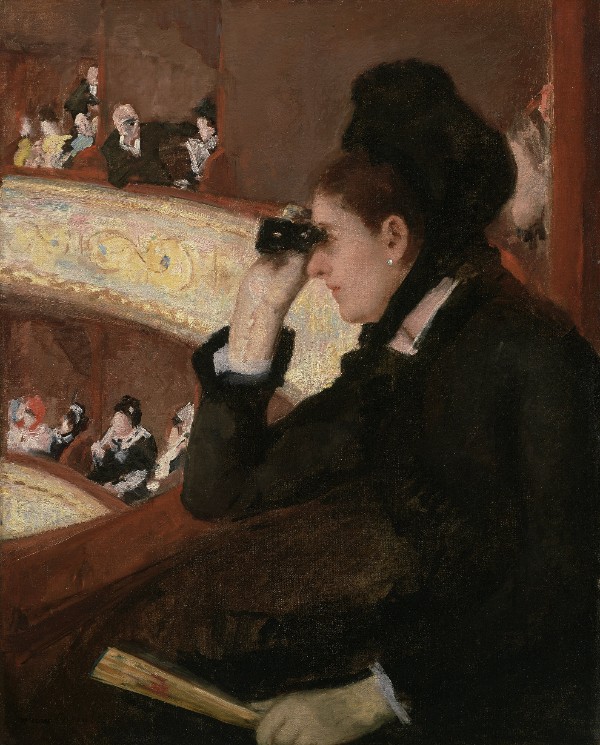
Cassatt: In the Loge / At the Opera, 1878 (Boston: Museum of Fine Arts)
In his string quartet, Welcher imagines that our woman has arrived at the opera after the curtain has risen. He opens with Mary’s Theme as a miniature overture before launching into a quotation of the Soldier’s Chorus from Gounod’s Faust. The first violin, who does not take part in the Gounod quotation, hovers above on high before descending to create a new melody. This melody is not related to Gounod but is yet another version of Mary’s Theme and its scale. At the end is another Gounod quotation, Valentin’s aria Avant de quitter ces lieux, also from Faust, where Valentin asks God to guard his sister Marguerite.
Dan Welcher: String Quartet No. 3, “Cassatt” – II. At the Opera (1878) (Cassatt String Quartet, Ensemble)
Welcher’s last movement is based on a late work by Cassatt, a rare example of her using a model in an outdoor setting. The palette is very limited, with greens and whites being the most dominant colours. The unusual orange sky and the shadows point to a timeframe of sunset. Ill health (including diagnoses of diabetes, rheumatism, neuralgia, and cataracts in 1911) started to slow her down, eventually stopping her work as she became almost blind. If you look at the difference in the face between this young woman and the one in the loge, above, you can sense her decaying eyesight.
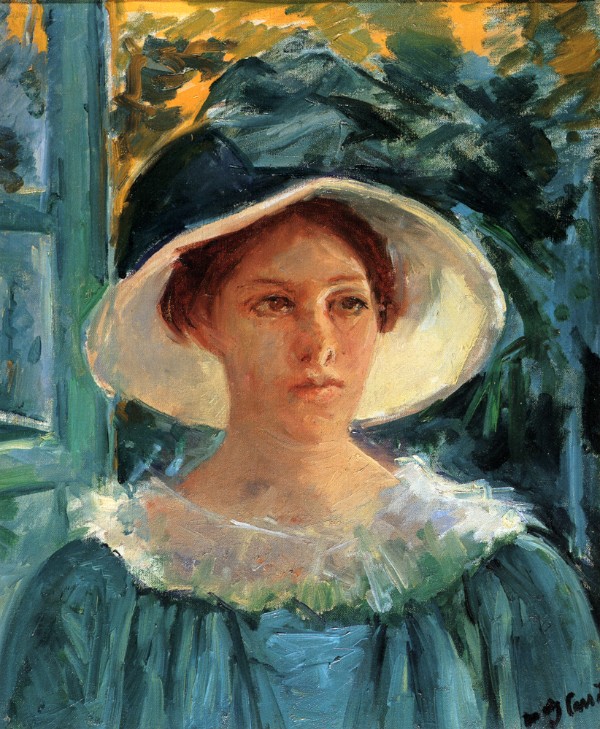
Cassatt: Young Woman in Green, Outdoors in the Sun (1909)
Welcher used the idea of Cassatt’s creeping blindness to create a movement that was based on melody, the sounds in the air that the hard-of-sight are so reliant upon. In this case, he creates three different melodies, ‘Young Woman’, ‘Green’, and ‘Sunlight’, using the most important parts of the image for his inspiration. He quotes Claude Debussy’s song ‘Green’, No. 5 in his Ariettes oubliées (1885–1887) as part of the string quartet.
He has each melody appear twice, once in its original form and then, after all have sounded, in a modified form, which he calls ‘a more diffuse setting’.
Dan Welcher: String Quartet No. 3, “Cassatt” – III. Young Woman in Green, Outdoors in the Sun (1909) (Cassatt String Quartet, Ensemble)
The three paintings by Mary Cassatt cover her career: learning through copying, a bold breakout, and her final years with medical difficulties. In the same way, Dan Welcher takes us through his creation of the Mary Theme, based on her name, as the start of each new movement and each new manifestation of Cassatt’s talent and skill. The late 19th century was a time of experimentation in art and discovery of colour, and Welcher’s work captures that in music as well.
For more of the best in classical music, sign up for our E-Newsletter