Paintings that Inspired William Popp’s ‘The Galleries’ Suite
Composer William Popp (b. 1950) puts together his own gallery of art in The Galleries. Looking at one 16th-century and three 19th-century paintings held in museums in London, Madrid, Washington, DC, and New York, he curates his own private gallery, choosing paintings that capture particular times or events.
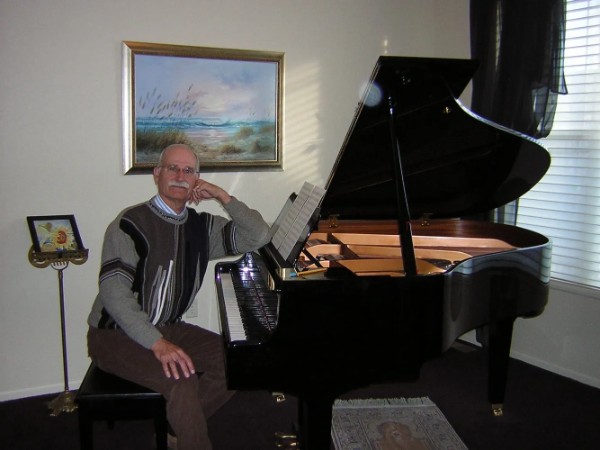
William Popp
He opens with an invisible concert. Edouard Manet (1832–1883), in his 1862 painting, Music in the Tuileries Gardens, shows us a fashionable crowd out for one of the twice-weekly concerts in the Gardens. The women are well-dressed, with voluminous dresses and careful bonnets. The little girls at the front centre are in the flouncy dresses of the day with the broad sashes that we will see later in a Renoir painting. The men have light-coloured trousers, long dark jackets, and wear polished top hats. The man to the centre, shown in profile with yellow-beige trousers and a top hat, is Manet’s brother, Eugène. A chair at the right holds abandoned children’s toys: a hoop with a stick (on the chair) and a ball underneath
Manet himself appears, at the far left of the picture, partially hidden behind the painter Comte Albert de Belleroy. As a scene of urban leisure, it is unmatched and was innovative for its time. At the same time, it’s a picture of Manet and his circle. The two seated women in yellow are Madame Lesjosne on the left and Hérminie d’Alcain, the wife of Jacques Offenbach, on the right. Offenbach himself is visible on the center-right, seated in front of a tree wearing a tall hat.
Above Mme. Lesjosne by the big tree are fellow artist Henri Fantin-Latour (looking straight at us), to the right is the poet and critic Charles Baudelaire and then, with a full beard and wearing a brown suit, is the critic Théophile Gautier. Baudelaire, whom Manet had met at a salon held by Mme Lesjosne, was a great influence on Manet at this time.
But where are the musicians? The viewer stands in their place, looking out over their audience.
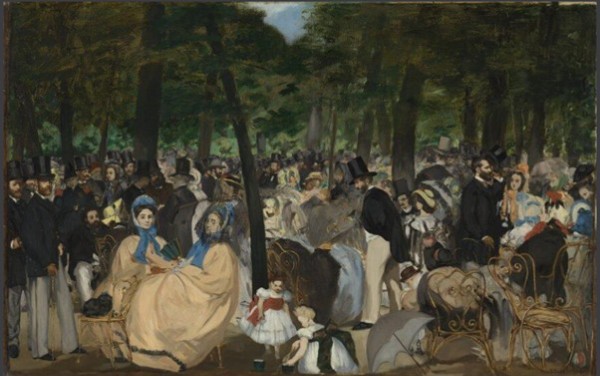
Manet: Music in the Tuileries Gardens, 1862 (London: The National Gallery)
In his music, Popp supplies us with the music that is invisible in the painting, starting with the orchestra’s tuning. They launch off, not particularly impressively, and then become part of the painting, traveling from person to person and capturing their spirit.
William Popp: The Galleries – I. Music in the Tuileries Gardens (York Symphony Orchestra; Lawrence Golan, cond.)
We now travel back in time to El Greco (1541–1614) and his painting Fable. A young man is blowing on a burning ember. It lights up his face and takes the attention of the monkey on the left and a young man on the right. Everyone is caught up in the moment, and each gazes on the light with a different expectation: the monkey in puzzlement, the centre figure is caught up in keeping it alight, and the man on the right, fascinated but wary.
The title comes from Pliny the Elder, who, in Medicine, volume 32 of his Naturalis Historia (77-79 AD), reflects on the harmful effect that high living may have on morality. The young man and the monkey were common representations of sexual desire in paintings of the period.
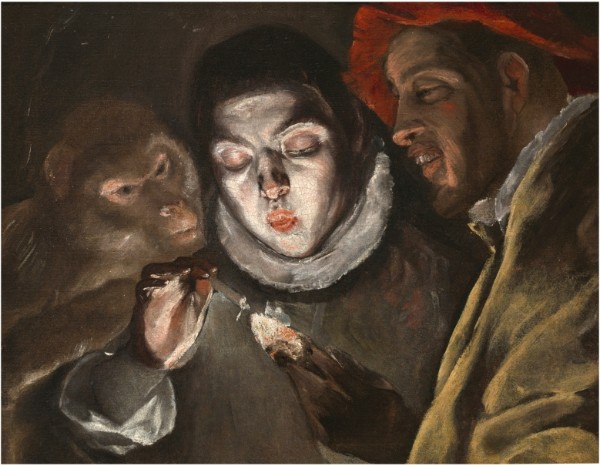
El Greco: The Fable, 1580 (Madrid: The Prado)
Popp’s music picks up on the darkness of the image and the ambiguity of the three figures. Important forces are in motion when our innocent blunders into the midst of them with his jolly melody.
William Popp: The Galleries – II. The Fable (York Symphony Orchestra; Lawrence Golan, cond.)
We return to the outdoor sun with August Renoir (1841–1919) and his Girl with a Hoop of 1885. The nine-year-old Marie Goujon was painted on commission for her father, Sénateur Étienne Goujon [Etienne Devilliers]. In the painting, a brown-haired girl with her hair tied back with a blue ribbon and dressed in a light blue dress with a darker blue sash that matches her hair ribbon, stands holding a hoop in her left hand and a stick in her right hand. Her blue socks match the ensemble, and her black shoes are ready to carry her off at a run. She stands, cheeks flushed, looking expectantly at the viewer. Behind her is lush vegetation and flowers.
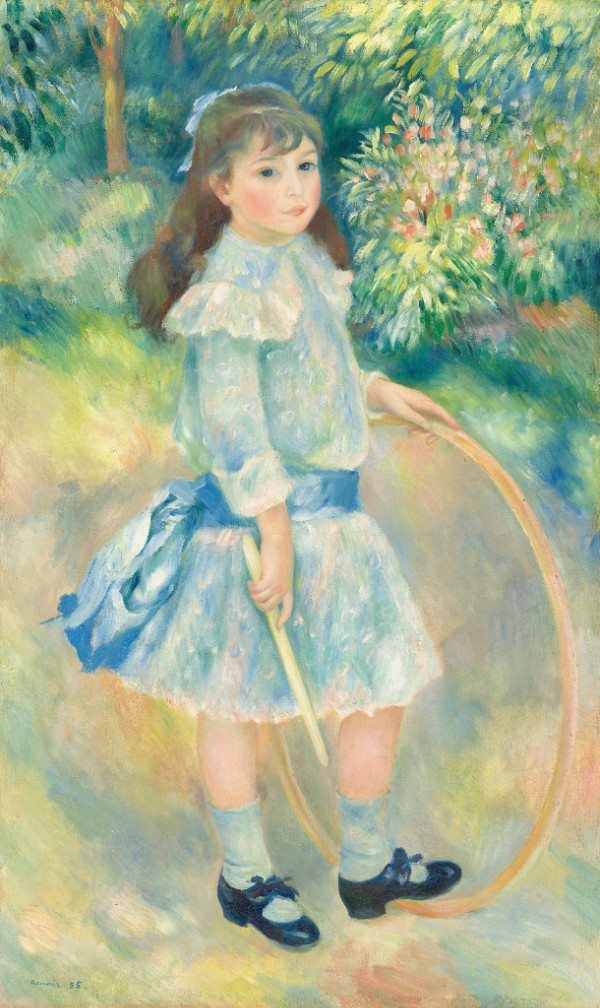
Renoir: Girl with a Hoop, 1885 (Washington, DC: National Gallery of Art)
In his music, Popp gives us the child’s day, which just starts with the hoop. There’s running and jumping, and sitting to watch something very carefully, and, perhaps, a cat.
William Popp: The Galleries – III. Girl with a Hoop (York Symphony Orchestra; Lawrence Golan, cond.)
We close in the sunny south of France. Wheat Field with Cypresses of 1889 by Vincent van Gogh (1853-1890) was part of a series he was working on featuring the dark, towering trees. He saw this as one of his ‘best’ summer landscapes, and after this one, painted outdoors, made a copy now in London at the National Gallery and a smaller one for his mother and sister held in a private collection.
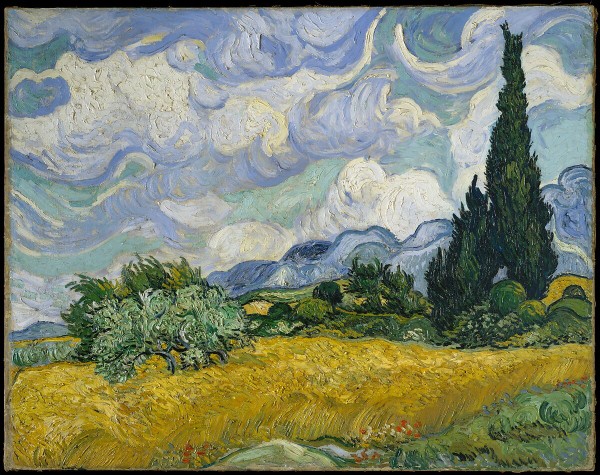
Van Gogh: Wheatfield with Cypresses, June 1889 (New York: Metropolitan Museum of Art)
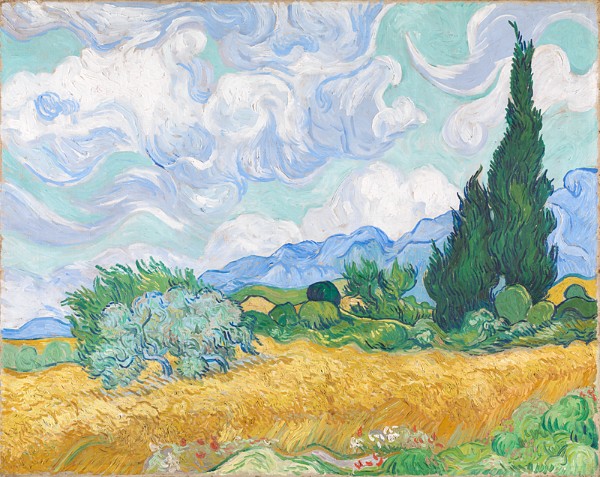
Van Gogh: A Wheatfield, with Cypresses, September 1889 (London: The National Gallery)
In June 1889, van Gogh voluntarily entered the psychiatric hospital of Saint-Paul de Mausole, in the village of St-Rémy in the south of France. The second version, painted indoors at the hospital, smooths away the character of the clouds and the features of the wheat and the greenery.
In his music, Popp explores the internal van Gogh, with days of utter happiness followed by his massive depressions. Van Gogh wrote of his variable temper at the time: ‘Sometimes moods of indescribable anguish, sometimes moments when the veil of time and fatality of circumstances seemed to be torn apart for an instant’. After a mighty crash on the gong, the character of the work changes and eventually, a version of the Dies Irae flows through, presaging the artist’s suicide the following year.
William Popp: The Galleries – IV. Wheat Field with Cypresses (York Symphony Orchestra; Lawrence Golan, cond.)
One of the joys of a collection like this is that it is not constrained by any reality – the pictures are in collections from around the world, yet have come together because one composer saw them as being together in the gallery in his mind (and his music). The Manet and El Greco are dark images, but for very different reasons: the Manet because of the clothing and the shadow under the trees and the El Greco for its focus on the face of the central figure. Both Renoir and van Gogh are set outside, but where the young girl has her future ahead of her, van Gogh is looking at the dark side of his soon-to-be-ended life.
For more of the best in classical music, sign up for our E-Newsletter