Inspirations Behind Judith Weir’s Heroic Strokes of the Bow
Many of Paul Klee’s paintings have made it into music, especially his Twittering Machine.
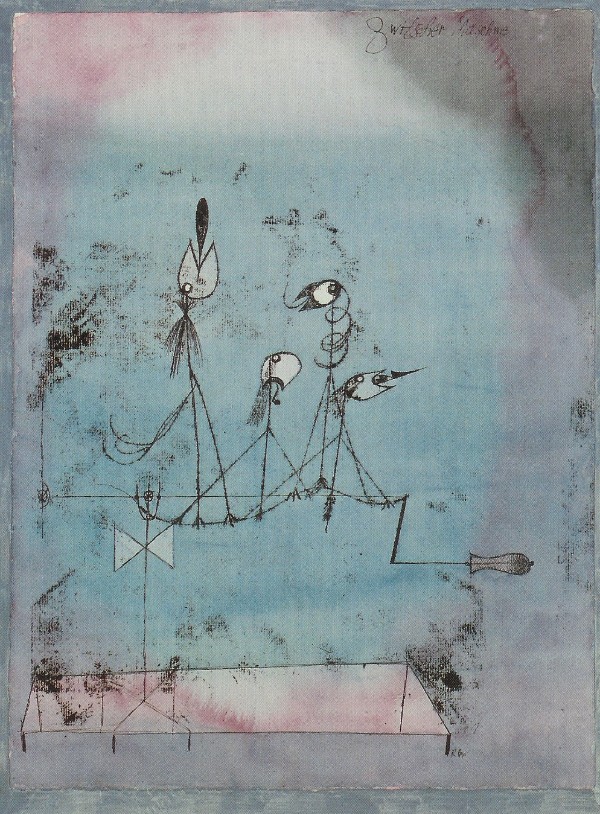
Klee: Die Zwitscher-Maschine, 1922 (PK 1922, 151)
Composers have written their own twittering machine music for symphony orchestra, flute and computer, String quartet, guitar trio with flute and clarinet, and even piano, marimba, and chamber orchestra.
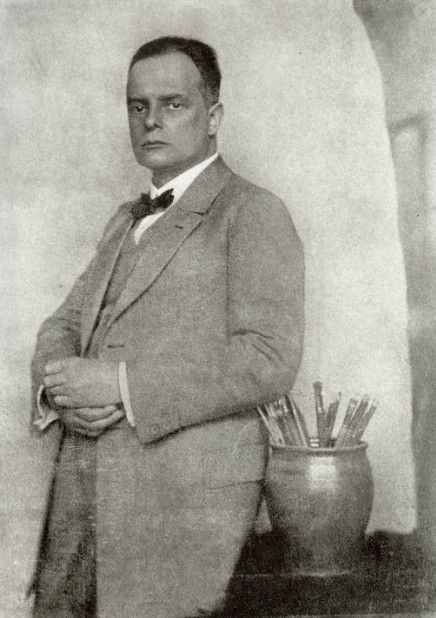
Paul Klee
If we turn the example around, we have an occasion where Klee painted elements of a musical instrument, the bow and pegs of a violin, along with other designs, not specifically related to a violin, and that has been turned into music.
The painting, in blue and black, used pink newsprint for its canvas. In today’s digital world, we’re not used to coloured newsprint but, starting in 1893, London’s Financial Times started to be printed on salmon-coloured paper, to make it stand out on the news stand; other papers, such as The Economic Times, followed. Newspapers went pink because, at the time, it was less expensive to dye newspaper pink than to bleach it white.

The Financial Times on a newsstand
To return to Klee. In the painting, the newsprint of the paper is visible through the blue background as vertical type. For stability, the newspaper has been pasted on dyed cloth on a board. By using a recognizably financial newspaper as his basis for support for a work on music, is Klee making a statement about the ongoing Nazi degenerate art exhibition? Klee lived in Switzerland, outside of Germany’s control, but was very much observant of the situation in Europe. Another painting from the same time, with many of the same attributes, including a similar title, was his Heroische Rosen (Heroic Roses).
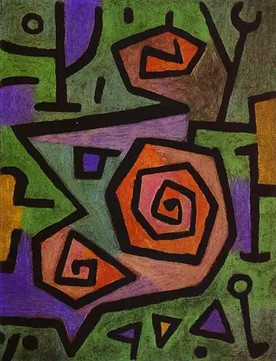
Klee: Heroische Rosen, 1938 (Düsseldorf: Kunstsammlung Nordrhein-Westfalen)
Against the blue background, looking almost like hieroglyphics, are curves and zigzags in black. Said to be a tribute to the violinist Adolph Busch, who was a friend to Klee, the painting takes some of the design elements of a violin and reduces them to lines.
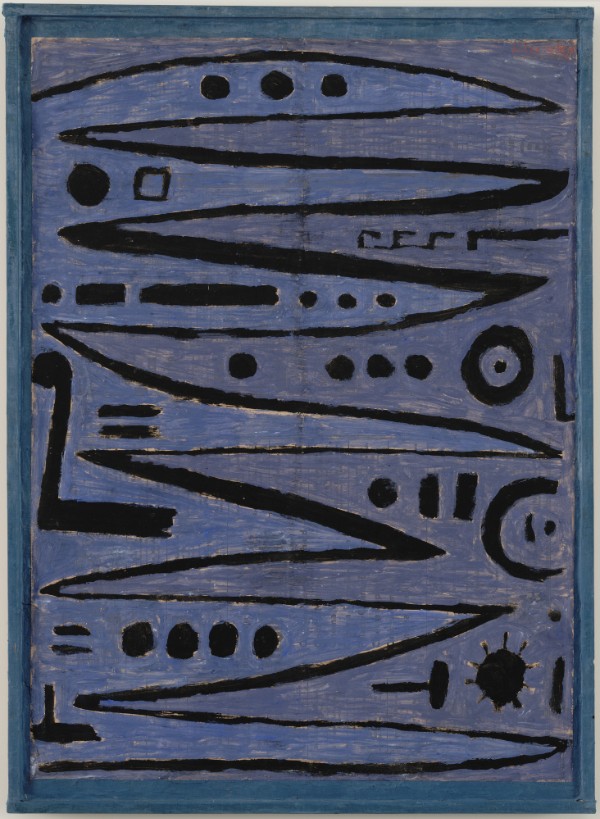
Klee: Heroic Strokes of the Bow (Heroische Bogenstriche), 1938 (New York: Museum of Modern Art)
In reality, a violin bow has a very specific shape that brings the hair of the bow (generally made from a horse’s tail hair) into tension, so it will make the violin strings resonate. In his painting, the details of a bow have been reduced to a straight line and a curve, which is more like someone’s idea of a bow (being more like the bow of a bow and arrow) than a violin bow.
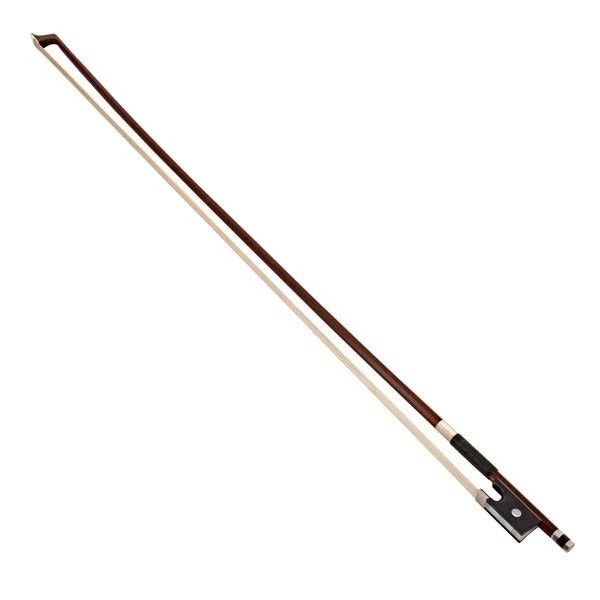
Modern violin bow
The tuning pegs, which attach to stretch the strings across the violin and are used to micro-adjust the length of the string to keep pitch, are also represented in a sketch-like way.
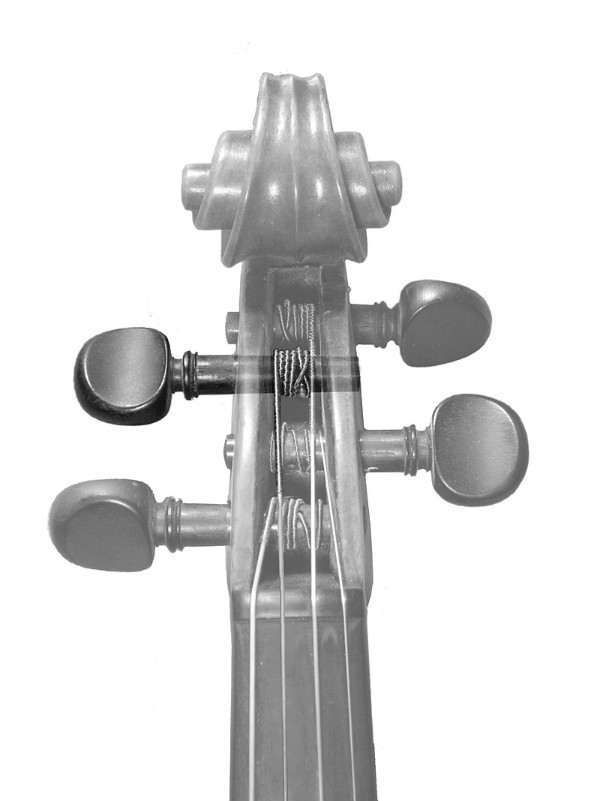
Violin pegbox with tuning pegs (image by Just plain Bill)
The other elements in Klee’s picture are up to your imagination.
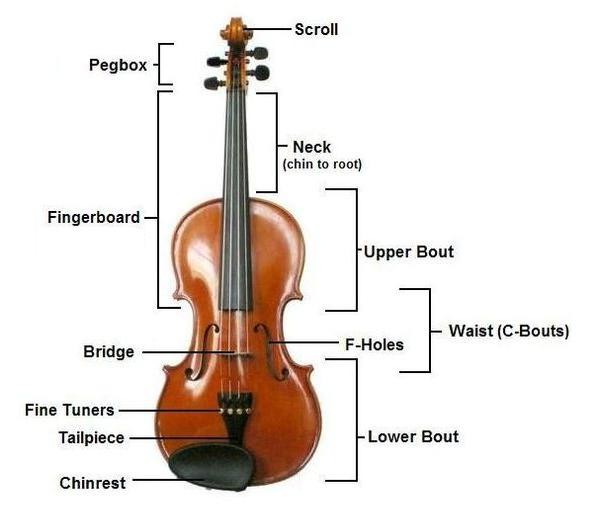
Parts of the violin (image by Sotakeit)
The 4 dots at the bottom could be the four strings viewed end-on, the L-shaped element on the left side could be a stylized idea of a violin from the pegbox down to the tailpiece or s stylized version of the F-holes. There are so many ways the images could be read; we’re better off appreciating them and not defining them.
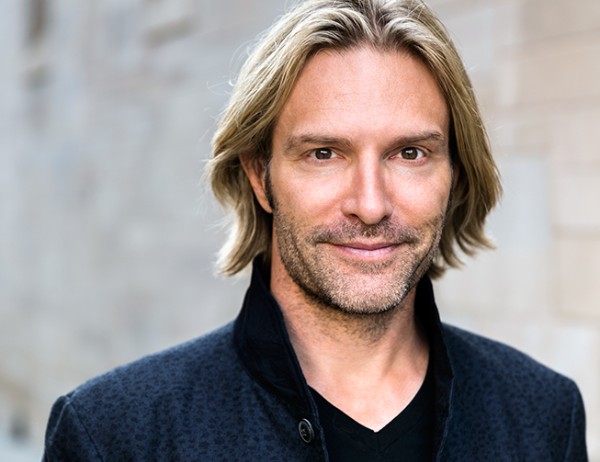
Scottish composer Judith Weir used the Klee image as the inspiration for her 1991–1992 work, Heroic Strokes of the Bow, written for small orchestra. The composer links the work by title with the Klee image, but in its internal structure with early 19th-century symphonies, not the least through the word ‘Heroic’ in the title. Unlike Beethoven, Weir’s use of the word is more ironic than defining.
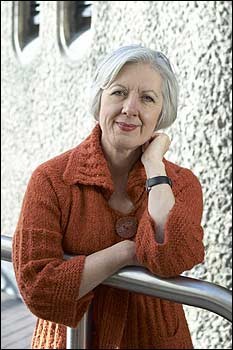
Judith Weir
For Weir, the violin can be seen as an absurdity, in her words, an instrument that has ‘excessive physical energy applied to a small piece of wood’. And thus, she starts her piece with the violins busily energetic. The rest of the orchestra contributes isolated notes and chords while the violins attempt to create a centre. Finally, the elements come together: ‘a repeated single pitch, an angular aspiring motif, a syncopated figure of interlocking arpeggios, a rogue E natural “irritant” disrupting the home key, and then a calmer “second subject’–like melody in overlapping low flutes and violins’ to create the outlines of what could very much be called a neoclassical sonata movement. By the end of the work, the staggering, stuttering fragments have come together and the ‘orchestra has learned to sing’.
Judith Weir: Heroic Strokes of the Bow (BBC Symphony Orchestra; Martyn Brabbins, cond.)
Heroic Strokes of the Bow was written for the Westdeutsche Sinfonie and its conductor, Dirk Joeres, and received its premiere in 1992.
As a representation of Klee’s work, Weir’s starts with interrupted statements that could be equated to running your eyes down the various elements of the painting. By the time the work has come together at the end, we’ve stepped back and are taking a look at the full painting, focusing not on the details, but on the overall effect.
For more of the best in classical music, sign up for our E-Newsletter