Although Iveta Apkalna is one of Europe’s most celebrated organists, she has never held a traditional church post. Instead, her titular position at the Elbphilharmonie in Hamburg, a concert hall rather than a house of worship, reflects a path that is increasingly common among a new generation of virtuosos.
Apkalna belongs to a growing cohort of organists whose careers unfold not from choir lofts but from international stages, a trajectory underpinned by more than fifteen acclaimed recordings that reveal the full expressive range of the modern instrument.
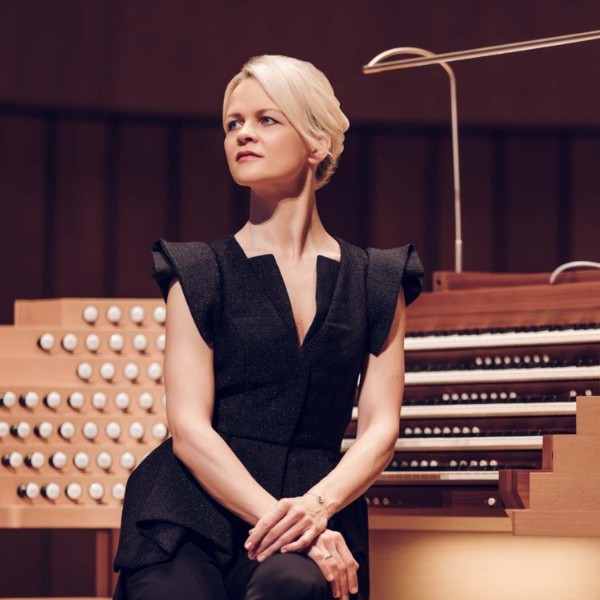
Iveta Apkalna © Ko-Cheng Lin
To celebrate her birthday on 30 November 1976, let us take a closer look at how Apkalna reshaped the evolution of the organist’s profession in the 21st century.
Iveta Apkalna performs Pärt: Spiegel im Spiegel
A Tradition Reinvented
The evolution of the organist’s profession is often described as slow, bound to centuries-old traditions and liturgical expectations. Yet Apkalna’s career demonstrates that the 21st century has reshaped this venerable role with surprising speed.
For much of the instrument’s history, the organist was first and foremost a servant of the church, an employee with weekly duties, tied to a specific instrument and a specific community. The most famous names of the Baroque, from Buxtehude to Bach, built their reputations from cathedral lofts and town churches.
For centuries, an organist’s artistic output was anchored in the demands of religious life, and well into the 20th century, the typical career still revolved around a blend of church employment, teaching, and occasional recitals.
Iveta Apkalna performs Bach: “Wachet auf, ruft uns die Stimme,” BWV 645
Into the Secular Spotlight
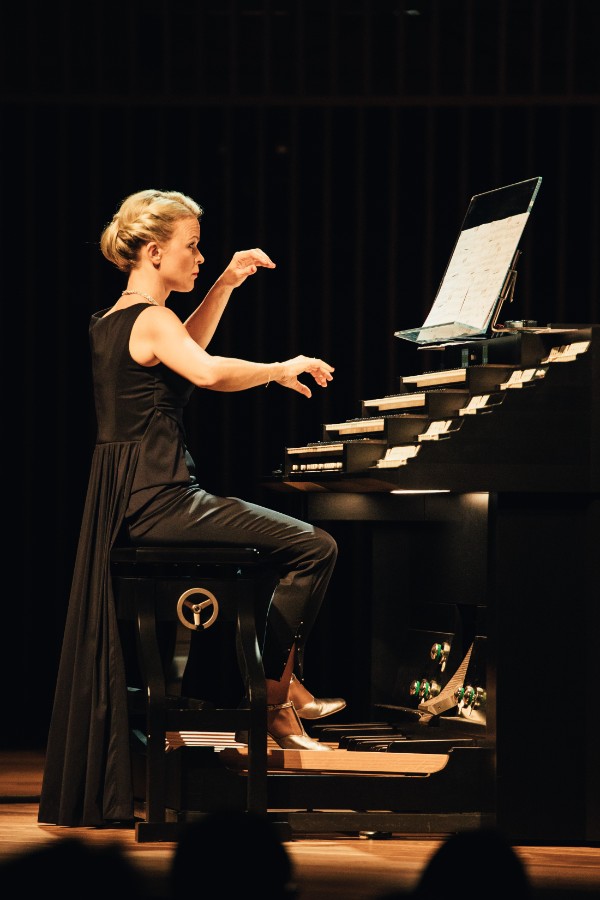
Iveta Apkalna © Kristaps Anskens
Apkalna represents a departure from this model. Her musical formation prepared her not for liturgical service but for the concert stage. Her ambitions were shaped not by the rhythms of the liturgical calendar but by the repertoire that allows the organ to flourish as a symphonic, expressive, and theatrical instrument.
The modern organist, in her hands, becomes not a custodian of tradition but a performer in the full sense of the word. It is one who tours, records, and commissions new works by treating the organ as part of contemporary musical culture.
Her appointment in 2017 as the first titular organist of the Elbphilharmonie was symbolically important. A concert hall granting the title traditionally associated with cathedrals marked a subtle but profound shift, with organ performance moving from sacred to secular spaces.
Iveta Apkalna performs Poulenc: Organ Concerto
Beyond the Choir Loft
Apkalna’s role at the Elbphilharmonie is not to accompany hymns or guide congregational singing. Rather, she explores a vast repertoire ranging from Bach to Pärt, and extends it through ongoing collaborations with living composers.
Church positions come with inevitable constraints like limited rehearsal time, duties that prioritise liturgical practicality over artistic exploration, and instruments that may be sonically beautiful but not always suited to a broad concert repertoire.
The concert hall, by contrast, offers the freedom to program at will, enabling organists to craft long-range artistic projects and build personal narratives through recordings, recital cycles, and commissioned works.
Charles-Marie Widor: Organ Symphony No. 5 in F Minor, Op. 42, No. 1: V. Toccata: Allegro (Iveta Apkalna, organ)
Artistry Without Constraints
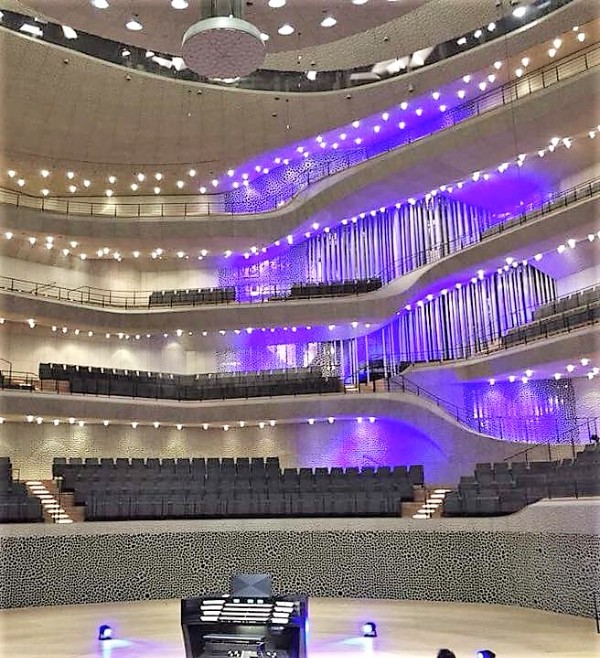
The Elbphilharmonie’s Klais organ
The Elbphilharmonie’s Klais organ, with its 69 stops and richly varied sound palette, becomes her laboratory, and this freedom is central to the modern concert organist. Apkalna’s discography displays an unusually wide range. These recordings document her artistic identity more vividly than any fixed church position might have permitted.
Her example mirrors a wider trend. Around the world, new organs are increasingly installed not in religious spaces but in cultural ones. Concert halls in Hamburg, Paris, Katowice, Los Angeles, Copenhagen, and Shenzhen have invested in state-of-the-art instruments that place the organ alongside orchestras and visiting soloists.
These instruments are not designed for worship but for spectacle, for adventurous programming, and for integration with multimedia, electronics, and newly commissioned repertoire.
Iveta Apkalna performs Kalējs: Lux aeterna
A Bridge Between Past and Present
This shift does not diminish the historical connection between the organ and the church, but it does broaden the instrument’s cultural reach. Apkalna herself often speaks about the organ as a bridge between past and present, and between tradition and innovation.
Her performances frequently retain a spiritual dimension even outside a sacred context, as the organ’s resonance remains intact whether it stands under a Gothic vault or a modern acoustic canopy.
Ultimately, Apkalna’s career exemplifies how the organist of the 21st century can honour the legacy of the instrument while expanding its horizons. She shows that virtuosity, curiosity, and artistic independence can lead to a life in music that is both deeply rooted and profoundly contemporary.
For more of the best in classical music, sign up for our E-Newsletter