Frédéric Chopin’s brief engagement to Maria Wodzińska, a young Polish countess and gifted artist, is one of the most overlooked moments of his love life.
Born in 1819 to an aristocratic family, Maria first met Chopin when she was just a child. Their families were close friends, and he even gave her informal piano lessons.
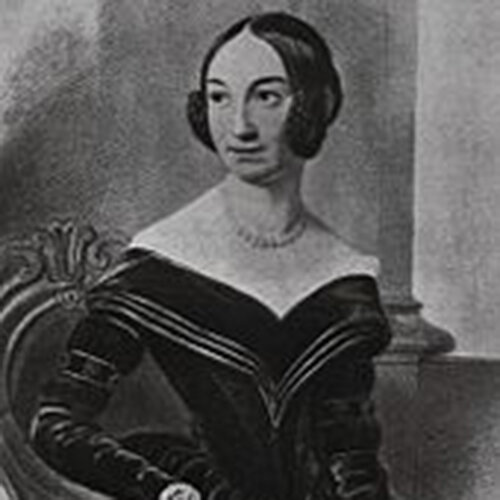
Maria Wodzińska, year 1840
Their love story – complete with a romantic twilight proposal, a meddling future mother-in-law, and ultimately heartbreak – offers a revealing glimpse into Chopin’s human side.
At the same time, Maria Wodzińska was more than just “Chopin’s fiancée.” She was also an accomplished musician and artist in her own right. In fact, if you’re a classical music lover, you’ve probably seen her artwork without knowing it.
Today, we’re looking at the life of Maria Wodzińska.
Meeting Maria Wodzińska
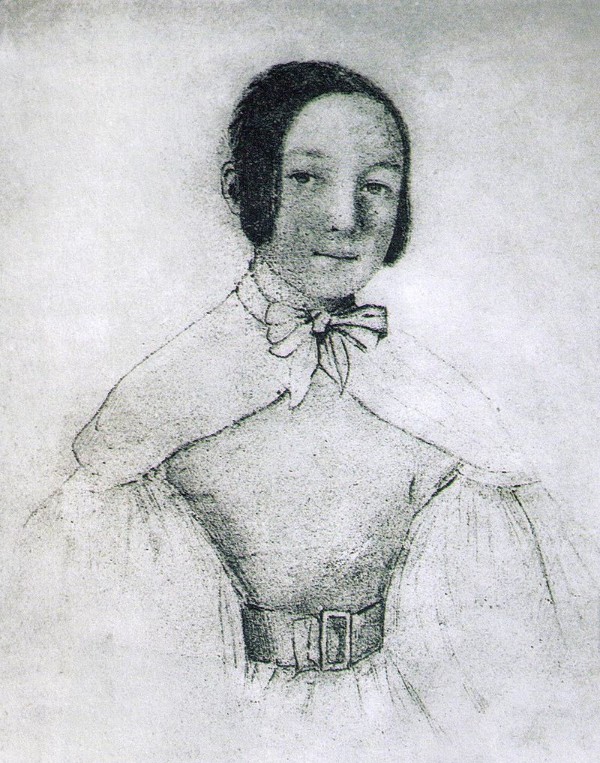
Maria Wodzińska self-portrait in the 1830s
Maria Wodzińska was born to a Polish count and countess on 7 January 1819, the middle of five children.
Three of her brothers attended the Warsaw school where Chopin’s father taught, and those brothers boarded with Chopin’s family for a year.
In the 1820s, the two families became friends and regularly visited each other.
Chopin may have been nine years older than Maria, but he still enjoyed running around the house and playing games with her.
He also gave her informal piano lessons whenever she visited Warsaw.
The November Uprising and Exile
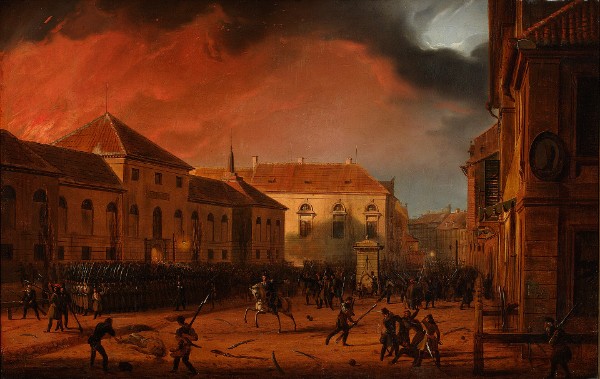
The November Uprising
Her idyllic childhood was shattered in November 1830, when the November Uprising occurred.
The November Uprising was a Polish revolutionary movement directed against the dictatorial Russian occupiers.
Chopin had left Warsaw shortly before the uprising began in order to advance his international career. But what could have been a temporary trip turned into a painfully permanent exile, resulting in acute homesickness and a defiant sense of patriotism that would colour his works for decades to come.
As for the Wodzińskis, they decided to leave Poland in late 1831 to wait out the political unrest. The family moved between Berlin, Dresden, and Geneva.
Becoming a Teenager
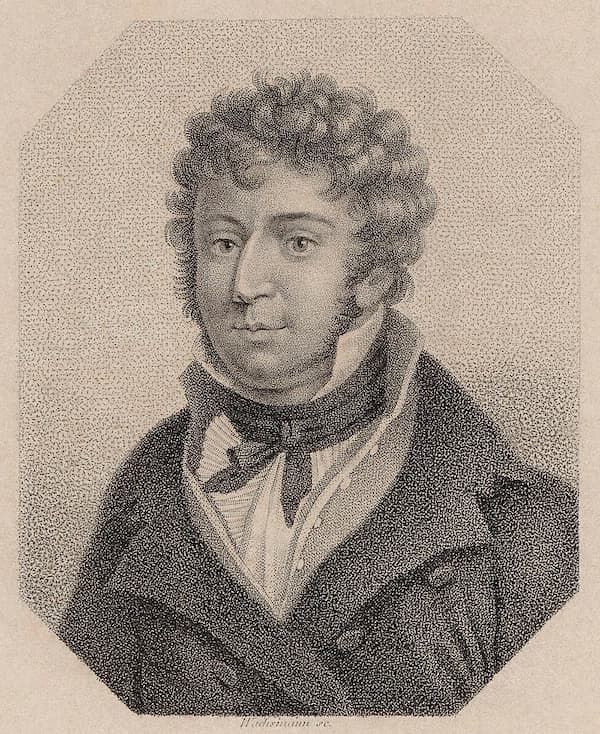
Anton Wachsmann: John Field, ca 1820 (Gallica: btv1b84179686)
As she grew into a teenager, Maria developed her multiple artistic talents.
She studied piano with John Field, the same composer who pioneered the piano nocturne, a genre that Chopin would later perfect.
Field’s Nocturne No. 9
She also studied art at the Geneva Academy and became a talented artist. In fact, she would end up drawing one of the most iconic images of Chopin ever made when she was just a teenager.
She also had a number of admirers. The most politically prominent was Prince Louis-Napoleon, the future Napoleon III and a nephew of Napoleon Bonaparte.
Another admirer was Polish poet Juliusz Słowacki, who had to leave Poland to live abroad after the uprising.
All were taken by her charm, intelligence, and talent, but she wasn’t interested – or old – enough to pursue them.
Meeting Chopin Again
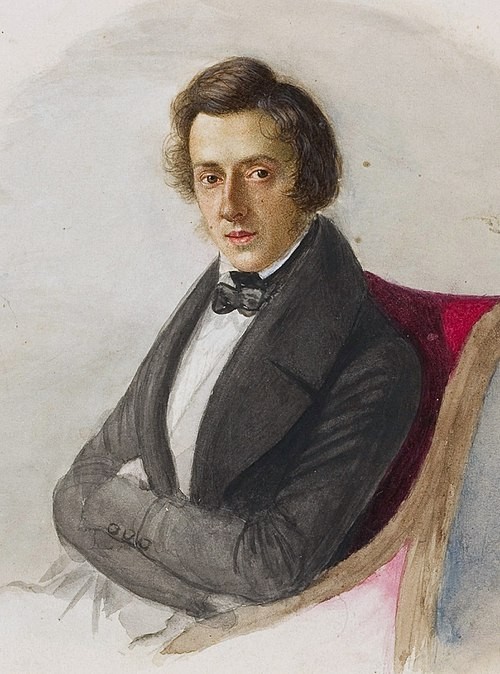
Maria Wodzińska: Chopin, 1836 (National Museum in Warsaw)
In 1834, the Wodzińskis sent their first invitation to Chopin to come visit them in Geneva.
His schedule kept him from accepting, but he did send a copy of his Waltz in E-flat-major, Op. 18 to them, autographing it to Maria.
Chopin’s Waltz in E-flat-major
In reply, 15-year-old Maria sent him a set of variations that she had written herself.
There is frustratingly little in the historical record about how much she composed, or what Chopin’s reaction to these variations was, but at least we know that she composed.
In 1835, Chopin went to visit his parents in Karlsbad. On his way back to his home in Paris, he stopped in Dresden, where he went to see the Wodzińskis.
At the time, Maria was sixteen, and Chopin was 25. He was enchanted by her, and the attraction was mutual.
They spent time exploring the beautiful city of Dresden together, visiting art galleries and tourist sites (chaperoned by her mother, of course).
On 22 September, he copied out the first few measures of his Nocturne in E-flat-major, Op. 9, No. 2, captioning it with the benediction “be happy.”
When he left, Chopin gifted her his Waltz in A-flat major, Op. 69, No. 1. It is sometimes known as “L’Adieu” (“The Goodbye”), but Maria wrote that word on the score, not Chopin.
Chopin’s Nocturne in E-flat-major
Chopin’s Waltz in A-flat major
A Scandalous Soiree
A semi-scandalous event occurred in Dresden when Chopin performed in the Wodziński salon.
In front of a number of illustrious guests, Chopin played a few of his own pieces, then improvised on a patriotic Polish song called “Poland Has Not Yet Perished.”
This song has an inflammatory lyric: “What the aliens have taken from us / We shall retrieve with a saber.”
Given the Polish revolutionary movement, Chopin playing that particular song sounded like a coded call to arms against the Russians. And unfortunately, there were two diplomats from Russia in the audience.
According to Chopin biographer Alan Walker, the Wodziński family was “told it might be in their best interests to leave Dresden.”
The Proposal
Despite the headaches Chopin had caused with his political statement, the Wodzińskis still kept in touch with him via letter.
Maria even wrote to him about how the family thought of him as a fourth son. He appears to have embraced the idea, given that he felt unsafe or at least unwelcome returning to his biological family, still trapped in Warsaw.
The next year, in the summer of 1836, he and the Wodzińskis met up in the spa town of Marienbad, spending two months together at the same hotel. He arrived on 28 July 1836.
During that trip, Maria made her famous sketch and watercolour of him.
They spent a delightful few weeks together. At the end of the summer, on 9 September 1836, the night before his departure, Chopin proposed to her in the twilight, and she accepted.
However, the men in the family weren’t keen on the match given Chopin’s poor health, free spirit, and lack of financial prospects.
So for the time being, the couple’s only confidant was Maria’s mother. She asked them to keep the engagement secret until she could bring the men of the family around.
That summer, Maria’s father was in Poland, trying to arrange for the return of their Polish estate post-uprising, and was unable to be convinced in person.
It was understood that once things were straightened out, the family was going to return home to Poland.
It was also understood that if he married Maria, Chopin would likely follow them and give up his cosmopolitan, bohemian career in Paris.
A Failed Long-Distance Relationship
After Chopin left Marienbad, the couple resumed their relationship by letter, but it was difficult for them to connect emotionally while dating long-distance. Plus, all of their letters were monitored by Maria’s mother.
The elder countess turned controlling, insisting that Chopin keep to an 11pm bedtime and wear the stockings and slippers that Maria had made for him, then criticising him for lying about it when he didn’t respond. (Chopin wrote back, a touch indignantly, “As I respect you, I assure you that I am not lying: I do remember my slippers, and when I play I think of ‘the twilight hour.”)
In January 1837, a letter with a rude and unpleasant tone arrived from Maria’s mother, with nothing but a bland postscript from Maria herself.
Chopin seems to have been upset that Maria wasn’t willing to stand up for him. The teenager’s attention was drifting, and her strong-willed mother was starting to micromanage the relationship.
The next month, Chopin got sick with a bad case of influenza, which infuriated the countess; she still thought he wasn’t taking appropriate measures against illness.
To add insult to injury, Maria’s brother borrowed money from both Chopin and his father, and then didn’t pay it back to either in a timely fashion.
It was clear by the summer of 1837 that this relationship was doomed.
At some point that year, Chopin realised it. He tied up letters from the family in a bow and curtly labeled the stack “My sorrows.”
Maria’s Marriages
On 24 July 1841, at the age of twenty-two, Maria married Józef Skarbek, the wealthy son of Chopin’s godfather Fryderyk Skarbek.
Chopin’s sister Ludwika wrote to her brother telling him the news. She believed that Skarbek was looking for a wife to take care of him, not a true life partner, and felt that Skarbek was getting the better end of the bargain.
Ludwika’s words were prophetic; the marriage was unhappy, and within a few years, they were divorced.
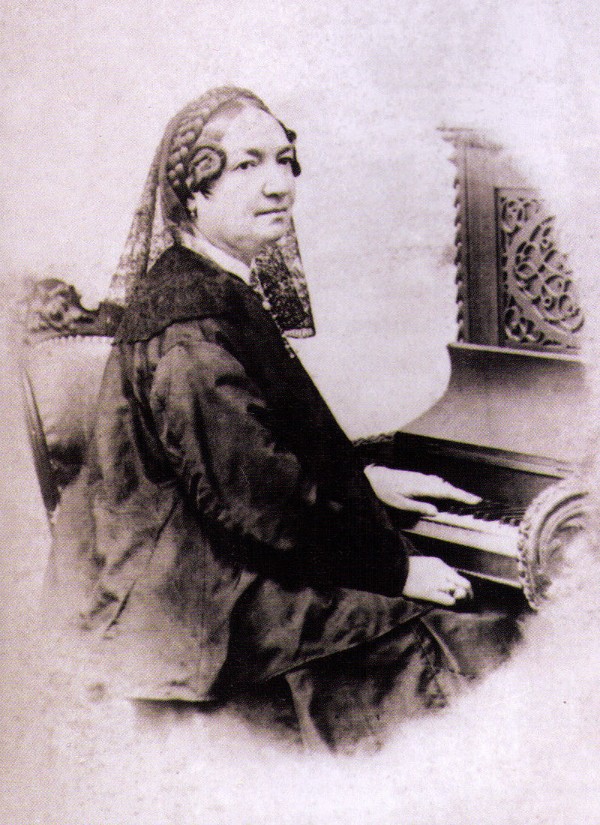
Maria Orpiszewska
Maria remarried on 26 October 1848 to Władysław Orpiszewski, a leaseholder of her first husband’s estates.
Her family disapproved of this second match and even cut off contact with them. But despite her family’s disapproval, the marriage was happy.
They had one child together, but he died tragically at the age of three.
Maria’s Death and Legacy
Biographical information about her life past that point remains scant.
We know that Orpiszewski died in 1881 in Florence, and that Maria moved to live with her niece.
She ended up dying on 7 December 1896 and was buried in the village of Kłóbka in Poland.
Maria Wodzińska has often been critiqued and criticized in Chopin biographies as passive, which seems rather unfair. After all, he was just sixteen when they courted! She was still learning how the world worked, and what role she would be playing in her dysfunctional family’s dynamic.
Plus, she ultimately ended up developing a certain amount of assertiveness, given that in her late twenties, she divorced her husband and married someone her family didn’t approve of.
It is fascinating to consider what might have happened if she and Chopin had married, and how different their lives would have been if he’d returned to Poland with her.
Maybe their life together would have been very happy and productive…or maybe Chopin would have spent years raising their children and embroiled in her family’s various petty dramas, with little time to compose. Maybe in the end, drifting apart from him was a gift she unknowingly gave to music lovers of the future.
For more of the best in classical music, sign up for our E-Newsletter