The composer Louis Wayne Ballard (1931–2007) was awarded his master’s degree in music from the University of Tulsa, Oklahoma, in 1962. He had private composition lessons with Milhaud, Castelnuovo-Tedesco, Surinach, and Labunski and worked for the Institute of American Indian Arts (IAIA) in Santa Fe, New Mexico.
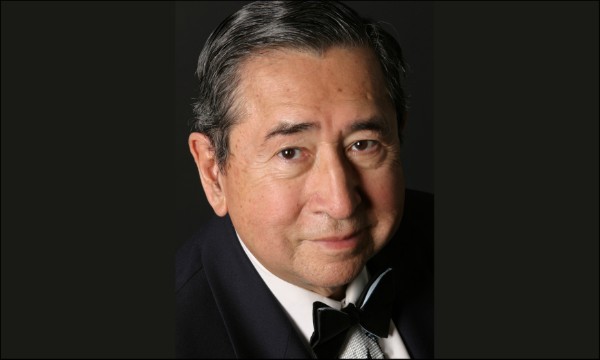
Louis Wayne Ballard
A member of the Quapaw tribe from Oklahoma, Ballard, also known as Honganózhe (Grand Eagle), found that his students learning music at the IAIA didn’t know their own native music, and this became the focus of his life. He collected Indigenous North American songs, taught those songs in his classes and spoke about them in his public lectures. He also made them part of his own compositional process, incorporating not only songs, but also instruments and characters into his works.
He wrote a series of six orchestral works under the title of Fantasy Aborigine, each with a subtitle focusing the work on a different tribal area: Fantasy Aborigine No. 1, Sipapu, written in 1963, takes its name from a feature in the floor of a Hopi kiva. Fantasy Aborigine No. 2, Tsiyako (1976), is a mythological creature from the Pacific Northwest. Fantasy Aborigine No. 3, Kokopelli (1977), is the flute-player with a humped back in Hopi culture. Fantasy Aborigine No. 4, Xactee′oyan, Companion of Talking God (1982), refers to deities in the Navajo culture. Fantasy Aborigine No. 5, Naniwaya (1988), is a sacred mound in the Choctaw culture of Mississippi, considered the original place of the Choctaw people. Fantasy Aborigine No. 6, Niagara (1991), refers to the famous falls that take their name from an Iroquois word. The breadth of references in these works gives an indication of Ballard’s wide-ranging research.
Of these six works, the best known is No. 3, based on the trickster god Kokopelli.

Kokopelli
The work was commissioned by the Flagstaff Symphony Orchestra and received its premiere in April 1977. Ballard talked about his concept of Kokopelli, who, because of his omnipresent flute, was imagined by Ballard as the ‘God of music of Native America’, a kind of modern-day Orpheus.
Louis Wayne Ballard: Fantasy Aborigine No. 3, “Kokopelli” (Fort Smith Symphony; John Jeter, cond.)
What we clearly have is an amalgam of European and American music, but American music from a variety of sources. The rhythms and the melodies are from Ballard’s research, but the construct of a Fantasy, even using the word ‘aborigine’, is distinctly from outside the Native American sphere.
One of the other ways that Ballard influences the sound is through the use of percussion from outside the European sphere, including ‘a hide bundle drum, a Yaqui Indian gourd water drum, Tewa seashell rattles, a Hopi rasp stick resonator, Hopi gourd rattles, and a cricket clicker’. The last is a metal clicker, introduced into Europe by the 101st Airborne, who used them on D-Day to quickly determine friend from foe – you click once, and if you got two clicks back, it was a good guy. They are now mostly used in dog training for positive confirmation; however, they do give a nice cricket sound.
Ballard was the first Native American to break into the realm of art music. If you remember, it was Dvořák who first advocated the use of Native American music in American music, but it was still decades before the integration of that music into ‘classical’ music became a norm.
Ballard wrote music for ballets, including Four Moons (1967), which was danced by four Oklahoma ballerinas from four different tribes: Moscelyne Larkin (Shawnee), Rosella Hightower (Choctaw), Marjorie Tallchief (Osage), and Yvonne Chouteau (Cherokee). Larkin had made her name dancing with the successor companies to Diaghilev’s Ballets Russes, the Original Ballet Russe and the Ballet Russe de Monte Carlo. Rosella Hightower also danced with the Ballet Russe de Monte Carlo before moving to New York, where she was a member of Ballet Theatre (now known as American Ballet Theatre, ABT). Marjorie Tallchief was “première danseuse étoile” of the Paris Opera Ballet and danced with The Ballet Russe de Monte Carlo and other companies. She was the younger sister of ballerina Maria Tallchief, famed for her work with George Balanchine at ABT. Yvonne Chouteau started work with the Ballet Russe de Monte Carlo at age 13, and danced with them for 14 years. The set of Native American ballerinas from Oklahoma was normally referred to as the Five Moons, with the addition of Maria Tallchief.
Ballard strove to both educate his students in the music of their tribes and to inform symphonic listeners about the wealth of music that was around them. His music includes elements that are strictly tonal and elements that borrow from atonal and twelve-tone theory. Behind it all, his own heritage, based in the music, the art, the dance, the literature, and the mythology of America’s indigenous cultures, informs everything.
For more of the best in classical music, sign up for our E-Newsletter