It’s not often you see a production of Rigoletto that focuses more on the louche women rather than the louche men. The revival production by Greek National Opera, originally staged in 2022, tried to set the scene in the ‘corrupt society of the Italian province of the 1980s’. Ah yes, the 1980s when men wore silver velvet suits with matching snap-brim fedoras next to men in baseball caps and plaid suits or swanned about in luxurious dressing gowns with long luxurious tails fanning behind them. I think it was a fever dream then, and now, it’s even more ludicrous. Even with revivals, you have to ask how today’s society has changed and how it will view what you’re showing, even three years away from the first production.
The debauchery in the Ducal court is shown through the married women (such as The Countess of Ceprano) in high-class golden gowns….and the low-class dancing girls in spotted or striped body suits with black leather bikini bottoms and tap shoes. The men stand around in groups, seemingly to hope a woman will come by so that they can grab her.
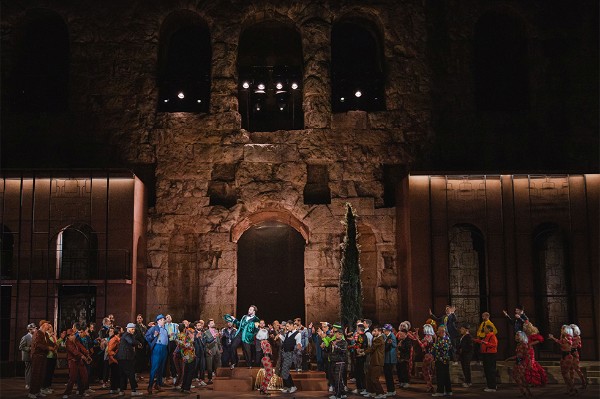
The debauched court of the Duke, 2025 (Greek National Opera)
When the orgy gets to its height, the girls, who have been dancing, posing, and doing the old bump and grind on the stage edge, strip down the top of their body suits to go top naked, except for the large black taped Xs over their nipples. More grinding and sex posing continue, except now the women are draped over the men. Really? This all seems to go for the obvious, when we can see from today’s politics that most corrupt and decadent administrations seem to have very few women involved at all.
Dimitris Platanias as Rigoletto didn’t quite catch the sharp, edgy court jester we’ve seen in other productions, but he seems to be sort of slugging his way through a situation that he was entirely fed up with. When he could exercise his edged tongue, it went well, but otherwise, he was lost in a sea of overly colourful courtiers. When he could escape from the court to be with his daughter or while negotiating with Sparafucile, he was much more powerful. In the court, however, especially in the scene where he’s trying to find his daughter, he just seemed very ineffective. Even when he came out to do his bows, he didn’t seem at all pleased that it was all over.
Nina Minassian as Gilda was not very effective at all. Her vocal lines didn’t flow, and you could feel her setting up her top notes and her doubts that she could land them. Her volume was uneven, and she wasn’t able to put across the innocent convent student well. Her costume was just poor – what looked like a green housecoat over white pyjamas just didn’t convey her character at all.
Liparit Avetisyan, as the Duke of Mantua, didn’t create a character that everyone was compelled to follow. He has the first big aria of the opera (‘Questa or Quella’) and to sing it while slapping the butts of the dancers made him look more opportunistic than evil. His ‘La donna é mobile’ did well, but when it comes again as Rigoletto is gloating over his supposed dead body, it just didn’t have the shock value that other productions have been able to instil. If the Duke had been at least visible, walking off singing it after his time with Maddalena, rather than seeming to sing it to Maddalena while they’re hidden in bed.
Giuseppe Verdi: Rigoletto (excerpts) – Act III: La donna è mobile (Liparit Avetisyan, tenor; Kaunas City Symphony Orchestra; Constantine Orbelian, cond.)
Some clevernesses: for the abduction scene, all the courtiers were disguised with big bobble heads of Marlon Brando.
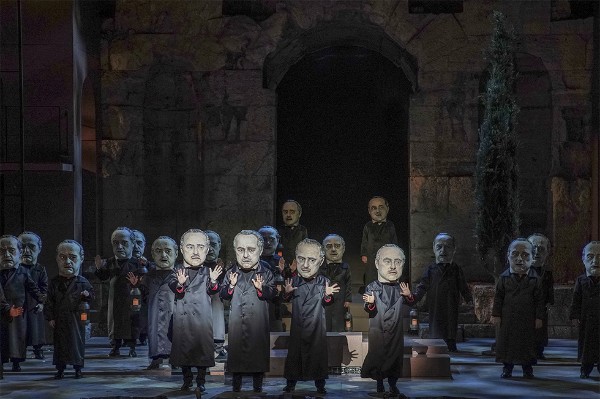
The Courtiers disguised in the abduction scene, 2025 (Greek National Opera)
What didn’t work was to put a duck head on Rigoletto. In that scene, he’s supposed to be holding the ladder the kidnappers use, but while that’s happening on the side of the house, he’s holding the gates of the house in rather a useless gesture. More attention really does need to be paid to the stage directions that were in the original libretto – without him as an active participant in the kidnapping, his presence doesn’t make sense just holding on to a locked gate.
The relationship between Gilda and the Duke / Gualtier Maldè is a bit of a puzzle. At the beginning, she doesn’t know who he is except for the name and that she’s seen him at church. After the kidnap scene, the shame of her rape gets sublimated into her unending love for him, despite how he acts toward Maddelena, Sparafucile’s sister (we’ll ignore the fact that the Duke is already married). Perhaps the message here is not to send your daughter to a convent school – sensibility seems to fly out the window!
The scene at Sparafucile’s house works well. The mousy Gilda is overwhelmed by the prostitutes in body suits and heels all over the neighbourhood. She discovers the infidelity of the Duke and that he uses those special love phrases not just with her but with every girl he meets. On the other hand, the Duke doesn’t seem to have a problem with making love to Maddelena on the street or bedding down on the roof just before an enormous thunderstorm starts on stage. Rigoletto proves his point to Gilda about the Duke’s faithlessness. His terrible surprise when he finds that the body in the sack is Gilda and not the Duke is well played out. As mentioned above, when the Duke sings his little ditty about unfaithful women again, it doesn’t come off as the shock it should.
Other things that didn’t make sense: The Count of Monterone, who comes looking for his daughter (cue one of the half-naked dancers to hide behind someone else), is dressed as a priest with a black gown and a reversed collar. Even in the debauched Italian court, this is supposed to be, Italian priests wouldn’t be bothering around the court for their lost daughters that they’re not supposed to have. Italy is still Italy in that regard. Yes, it’s great that Monterrone can appear in the centre archway, his gown billowing around him in the smoke as he holds up his mask-head above his head, but hardly credible. It’s all quite menacing, but somehow not effective. It also didn’t help that he showed up in the overture with his menacing head and billowing gown…before he’d even been killed. His curse against the court needed more fire and spit, as well as more attendees.
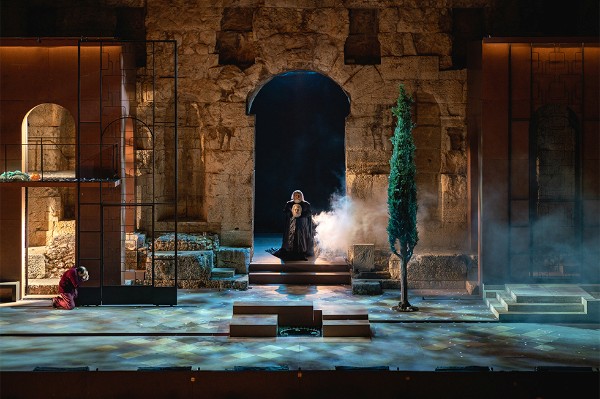
The Count of Monterone carrying his head, 2025 (Greek National Opera)
So we have the bump and grind of the court girls and the bump and grind of the prostitutes outside Sparafucile’s – what about the hump? It’s remarked on by the courtiers, but our Rigoletto does not, in fact, have this bodily defect. According to the director, Katerina Evangelatou, it is a metaphorical hump that is caused by the actions of the dissolute society in which he lives. Nice try, but it just makes him look like every other courter. It’s his difference that makes him what he is, not his sameness.
It’s perhaps indicative of the evening that the loudest applause and the cause for the house rising was when it came time to recognise the orchestra. They were outstanding, with special callouts to the flute section for the lightning during the storm scene at Sparafucile’s house. The conductor was Derrick Inouye.
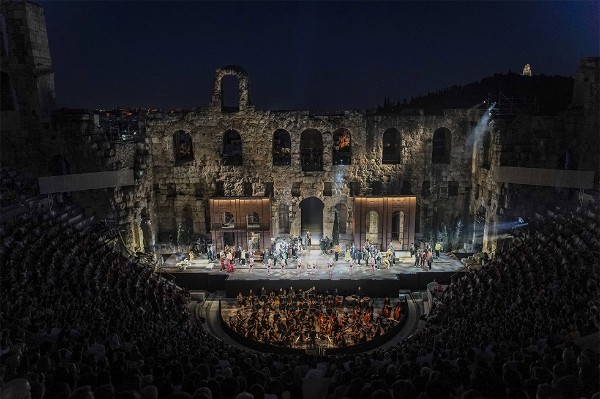
Rigoletto at the Herodion, 2025 (Greek National Opera)
Rigoletto
Greek National Opera
Odeon of Herodes Atticus
27, 29, 30, 31 Jul 2025, starting at 9 pm.
For more of the best in classical music, sign up for our E-Newsletter