Claudio Monteverdi (1567-1643) was the most important musician in late 16th and early 17th-century Italy, and the first great composer of opera. He developed powerful ways of expressing and structuring musical drama, and he is frequently hailed as the “creator of modern music.”
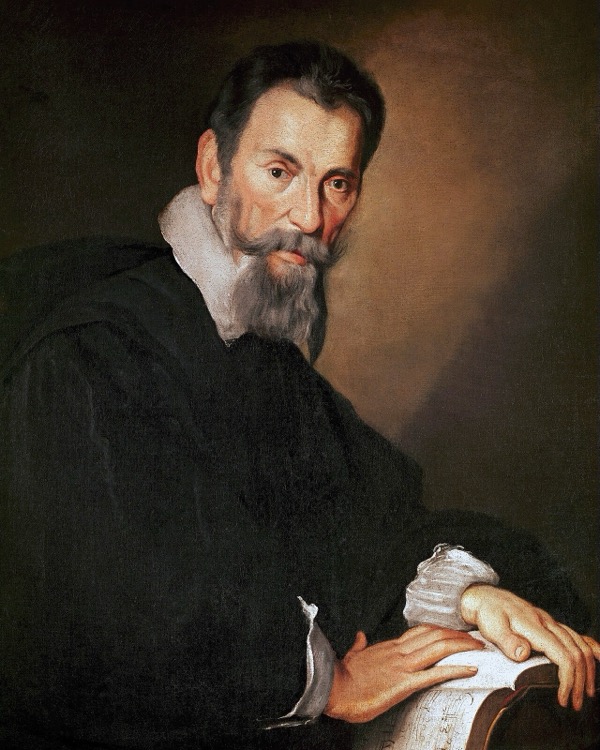
Claudio Monteverdi, oil painting by Bernardo Strozzi, c. 1630
Composing in nearly all the major genres of the period, Monteverdi instigated a paradigm shift in musical thinking that bid farewell to the late Renaissance and ushered in the artistic expressions of the early Baroque.
Claudio Monteverdi: Vespro della Beata Vergine, “composti sopra canti fermi” – Deus in adiutorium (The Sixteen; The Sixteen Orchestra; Harry Christophers, cond.)
Claudio Monteverdi: Vespro della Beata Vergine, “composti sopra canti fermi” – Psalm 109, “Dixit dominus” (The Sixteen; The Sixteen Orchestra; Harry Christophers, cond.)
Vespers and Vision
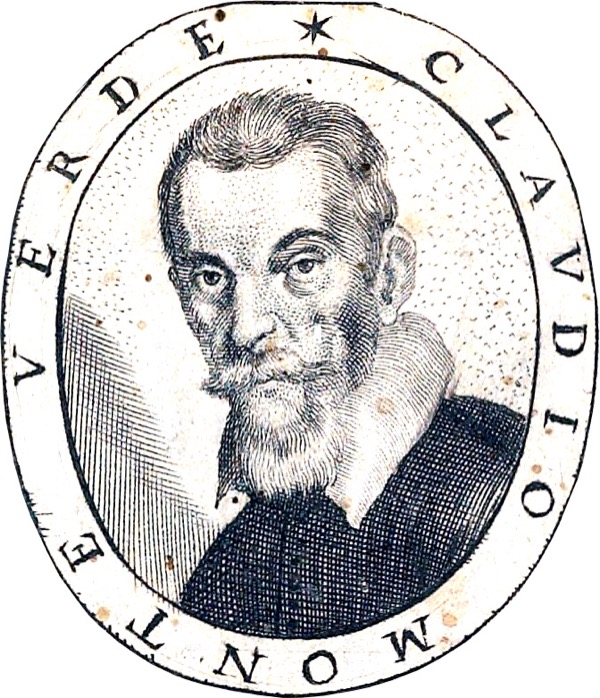
Claudio Monteverdi, engraved portrait from Fiori poetici, 1644
Monteverdi’s talent for communicating the whole range of human emotions propelled music into a completely new and almost modern consciousness. He composed at least eighteen operas, and the surviving works have lost none of their power and expressive force.
Probably born on 9 May, but certainly baptised on 15 May 1567, Monteverdi composed his Vespro della Beata Vergine (Vespers for the Blessed Virgin) in 1610, and to celebrate his birthday, let us explore one of the greatest works of sacred music ever written.
Claudio Monteverdi: Vespro della Beata Vergine, “composti sopra canti fermi” – Psalm 112, “Laudate pueri dominum” (The Sixteen; The Sixteen Orchestra; Harry Christophers, cond.)
Claudio Monteverdi: Vespro della Beata Vergine, “composti sopra canti fermi” – Psalm 121, “Laetatus sum” (The Sixteen; The Sixteen Orchestra; Harry Christophers, cond.)
Medieval Rite
Although published in 1610, individual movements of the Vespers had been composed at various times, and Monteverdi assembled them into a more or less coherent unit shortly before publication.
Vespers, in short, is the sunset evening prayer service of the Roman Catholic Rite. It remained virtually unchanged from the Middle Ages until 1970. Musically, it included psalms, hymns, and chanted lessons, and the text was delivered in a variety of ways.
The priest delivered his text in a monotone, yet slightly inflected to indicate punctuation. The psalms and Magnificat were sung slightly more elaborately, with each verse sung on a reciting note but intoned with a few rising notes and closing with a descending phrase.
Claudio Monteverdi: Vespro della Beata Vergine, “composti sopra canti fermi” – Concerto: Duo seraphim (The Sixteen; The Sixteen Orchestra; Harry Christophers, cond.)
Claudio Monteverdi: Vespro della Beata Vergine, “composti sopra canti fermi” – Concerto: Audi coelum (The Sixteen; The Sixteen Orchestra; Harry Christophers, cond.)
Between Cathedral and Theatre
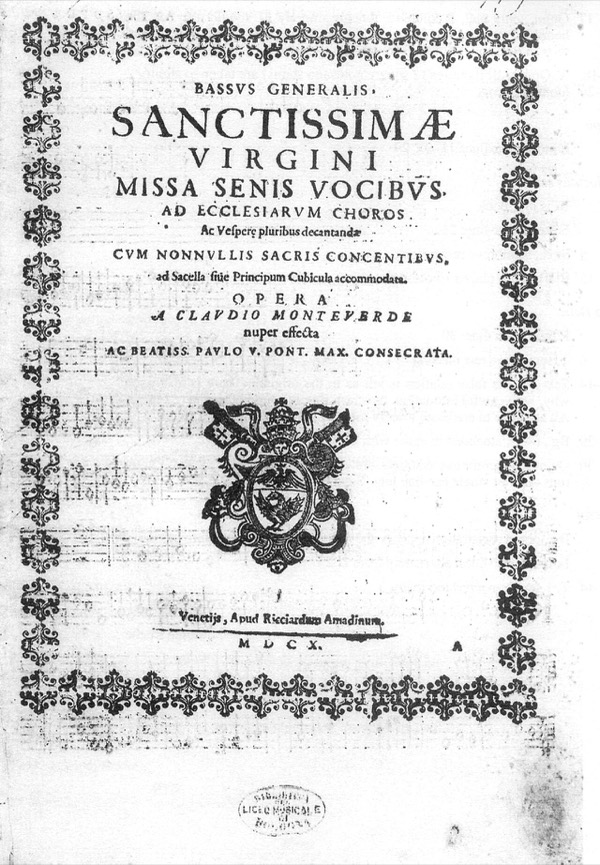
Title page of Monteverdi’s Vespro della Beata Vergine
On special occasions, there could be more elaborate music, as the psalter was sung throughout, with prescribed psalms replaced for special occasions. Mary’s song of praise on being told by the angel Gabriel that she was pregnant was a fixed point in all Vespers.
Vespers, apart from the Mass, was the service that received most musical attention, and it could at times be treated almost like a concert. Maybe that’s the reason why the Monteverdi setting also includes a suite of instrumental dances, concerto sections for voices and orchestra, and even a love song.
We still don’t clearly know or understand why Monteverdi combined sacred and secular music in an almost operatic style, or what prompted him to publish this work in the first place.
Claudio Monteverdi: Vespro della Beata Vergine, “composti sopra canti fermi” – Sonata: Sancta Maria ora pro nobis (The Sixteen; The Sixteen Orchestra; Harry Christophers, cond.)
Claudio Monteverdi: Vespro della Beata Vergine, “composti sopra canti fermi” – Hymn: Ave maris stella (The Sixteen; The Sixteen Orchestra; Harry Christophers, cond.)
Career Strategy
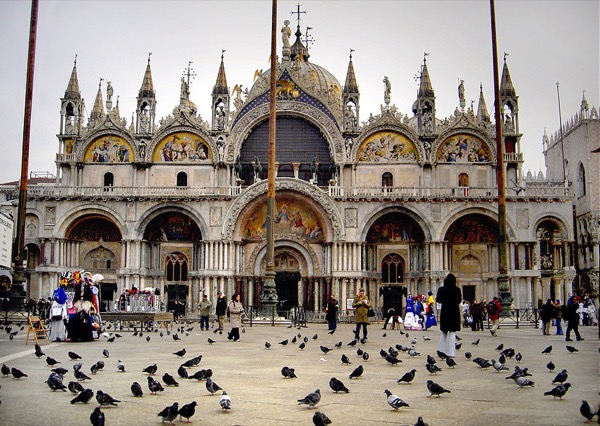
St. Mark’s Basilica, Venice
Between 1590 and 1612, Monteverdi made his living working for the Gonzaga family in Mantua. His relationship with the ducal court was rather strained at times, and Monteverdi was actively seeking employment elsewhere.
It is entirely possible that the publication of the 1610 Vespers, dedicated to Pope Paul V., was intended as a prospective résumé for a post of maestro di cappella at a major church or cathedral. Although there is no evidence that the Vespers was performed around the time of its publication, we do know that Monteverdi was eventually appointed maestro di cappella at St. Mark’s in Venice in 1613.
The conventional order of events at a Vespers service included an opening versicle and response, five psalms, a liturgical hymn, and a concluding Magnificat in praise of the Virgin Mary. Conventionally, the psalms would be preceded and followed by an antiphon.
Claudio Monteverdi: Vespro della Beata Vergine, “composti sopra canti fermi” – Magnificat: Et exultavit (The Sixteen; The Sixteen Orchestra; Harry Christophers, cond.)
Claudio Monteverdi: Vespro della Beata Vergine, “composti sopra canti fermi” – Magnificat: Quia respexit (The Sixteen; The Sixteen Orchestra; Harry Christophers, cond.)
Astonishing Variety
For his 1610 publication, however, Monteverdi substituted five motets instead. Scholars have hotly debated whether these sacred concertos, as the first printed score indicates, should actually be part of the Vespers or represent independent and separate compositions.
This kind of variety alone makes this composition unique. Monteverdi freely mixes thrilling psalm settings with virtuosic writing for both multi-part choir and instrumentalists. And then there are exotic and sensual settings of texts from the “Song of Songs” for solo voices.
Every movement is full of luscious harmonies, drama, and an evocative musical language which is beautifully constructed. Monteverdi’s music is rather virtuosic as he stretches every singer’s versatility to the limit, yet his demands have an exhilarating effect.
Claudio Monteverdi: Vespro della Beata Vergine, “composti sopra canti fermi” – Magnificat: Deposuit potentes de sede (The Sixteen; The Sixteen Orchestra; Harry Christophers, cond.)
Claudio Monteverdi: Vespro della Beata Vergine, “composti sopra canti fermi” – Magnificat: Esurientes implevit bonis (The Sixteen; The Sixteen Orchestra; Harry Christophers, cond.)
Between Scholarship and Sound
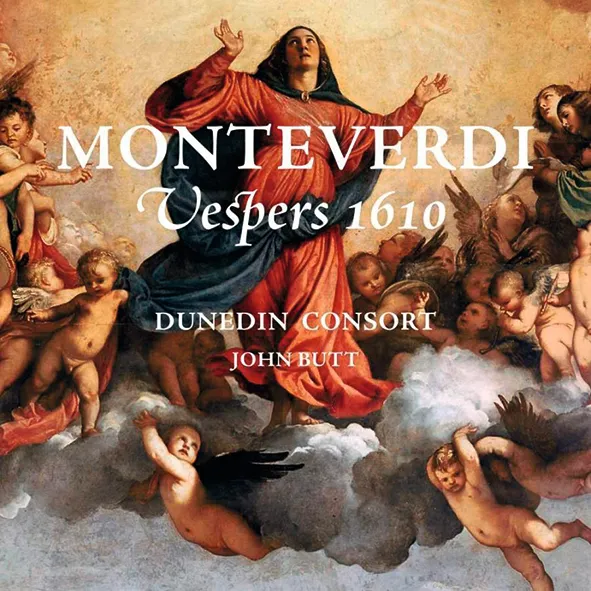
Recording of Monteverdi’s Vespers of 1610
Disagreements about historical context and the correct order of movements aside, significant arguments arise over matters of performance practice. For one, it is a towering masterpiece of epic conception and structure.
Musically, it represents a compendium of all commonly heard musical styles in Italy at the beginning of the 17th century. Yet in modern performance and interpretation, each concert has to take a stance on various issues, ranging from liturgical interpretations to performance practice.
The musicologist Denis Arnold once suggested that to perform the Vespro della Beata Vergine (Vespers for the Blessed Virgin), “is to court disaster.” Arnold further asserts, “To write about it is to alienate some of one’s best friends.” (Arnold, Monteverdi, Oxford University Press, 2001)
Claudio Monteverdi: Vespro della Beata Vergine, “composti sopra canti fermi” – Psalm 147, “Lauda Ierusalem” (The Sixteen; The Sixteen Orchestra; Harry Christophers, cond.)
Claudio Monteverdi: Vespro della Beata Vergine, “composti sopra canti fermi” – Magnificat II: Et misericordia (The Sixteen; The Sixteen Orchestra; Harry Christophers, cond.)
Unresolved Decisions
The title page of the first edition suggests a relatively small number of performers, with one singer per part. Nevertheless, it is not uncommon today to hear large choral forces attempting to realise the splendour of the music.
Adding to the confusion, Monteverdi was very specific about the exact instrumentation for some movements, down to the organ registrations to be used, and completely silent on that matter for others. Furthermore, two movements feature notation suggesting some form of transposition.
A downward transposition solves the problem of exceedingly high instrumental parts, but introduces painfully low vocal parts. Many of today’s performances might not be historically authentic or even represent the composer’s intention, but are guided by practical adaptations for available instrumental forces or the occasion of performance.
Claudio Monteverdi: Vespro della Beata Vergine, “composti sopra canti fermi” – Magnificat II: Deposuit potentes (The Sixteen; The Sixteen Orchestra; Harry Christophers, cond.)
Claudio Monteverdi: Vespro della Beata Vergine, “composti sopra canti fermi” – Magnificat II: Suscepit Israel (The Sixteen; The Sixteen Orchestra; Harry Christophers, cond.)
A Musical Calling Card
Whatever the case may be, the 1610 Vespers is a remarkable collection of music in a grand musical design, full of sensuous intimacy and drama that is theatrically maintained. Questions as to where it was written, why it was written, and who it was written for are probably not really that important.
Jeffrey Kurtzman, who edited a publication of the work, notes, “it seems as if Monteverdi was intent on displaying his skills in virtually all contemporary styles of composition, using every modern structural technique.” (Kurtzman, Monteverdi Vespers 1610, 2000)
And as musicologist Tim Carter summarised in his dictionary entry in 2007, “Monteverdi’s three major collections of liturgical and devotional music transcend the merely functional, exploit a rich panoply of text-expressive and contrapuntal-structural techniques.” (Carter, GMO, 2007)
In all possibility, the Vespers of 1610 was Monteverdi’s calling card. He demonstrated that he had full mastery of the old polyphonic style and that he could handle the bold new expressive language of the Baroque. And pretty clearly, the position he was angling for was the post of choirmaster at the Basilica of St. Mark’s in Venice.
For more of the best in classical music, sign up for our E-Newsletter