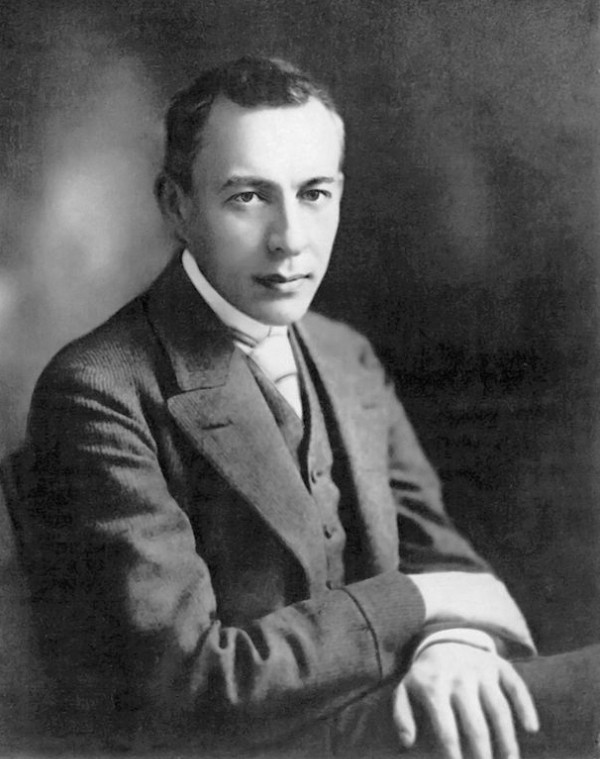
In this entry, we’re sharing more of the history behind Tchaikovsky’s heir.
To sum up the story so far, in late 1883, Tchaikovsky’s young niece Tatyana came to the composer for help when she became pregnant out of wedlock.
Tchaikovsky helped pay for her lodging and medical care in Paris, away from their family’s prying eyes.
Tatyana gave birth to a baby boy named Georgy, and Tchaikovsky found himself taken by the baby. He wrote to his brother Modest that he was considering adoption.
Here’s where the story picks up again.
Tchaikovsky Ponders Adoption
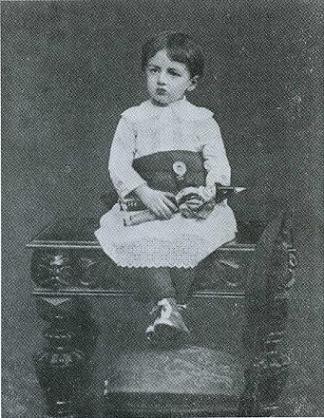
Little Georgy, ca 1889
Tchaikovsky returned to Paris in the late winter of 1884, when he attended Georgy’s christening in February.
The whole time, he was stressed about his obligations to Georgy, or, as he’d nicknamed him, “Zhorzh.”
He wrote to Modest:
I have now decided to start saving in earnest — after all, I now have an heir. On the whole, Zhorzh’s fate worries me very much. What should I do with him?
He worried about bringing him back to Russia:
When can he be brought to Russia? Economic considerations should require him to be taken at once, because his upkeep would, as it turns out, be terribly expensive, but in what capacity, according to what formalities? And it’s a pity to take him away now; he’s doing very well here.
He even began contemplating raising Georgy as his own son.
The Adoption Falls Through
Time passed. Tchaikovsky wrote his famous Orchestral Suite No. 3 while visiting his sister and Tatyana that summer.
Tchaikovsky’s Orchestral Suite No. 3
Finally, he decided to ask his publisher, Pyotr Jurgenson, to travel to Paris and make arrangements for Georgy’s relocation to Russia and eventual adoption by Tchaikovsky.
But fatefully, Tatyana asked her uncle to hold off another year. Her stated reason was that Georgy was thriving with his foster family back in France, and she didn’t want to relocate him. But it’s also possible that she wanted to delay Georgy’s move to Russia to avoid difficult questions from the family members who didn’t yet know she’d been pregnant.
One of the family members who did know Tatyana’s secret was her uncle, Tchaikovsky’s brother, Nikolay.
In August 1885, Nikolay and his wife Olga traveled to Brussels to attend the First International Railway Congress. (Nikolay worked in the railroad building industry.) While traveling through Paris, the couple stopped by to meet Georgy. They quickly fell in love with him.
“Zhorzh at once manifested his liveliness by breaking off the leg of the toy horse that we had brought him,” Nikolay reported in a letter to Tchaikovsky.
Tchaikovsky came to realise that his brother and sister-in-law would be able to create a more settled home for Georgy than he ever could. He stopped pursuing the adoption.
A Fidgety Georgy Travels to Russia With Tchaikovsky
Tchaikovsky’s Manfred Symphony
Another year passed, during which Tchaikovsky wrote his Manfred Symphony.
In May 1886, he arrived in Paris alongside Olga, ready to help smooth out any legal hurdles and accompany the toddler back to Russia.
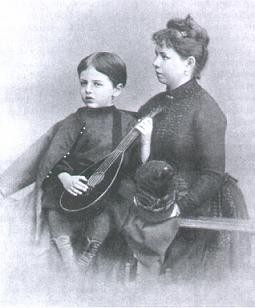
Georgy and his adoptive mother Olga
He reported to his brother Modest:
A delightful, pleasing and attractive child — but, my God, the trouble he is going to cause us during the journey! He cannot sit still for one second; I have never before seen such a restless and nervous creature.
His parental blood manifests itself very strongly. It is impossible to be angry with him because he is so kind, tender and sweet that it makes your heart melt…
He prattles away delightfully, but what particularly fascinates me is when he sings, for example, the Marseillaise at the top of his voice.
Clearly, music ran in the boy’s blood.
Georgy Arrives in Russia
The party arrived safely in St. Petersburg, and soon after their arrival, Georgy was baptised with the Russian name Georgy instead of Georges.
Tchaikovsky served as godfather. He reported to Modest:
Zhorzh in his little overall sat in my arms, silently and earnestly, but when he was immersed into the font (I immersed him myself), he cried a lot.
On the whole, he was sad and quiet that day; he was particularly affectionate towards me, and in order to avoid a scene (the other day, when I left, he was crying desperately), I made off when he couldn’t see it.
Tragedy struck the family in January 1887 when Tatyana, Georgy’s biological mother, died. She was only 25, and her son was still a toddler.
Corresponding With Tchaikovsky
Over the following few years, Georgy began writing notes to Tchaikovsky.
One of Olga’s letters from this time contained a flower that Georgy picked for Tchaikovsky.
For Easter 1891, Georgy wrote in a card:
My dear Uncle Petya, I hug you tightly and wish you a Happy Easter as well as Happy Birthday. Every day I pray to God for you.
Tchaikovsky responded with a wonderful birthday present: money for a bicycle, and a scheduled bicycle lesson with the owner of the shop where it was bought!
The little boy was awed:
How shall I thank you, my sweet, dear Uncle Petia, for the great pleasure which you have given me through this bicycle. I am so, so happy with it, I am learning to ride it, though it is rather hard to start with.
I kiss and hug you tightly, dear Uncle, stay healthy and please do definitely come to visit us at Ukolovo as you promised; I’ll be waiting for you.
Once again, I thank you for everything that you are doing for me!! Your Zhorzh
Georgy Becomes Tchaikovsky’s Heir
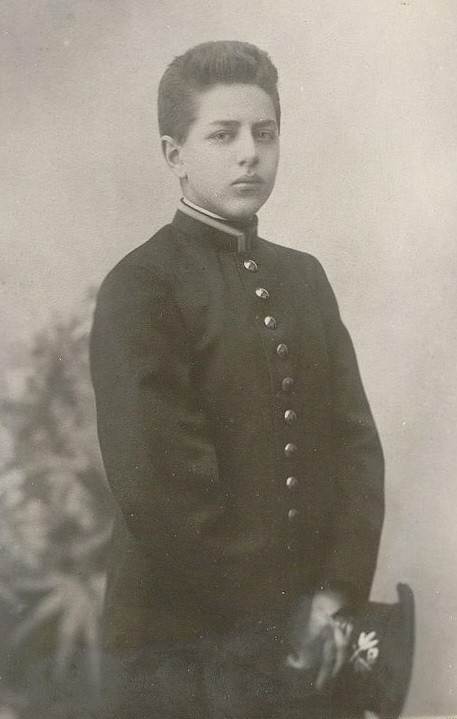
Georgy Tchaikovsky as an army cadet
Tchaikovsky may not have been Georgy’s biological father, but he was clearly delighted to be taking a fatherly role in Georgy’s life, even though it was from a distance.
In the fall of 1891, when he made his will, he named Georgy the sole beneficiary to his immovable property, as well as most of his capital (with a small portion designated for his servant, Aleksey Sofronov).
During this time, Tchaikovsky doted on another nephew, Vladimir Davydov, nicknamed Bob. “Doted on” may be too gentle a word to describe their relationship. By multiple accounts, Tchaikovsky was attracted to him and possibly in love with him.
And yet Tchaikovsky did not prioritise Bob over Georgy in his will. He left Bob the royalties to his operas…but only if he’d pay Bob 1200 rubles a year to Georgy.
Unfortunately, when Tchaikovsky died unexpectedly of cholera in the autumn of 1893, he owned no immovable property, so Georgy never saw any benefit.
We don’t know how Tchaikovsky might have changed his plans if he knew how close he was to death, or how his living longer might have impacted his legal plans as the children grew.
Georgy’s Academic Restlessness Begins
In 1893, Georgy passed the entrance exams for the Nicholas Cadet Corps in Saint Petersburg, meaning he began attending boarding school that fall.
That summer, before he left, he wrote Tchaikovsky an adoring letter:
My sweet and dear Uncle Petia!! We haven’t had any news from you for a long time and don’t know where you are now, though in the New Time we did read something about you. We are very, very eagerly expecting you in Ukolovo: please do come to us as soon as you can, my dear Uncle, don’t deceive us.
Tchaikovsky relented and visited them in July. He reported to Modest:
Zhorzh has grown a lot; he is naughtier and more fidgety than ever before, but he is very sweet.
He also agreed to pay most of the fees for Georgy’s schooling.
Life After Tchaikovsky’s Death
After Tchaikovsky’s shocking death in November 1893, Nikolay went to his brother’s house and claimed letters that Tatyana had written about Georgy.
There were still family members – including Tatyana’s father, and even Georgy himself – who didn’t know the full truth about Georgy’s parentage, and Nikolay didn’t want anyone to inadvertently discover the ten-year-old boy’s secret in Pyotr’s papers.
We don’t know who told Georgy the truth about his parentage, or when exactly that conversation happened. But it can’t have been after 1905, because that year Georgy wrote to Modest inquiring about a portrait of his mother in her coffin.
In 1895, Nikolay and Olga Tchaikovsky decided to move to Moscow, so their son forfeited his place in the St. Petersburg cadet academy.
Nikolay and Olga wanted him to understand the legacy that his uncle had left behind, and in 1896, they brought him to a performance of his uncle’s sixth symphony, a haunting experience for all of them.
Tchaikovsky’s Symphony No. 6, “Pathétique”
Georgy’s Academic Restlessness Continues
Georgy’s teenage years were difficult. He seems to have had mental health difficulties, including trouble focusing.
He eventually declared that the only thing he was suited for was being a soldier. His family did the requisite machinations to get him places at good schools and military institutions, but he kept changing his mind about what he truly wanted to study.
In 1904, Georgy passed exams for admittance to the Moscow Agricultural College. He also got married that summer to a woman named Yelena, who was a fan of his late uncle’s music.
But that year, Georgy gave up on the Moscow Agricultural College. Finally, he settled on the career he’d end up sticking with: civil engineering. (His adoptive father had worked as an engineer, so this final professional zigzag makes a certain amount of sense.)
The Tchaikovskys lived for a while in Italy while Georgy went to school and had a baby. They also lived for a time in Austria.
When World War I began, Georgy served with the First Railway Reserve Battalion in Kiev.
What Happened to Georgy Tchaikovsky?
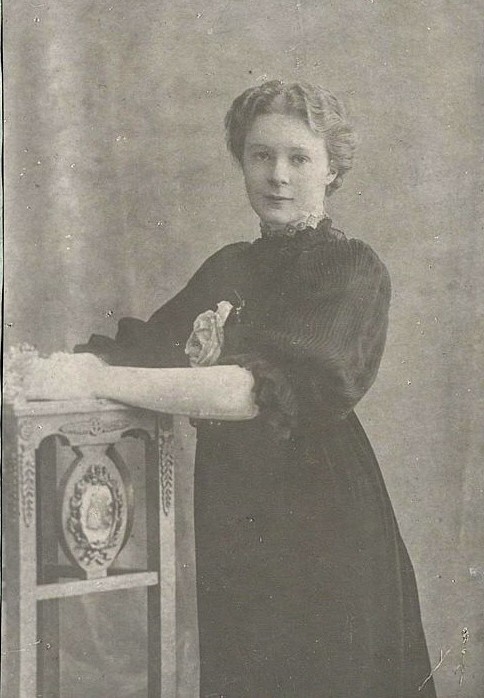
Yelena Tchaikovsky, Georgy’s wife
As astonishing as it may be, for many decades, Georgy’s fate after World War I was unknown.
Rumours had flown that he’d gone to the United States or died in one of Stalin’s gulags, but in 2017, the truth finally emerged: he actually moved to Yugoslavia.
He worked as an engineer and died in a suburb of Belgrade in 1940. His family later reinterred him in Rijeka, Croatia, where you can visit his grave today.
It is extraordinary that the details of Georgy’s story were unknown for so long, given his clear importance to Tchaikovsky.
Tchaikovsky’s loving relationship with Georgy offers great insight into his emotional life during the time he wrote some of his most famous works, and illustrates his deeply held devotion to his family.
It’s also a reminder that no matter how well we think we know a composer’s biography, there still might be important secrets about them left to uncover!
For more of the best in classical music, sign up for our E-Newsletter