In 1906, just thirteen years after Tchaikovsky’s sudden, shocking death, British musicologist Rosa Newmarch wrote the first full-length biography of the Russian composer.
In it, she includes a number of evocative details about his childhood. Today, we’re looking at some of the most interesting.
Not many people in Tchaikovsky’s family were musical.
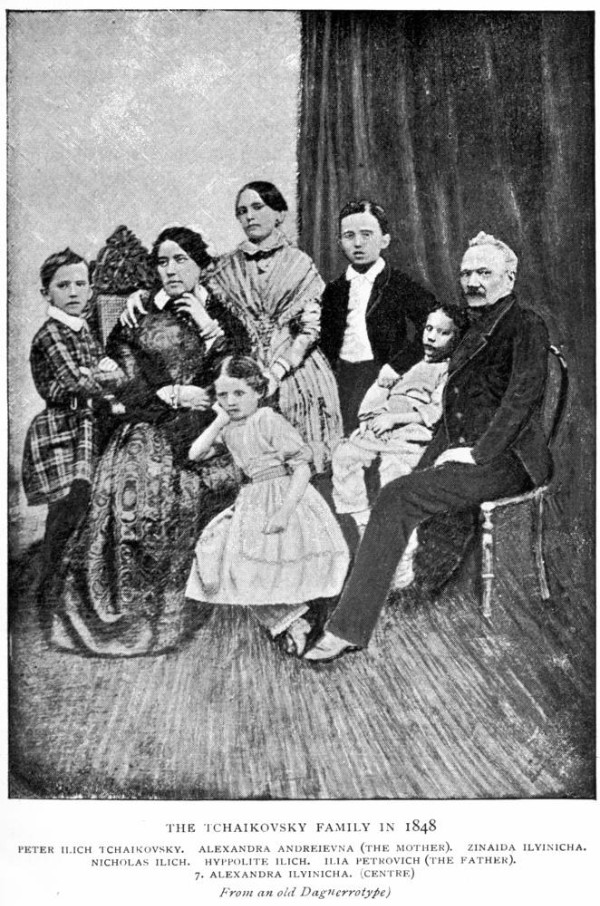
Tchaikovsky’s family
Newmarch wrote about Tchaikovsky’s genealogy:
Tracing back Tchaikovsky’s pedigree… There is not one instance of a professional musician, and only three can be considered amateurs – his mother’s brother, Michael Assier; her sister Catharine, in her day a well-known amateur in Petersburg society; and the composer’s mother herself, who sang the fashionable ballads of her youth with feeling and expression.
All the rest of the family…not only lacked musical talent, but were indifferent to the art.
Tchaikovsky’s mother was raised in an orphanage.
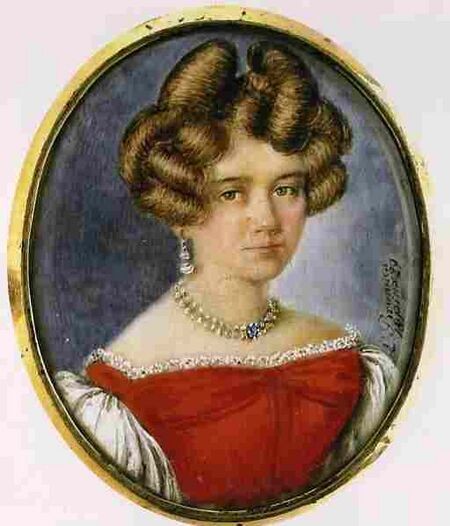
Tchaikovsky’s mother
Newmarch wrote about Tchaikovsky’s mother, Alexandra (or Aleksandra):
As early as 1816, she was left motherless and was brought up in a Female Orphanage, where she completed her education in 1829. The instruction in this school appears to have been excellent.
Alexandra Andreievna had a thorough knowledge of French and German. In addition, she played the piano a little and sang nicely. A satisfactory education for a girl who had neither means nor position.
She married Tchaikovsky’s father in October 1833, at the age of 21.
Tchaikovsky’s first governess worked with the family for four years.
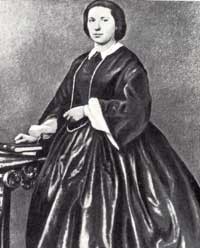
Fanny Dürbach
After their 1833 marriage, the Tchaikovskys had the following children:
- A baby girl who died in infancy
- Nikolay, born in 1838
- Pyotr Ilyich, born in 1840
- Aleksandra, born in 1841
- Ippolit, born in 1843
- Modest and Anatole, twins born in 1850
A cousin named Lydia also lived with the family.
After baby Aleksandra and Ippolit arrived, Tchaikovsky’s mother decided to hire a governess for Nikolay and Lydia.
But Tchaikovsky was so upset at being left out of the lessons that he was allowed to join them.
The governess’s name was Fanny Dürbach. After a three-week journey from St. Petersburg, she arrived at the Tchaikovsky home in November 1844 and lived there until 1848.
She was present as Tchaikovsky began exploring his early interest in music.
Tchaikovsky’s governess adored him and understood him.
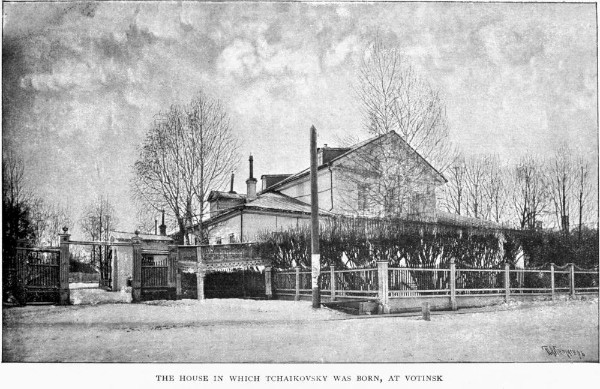
Tchaikovsky’s childhood home
Tchaikovsky adored Fanny Dürbach, and the affection was mutual. She even kept some of his childhood papers for decades after they parted. Eventually, his brother Modest took possession of them and brought them to the Tchaikovsky museum after Pyotr’s death.
Here are some of Dürbach’s memories of her famous pupil:
At lessons, no child was more industrious or quicker to understand; in playtime, none was so full of fun.
When we read together, none listened so attentively as he did, and when on holidays I gathered my pupils around me in the twilight and let them tell tales in turn, no one could improvise so well as [Pyotr] Ilich. I shall never forget these precious hours of my life.
In daily intercourse, we all loved him because we felt he loved us in return.
His sensibility was extreme; therefore, I had to be very careful how I treated him. A trifle wounded him deeply. He was brittle as porcelain. With him, there could be no question of punishment; the least criticism or reproof that would pass lightly over other children would upset him alarmingly.
Tchaikovsky’s emotional sixth symphony
Tchaikovsky once saved a cat as a child.
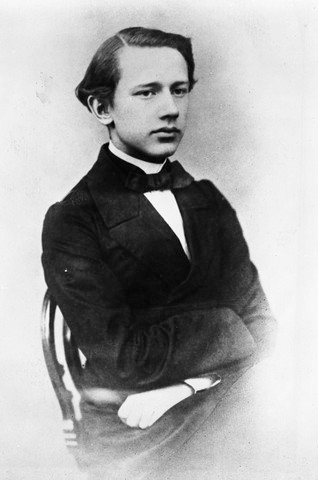
The young Pyotr Ilyich Tchaikovsky in 1863
His sensitivity extended to concerns over animal welfare. In Newmarch’s words:
The weak and unhappy always found in him a staunch protector. Once, he heard with indignation that someone was intending to drown a cat. When he discovered the monster who was planning this crime, he pleaded so eloquently that [the cat’s] life was saved.
Tchaikovsky was intensely patriotic as a boy…and spat on maps to prove it.
Dürbach also remembered the following story, hinting at the nationalism of Tchaikovsky’s future music:
Once, during the recreation hour, he was turning over the pages of his atlas. Coming to the map of Europe, he smothered Russia with kisses and spat on all the rest of the world.
When I told him he ought to be ashamed of such behaviour, that it was wicked to hate his fellow-men who said the same “Our Father” as himself, only because they were not Russians, and reminded him that he was spitting upon his own Fanny, who was a Frenchwoman, he replied at once:
“There is no need to scold me; didn’t you see me cover France with my hand first?”
He preferred playing piano to going outside.
Dürbach wrote:
As our leisure hours were few, I insisted on devoting them to physical exercise; but often I met with some opposition from [Pyotr], who would go straight from his lessons to the piano.
Otherwise, he was obedient and generally enjoyed romping with his sisters.
Left to himself, he preferred to play the piano or to read and write poetry.
Tchaikovsky’s first piano concerto
As a child, Tchaikovsky played the piano…and the window?
Newmarch wrote:
Very early in life, he displayed a remarkable ear and quick musical perception.
No sooner had he acquired some rudimentary knowledge from his mother than he could repeat upon the piano all he heard on the orchestrion [a mechanical musical instrument common in the nineteenth century].
He found such delight in playing that it was frequently necessary to drag him by force from the instrument. Afterwards, as the next best substitute, he would take to drumming tunes upon the window-panes.
One day, while thus engaged, he was so entirely carried away by this dumb show that he broke the glass and cut his hand severely.
This accident led his parents to reflect upon the child’s incurable tendency and consider the question of his musical education.
They hired a piano teacher soon afterwards…and the rest is musical history!
For more of the best in classical music, sign up for our E-Newsletter