In his 6th book of madrigals of 1614, Claudio Monteverdi was showing that he’d finally arrived. The title page proudly indicates his new position in Venice: ‘by Claudio Monteverdi, Maestro di Cappella of the Most Serene Signoria of Venice in S. Mark’.
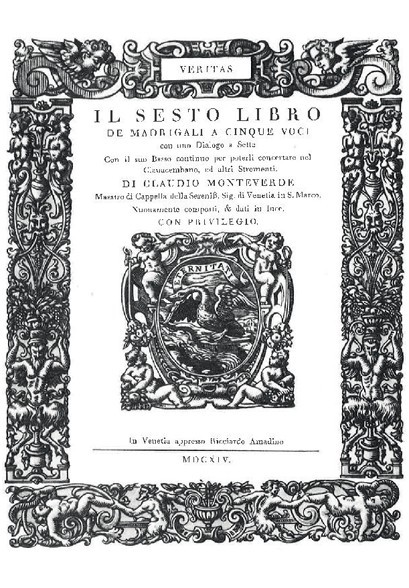
Cover of the Sixth Book of 5-Voice Madrigals, 1614
Monteverdi had been struggling in his appointment in Mantua serving the Gonzaga family. A few concerts had gone badly, and they were suspecting that he was looking elsewhere for employment. A change in leadership after the death of Vincenzo I Gonzaga in 1612 and the ascension of Francesco Gonzaga to leadership led to a reduction in the court expenses.
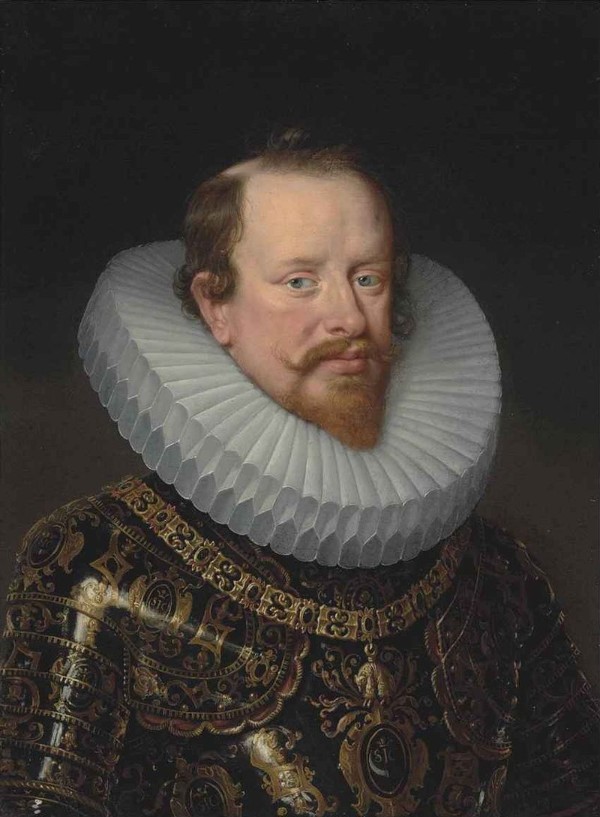
Studio of Frans Pourbus the Younger: Portrait of Vincenzo I Gonzaga, Duke of Mantua, in ceremonial armour,
wearing the livery collar of the Order of the Golden Fleece, ca 1600
Monteverdi was abruptly fired on 29 July 1612 and left Mantua to live in Cremona, where he had been born.
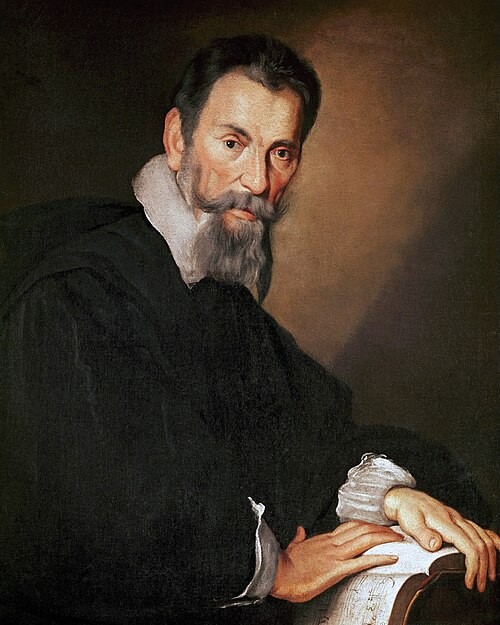
Bernardo Strozzi: Claudio Monteverdi, ca. 1630 (Tyrolean State Museum)
Duke Francesco Gonzaga died on 22 December 1612, and his successor, Cardinal Ferdinando, serving as regent, favoured the composer Santi Orlandi over Monteverdi. Finally, in mid-1613, with the death of Giulio Cesare Martinengo, the maestro of S Marco, Venice, on 10 July, Monteverdi auditioned for the post. The audition was on 1 August, and required him to provide music for a Mass. He was appointed on 19 August 1613 at a salary of 300 ducats. His arrival in early October was the end of a difficult journey that included highway robbery.
Although S. Marco was the prestigious centre of Venetian church and society activities, a series of poor maestri had led to a drop in quality. Monteverdi quickly returned it to its former glory. In addition to reorganising the choir, he also restocked its library and brought in new musicians.
Because of the demands on his time getting Venice in order, much of the music in the 6th book dates from his time in Mantua and from his year in Cremona.
One of the most important pieces in the collection is a funeral lament. Caterina Martinelli, known as ‘La Romanina’, came to Mantua from Rome and lived in Monteverdi’s house, as was common at the time. She was born in 1589 or 1590 and was brought to Mantua at the request of Duke Vincenzo I in 1603. He had originally wanted her to do her vocal training in Florence, but changed his mind and brought her to Mantua. She trained as a singer under Monteverdi’s wife, Claudia, and received musical training from Monteverdi. She was also a member of a female vocal ensemble that Monteverdi led.
Caterina’s training as a soprano pleased Duke Vincenzo so much that in 1606, he gave her a house. She sang regularly at the court and, in 1608, created the role of Venus in Marco da Gagliano’s La Dafne, one of the surviving early operas.
Marco da Gagliano: La Dafne – Scene 2: Che tu vadia cercando (Amore, Apollo, Venere) (Barbara Schlick, soprano; Norma Lerer, alto; Nigel Rogers, tenor; Camerata Academica, Ensemble; Jürgen Jürgens, cond.)
This was the same text by Ottavio Rinuccini that Jacopo Peri had set in 1597–98 in the very first opera, Dafne, but for which the music is lost.
Her triumph in La Dafne led to the leading role in Monteverdi’s new opera L’Arianna in 1608. Unfortunately, she died of smallpox in March 1608. Equally unfortunately, Monteverdi’s music for L’Arianna is lost except for the ‘Lament of Arianna’, which was published separately in the sixth book of madrigals.
The duke was devastated at Caterina’s death. He had a marble tomb built for her and ordered annual masses to be said in her memory. He commissioned Scipione Agnelli, a bishop in Mantua, to write a sestina (a complex poetic form of six six-line stanzas), and it was set to music by Monteverdi.
It’s valuable to look at the lyrics, because it gives us an insight into how Caterina Martinelli was described. The poet compares himself with Glaucus, a Greek sea-god who fell in love with the nymph Scylla (of Scylla and Charybdis). She, however, distained him because of his ugliness.
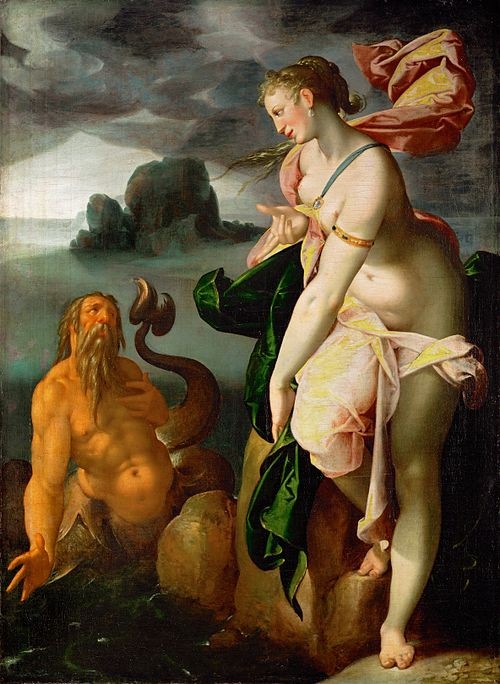
Bartholomeus Spranger: Glaucus and Scylla, 1580–1582 (Kunsthistorisches Museum)
The lament begins quietly, and when the cries ‘ah’ come, they are set off.
Sestina Lagrime d’amante al sepolcro dell’amata | Sestina Tears of a Lover in the Sepulchre of his Beloved |
Scipione Agnelli | |
Prima parte | First Part |
Incenerite spoglie, avara tomba, | Incinerated remains, greedy tomb |
Claudio Monteverdi: Madrigals, Book 6 (Il sesto libro de madrigali), SV 107-116 – Sestina: Lagrime d’amante al sepolcro dell’amata, SV 111: 1a parte: Incenerite spoglie (RossoPorpora Ensemble, Ensemble; Walter Testolin, cond.)
In the second verse, the poet is appealing to nature to join him in his lament
Seconda parte | Second Part |
Ditelo, o fiumi, e voi, ch’udiste Glauco | Tell, o rivers, and you who hear Glaucus |
Claudio Monteverdi: Madrigals, Book 6 (Il sesto libro de madrigali), SV 107-116 – Sestina: Lagrime d’amante al sepolcro dell’amata, SV 111: 2a parte: Ditelo, o fiumi, e voi ch’udiste Glauco (RossoPorpora Ensemble, Ensemble; Walter Testolin, cond.)
In the third verse, all of nature is reversed, with the sun shining at night and the moon during the day.
Terza parte | Third Part |
Darà la notte il sol lume alla terra, | By night the sun will light the earth, |
Claudio Monteverdi: Madrigals, Book 6 (Il sesto libro de madrigali), SV 107-116 – Sestina: Lagrime d’amante al sepolcro dell’amata, SV 111: 3a parte: Dara la notte il sol lume all terra (RossoPorpora Ensemble, Ensemble; Walter Testolin, cond.)
As she is received into heaven, he’s left alone on earth. All of nature, including the dryads and nymphs, is lamenting.
Quarta parte | Fourth Part |
Ma te raccoglie, o Ninfa, in grembo ’l cielo. | But heaven receives you, o nymph, into its lap. |
Claudio Monteverdi: Madrigals, Book 6 (Il sesto libro de madrigali), SV 107-116 – Sestina: Lagrime d’amante al sepolcro dell’amata, SV 111: 4a parte: Ma te raccoglie, o Ninfa, in grembo (RossoPorpora Ensemble, Ensemble; Walter Testolin, cond.)
Now he describes her, with golden hair and lily-white hands, as the ‘sun of Glaucus’. Even the muses cry at her death.
Quinta parte | Fifth Part |
O chiome d’or, neve gentil del seno, | O golden hair, gentle snow-white breast, |
Claudio Monteverdi: Madrigals, Book 6 (Il sesto libro de madrigali), SV 107-116 – Sestina: Lagrime d’amante al sepolcro dell’amata, SV 111: 5a parte: O chiome d’or, neve gentil del seno (RossoPorpora Ensemble, Ensemble; Walter Testolin, cond.)
In the final verse, the poet’s cries of unhappiness resound around the world, with everything saying ‘Ah Corinna’.
Sesta et ultima parte | Sixth and Final Part |
Dunque, amate reliquie, un mar di pianto | Therefore, beloved remains, a sea of tears |
Claudio Monteverdi: Madrigals, Book 6 (Il sesto libro de madrigali), SV 107-116 – Sestina: Lagrime d’amante al sepolcro dell’amata, SV 111: 6a parte: Dunque, amate reliquie, un mar di pianto (RossoPorpora Ensemble, Ensemble; Walter Testolin, cond.)
It’s an emotional poem, given an equally fervent setting by Monteverdi. When we think about Monteverdi’s compositional progress at this time, he was in the middle of creating the first operas, giving a single voice the ability to cry at a loss and ensembles the ability to comment on a situation. In this madrigal, we have both situations: the poet cries at the death of his Corinna, but also calls to the world to mourn with him.
Historically, Caterina Martinelli has nearly vanished from the historical record. The order for the perpetual masses, to be said by the Carmelite fathers, ceased with the suppression of the Carmelite order and the church and her tomb were razed in 1773. It’s only the madrigal-lament at her death that keeps her memory alive today.
For more of the best in classical music, sign up for our E-Newsletter