Created as a three-part collaboration between the Salzburg Easter Festival, the Royal Opera House in London, and Greek National Opera, director Oliver Mears moves the setting from the unknowable past to the current day. The costumes, by Annemarie Woods, are a puzzle, but more on that later.
As seems to be common with most shows at the Greek National Opera these days, the audience can’t be content to simply listen to the overture. Action must be placed on stage, in this case, the sale of a singer’s daughter to a brute of a man. Mother is paid, daughter is deflowered, and, in an act of pure illogic, it causes the mother, who hasn’t even seen the act, to go blind. Onto Act I.
Now the daughter is a singer, known as La Gioconda (The Happy One), who goes around Venice with her blind mother (La Cieca). Our heroine’s name is somewhat of a misnomer, since she seems to be saddled with the troubles of the world: her mother, a desire for a sea captain, Enzo, and is desired by Barnaba, a spy for the Inquisition. Barnaba stirs up trouble and the crowd moves against La Cieca, her prayers being reinterpreted as curses. Alvise, the head of the State Inquisition arrives, and condemns La Cieca on the word of Barnaba, but is stayed by his wife, Laura, who intercedes. In gratitude, La Cieca gives her a rosary.
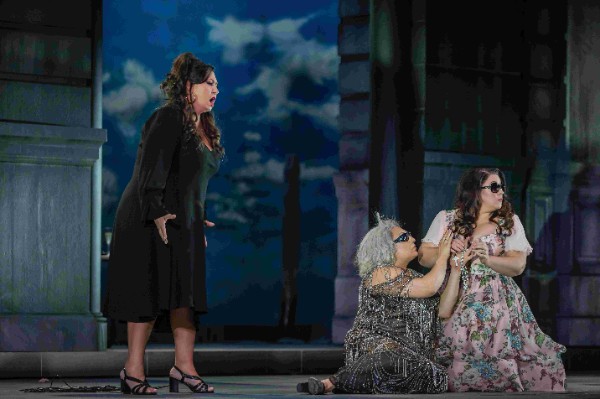
Act I: Laura (Alisa Kolosova) saves La Cieca (Anita Rachvelishvili) and is given the rosary and La Gioconda (Anna Pirozzi) observes, 2025
(photo by A. Simopoulos) (Greek National Opera)
The arrival of Laura changes the focus. Enzo is in Venice in disguise but has returned to see Laura, his true love. His affair with La Gioconda was only a ruse. He and Laura plan to sail away in the evening, but Barnaba has overheard their plans and decides to denounce Enzo to the Inquisition and Laura to her husband.
Once the setting for love and betrayal is set, the melodrama moves forward. The work is a mix of what might be expected from a French Grand Opera, but at the same time, it has elements of Verdi’s great choruses and act-closing dramas. La Gioconda, sung by Anna Pirozzi, was in magnificent voice, never ceasing to fill out the true emotional dimension of someone who is called on to be supportive while constantly being set aside. Her mother, sung by mezzo-soprano Anita Rachvelishvili, brought an amazingly warm and vibrant tone to La Cieca. She was matched by mezzo-soprano Alisa Kolosova in the role of Laura – the combination of both singers’ full dark tones was absolutely magical. When Laura and La Gioconda have their girl-fight over Enzo, that was another powerful duet.
The role of Barnaba was sung by baritone Dimitri Platanias, who brought a thuggish menace to the role. Alvise was sung by bass-baritone Tassos Apostolou. Both Platanias and Apostolou are mainstays of the Greek National Opera, and it was a pleasure to see them on stage and in such good voice. The waffling Enzo was sung by tenor Francesco Pio Galasso. The 6 leading roles were sung beautifully, and the strength of voice from the stage made some of the staging elements ludicrous (such as setting up a mike for La Cieca to sing for the crowds on stage – luckily it was for show only, or her strength of voice would have deafened everyone!).
We mentioned the costumes earlier. La Cieca trails around in a nearly floor-length 1920s flapper-style dress complete with rows of beading and fringe. You’d think she’d be better shown clothed in the basic black of old ladies, particularly as she seems to spend most of her time singing hymns or going to church.
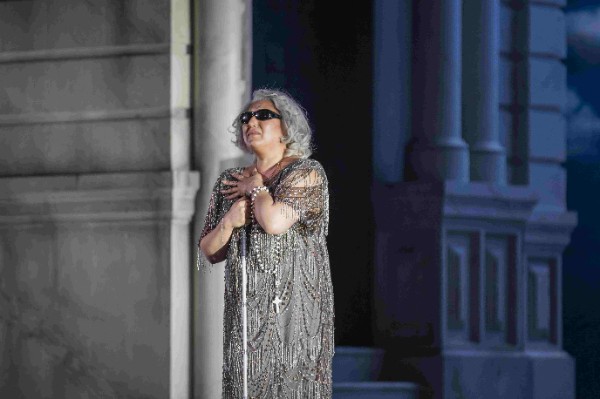
Act I: La Cieca (Anita Rachvelishvili), 2025 (photo by A. Simopoulos) (Greek National Opera)
Enzo makes his appearance in boating clothes and deck shoes, which somehow detract from his position as captain. The chorus was the real problem. The men were in modern casual clothes – ill-fitting jeans, ridiculous baggy shorts, Hawaiian shirts – while the women were dressed far better in dresses and less casual clothes. It made for an incohesive look – particularly in the party scene in Act III, where Alvise is in a double-breasted suit and half the chorus looks like they’re on the way to the beach. Barnaba, for some reason, is walking around the party in a full chef’s outfit, complete with toque.
Alvise has found out about Laura’s plans to run away with Enzo (thank you, Barnaba) and gives her poison to drink. La Gioconda replaces the poison with a sleeping potion, and Laura fools Alvise into thinking she’s dead.
In an interesting development in the Dance of the Hours, which in any other modern staging of a 19th-century opera with dance scenes would be dropped but is kept in La Gioconda because of its fame, the seemingly gratuitous rape scene during the overture finally finds its place. The Dance of the Hours doesn’t represent Morning, Noon, Evening, and Night, but rather the life of a family. Morning: the couple in Love. Noon: they have a child, and all dance together. Evening: Father dies, and mother sells the now-older daughter for money to live. Night: the grown-up daughter is now an elegant ballerina and has suitors galore. La Gioconda, who has been watching from the sidelines, changes the equation: the Ballerina is given a knife and, after accepting her suitors’ presents, kills them one by one.
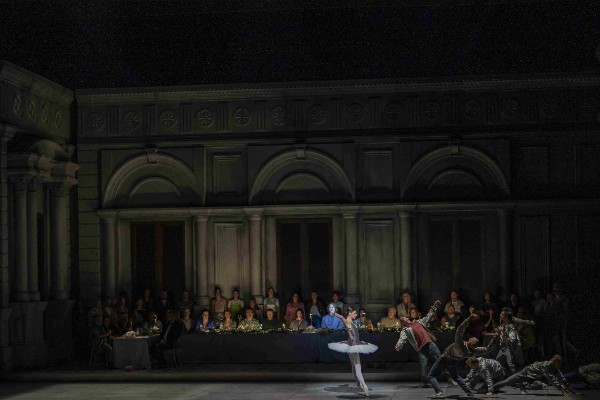
Act III: The Ballerina (Eleana Andreoudi) with a knife, 2025 (photo by A. Simopoulos) (Greek National Opera)
When a Ballerina whirls by in pirouettes with a knife, no one is safe. Since La Gioconda has been established as the director of the amusements at Alvise’s party, she’s now in a position to rewrite her history to her own satisfaction. Now the story starts to change from Ponchielli’s original. The Ballerina returns the knife to La Gioconda, who then stabs Alvise; she then returns the knife to the Ballerina, who pirouettes off-stage with it. One enemy gone.
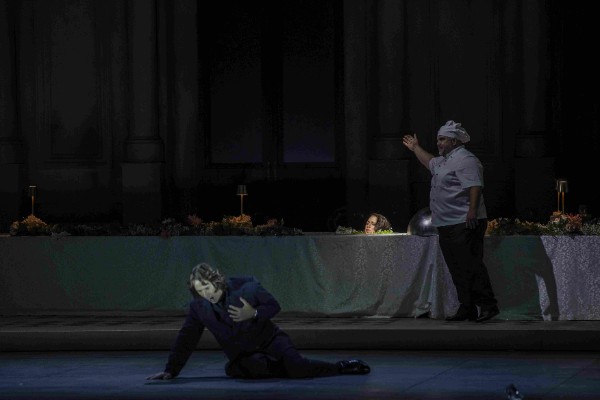
Act III: The death of Alvise (Tassos Apostolou) as Barnaba (Dimitri Platanias) reveals the head of dead Laura (Alisa Kolosova), 2025
(photo by A. Simopoulos) (Greek National Opera)
In the final scene, La Gioconda has been able to take the body of the sleeping Laura out of Alvise’s house and to free imprisoned Enzo by promising Barnaba that she will be his. La Gioconda prevails upon her friends who have brought Laura to her to go and look for her mother, not seen since last night. Enzo arrives and mourns the dead Laura, whom he last saw laid out in Alvise’s house. Enzo refuses La Gioconda one last time because of his desire for Laura, even if she has died. La Gioconda reveals that Laura’s tomb is empty and that she has been saved.
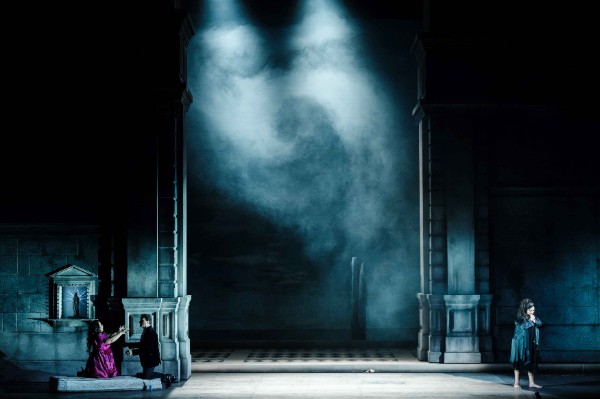
Act IV: Enzo (Francesco Pio Galasso ) meets the revitalized Laura (Alisa Kolosova) and La Gioconda (Anna Pirozzi) mourns, 2025
(photo by A. Simopoulos) (Greek National Opera)
Laura and Enzo give thanks to La Gioconda and exit in happiness.
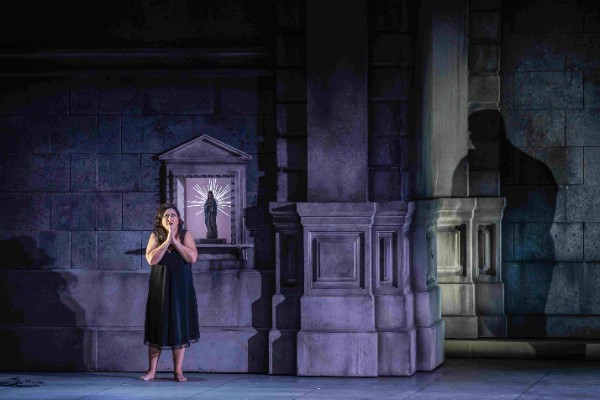
Act IV: La Gioconda (Anna Pirozzi) prays to the Virgin while Barnaba (Dimitri Platanias) lurks, 2025 (photo by A. Simopoulos) (Greek National Opera)
Barnaba turns up to claim La Gioconda’s promise and, in another break with the original, she stabs Barnaba, and he dies, but not until he has revealed that La Cieca is dead by his hand. Another enemy gone, and her mother no longer her responsibility.
In the normal version of this opera, La Gioconda suicides so that Barnaba will be left only with her dead body. Now, hearing the news that her mother is dead, and knowing that she’s killed Alvise and Barnaba, and that Laura and Enzo are gone, her final gesture is stilled. You get the feeling that, hearing the news of her mother’s death, and with all the people who have troubled her either dead or fled, her final feeling isn’t one of suicide but one of relief. She can now go and live the life she’s been putting off for other people. She can now truly be La Gioconda.
La Gioconda’s constant battle with jealousy made her a character who alternated good deeds with her desire for Enzo – She’s jealous of Laura, Alvise is hit in his pride that another man wants his wife, Barnaba is envious of everyone with more power and does all he can to take them down. It’s an entire opera of all the deadly sins.
The staging was very well done, with a final act scene change from exterior to interior made so gradually that one wasn’t aware of it until it was nearly complete. The costuming was amateurish at best – the chorus being the prime example of what not to do with a group of people who are defining your scenes. The singing was superb, and equipping the Ballerina in the Dance of the Hours with the weapon to change her future was positively inspired.
La Gioconda final trailer
Amilcare Ponchielli: La Gioconda
Greek National Opera co-production with the Salzburg Easter Festival and the Royal Opera House, London
GNO Stavros Niarchos Hall – SNFCC
19, 22, 25, 29 October; 01, 04, 07 November 2025
For more of the best in classical music, sign up for our E-Newsletter