Sit still, phones off, listen quietly, and no clapping between movements – curious about how our norms of concert-going developed, and the deeper meaning behind them? Look no further!
Gabriel Fauré: 3 Songs, Op. 7: No. 1. Après un rêve (arr. for trumpet and orchestra) (Lucienne Renaudin Vary, trumpet; Lille National Orchestra; Roberto Rizzi Brignoli, cond.)

Humour me for just a moment and imagine that you’re at some kind of non-classical concert, seeing a rock group, pop idol, or an indie singer-songwriter. You stand in a tightly packed throng of bodies, perhaps clutching an overpriced tin of something boozy, and gaze up at the artist performing. You feel anonymous, invisible, and part of a collective all at once, as bright lights and darkness swim across your field of vision, everyone around you swaying, dancing, even singing along. Between songs, the singer, band-leader, or simply the most extroverted member of the group might speak to the audience, telling little anecdotes about the way the song was written, or sharing tidbits about their experience of the tour. The audience is uninhibited and might cheer, whistle, wander out to the bar or bathroom, laugh, or simply leave.
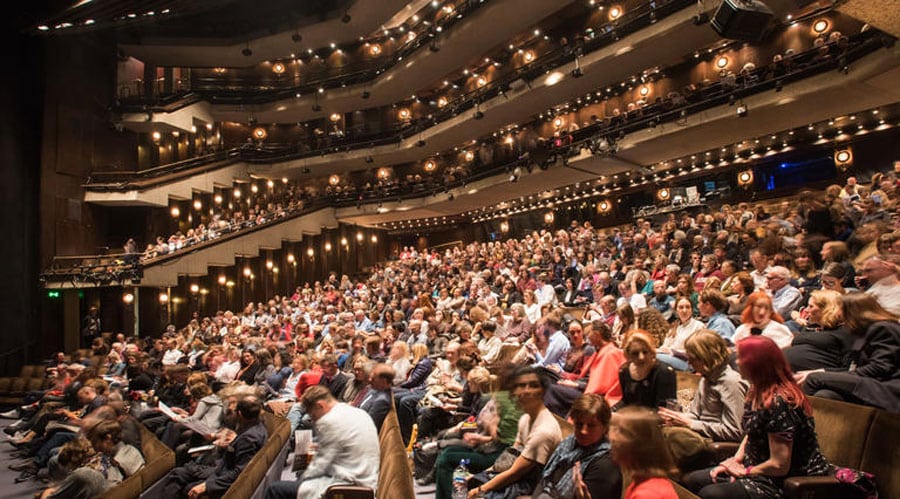
Allow me to whisk you away, subsequently, to a classical recital or evening at the symphony – think Wigmore Hall, the Barbican, or your equivalent bastion of classical music. You clutch a neatly laid out programme which gives a small CV of the principal performers as you navigate your way to an assigned seat. In your purse or bag, you might have cough drops, tissues, and a water bottle, as it would be mortifying to sneeze in an inopportune moment of artistic silence. There is a sense of decorum and order, with everyone dressed nicely. While you may feel enthralled and moved by the music, you probably try to keep this as internalised as possible, without crying, gasping, or otherwise “making a scene.” Throughout the event, there will be moments of silence so intense you feel almost as nervous as you imagine the performer might be – as they adjust the piano stool in solemn silence, or in the breathless moments of fading resonance where you may not know whether you should clap.

As I’ve hopefully illustrated quite vividly, concert etiquette varies enormously, and while some of these variations simply come down to national differences, the infrastructure of specific venues, and the preferences and personalities of the musicians involved, what we call “classical” music often comes with a whole host of expectations and rules for concert etiquette. At first glance, these behavioural norms may seem purely practical or obvious: after all, of course you should sing along at that folk concert! You’ve been invited to do so by the singer themselves, who takes your knowing the lyrics as a sign of great emotional connection, and who is heavily mic’ed up – you couldn’t possibly drown them out or annoy your neighbour. Besides, there isn’t the same discrepancy in vocal skill between you and, say, Bob Dylan as there is between you and an operatic tenor at the absolute zenith of their career. On the other hand, a masterful interpreter of Lieder has spent years perfecting their colour, bel canto technique, and timbre – to hear your seat-mate humming along would be an affront.
Teasing out the “common sense” reasoning for concert-going convention is like pulling a plant up out of the soil and discovering a tangled, interconnected web of roots below, with delicate tendrils reaching into dark, rich, and hidden places, interspersed with clumps of soil and wriggling earthworms. We suddenly find ourselves grappling with questions like: how should we engage with music, with our bodies, minds, or both? What does it mean to be a respectful audience member – and why should I be respectful? What economic, political, and geographical factors shaped our current classical concert etiquette – and what factors still hold it in place, or are pressuring it to shift? Where do questions of elitism, of specialised training and cultural capital, come into play? In other words, the situation is suddenly messy, complex, and alive.
The first behavioural condition imposed on classical audiences is being predominantly silent, even when that may involve the repression of instincts or emotions. In his book Listening Service, 101 Journeys Through the Musical Universe, Tom Service dedicates an entry to the idea of silence. He points out that there is no such thing as silence in areas fit for human habitation, as there are always “vibrations of waves of different frequencies, from electro-magnetism to gravity waves, from shock waves to sound waves.” Even in anechoic chambers with “specially designed foam insulators” that aim to as closely approximate silence as possible, composer John Cage could still hear his heartbeat and the high whine of his own blood pressure. Living in London, the siren-song of ambulances, the inconsiderate fanfare of the accelerating motorcycle, and a constant low roar of human noise become a kind of background score to your life, unless you manually intervene with noise-cancelling headphones. If you do escape to the countryside, or a quiet housing estate with well-insulated walls, you may feel the quiet almost pressing on your ears, an audible phenomenon in itself, and you might remark in hushed tones: “It’s so quiet here.” The truth is that the universe is a noisy place, and nature is always singing her own song.
Bringing this impossibility of silence idea back to the concert hall, John Cage’s 4’33” invites a pianist to simply sit at the piano, opening and closing the lid between “movements,” forcing the audience to listen to none other than their own sniffles, shuffles, and chair-squeaks, and ask themselves the uncomfortable question: was this sound, noise, or… music? Sound-sources may exist outside of us, but our perception of them is shaped by our bodies and brains, our attention, and our value systems. Silence is a kind of relation, a contrast between sound deemed contextually irrelevant and important, between wanted or unwanted sound, between somewhat-quiet and very loud – what Service calls “pseudo-silence.” The breathless pause before the eruption of a final earth-shattering orchestral chord provides the contrast that gives that chord its expressive power. In this way, silence is an understandably powerful tool, and therein lies a partial explanation for the hegemony of silence in the classical concert hall. There is a desire for fullness of artistic effect and intensity, for sensitivity to micro-alterations in interpretation, to the ability to perceive the slightest wavering of tone-colour. Much of this can be said to enable musical and affective complexity. Lovers of classical music have often lived with a particular piece for many years, and they don’t just want to hear and see it performed – they want to be alive to the qualities of that particular performance, and for this, we need a strong presence of “pseudo-silence” – well-behaved, quiet audiences.
In the second part of this article, we’ll explore how this pseudo-silence can also arise spontaneously in non-classical concerts, the surprisingly noisy history of the classical canon, and cast our eyes to changing trends of concert etiquette – and the kind of concert culture we might wish to work towards.
For more of the best in classical music, sign up for our E-Newsletter