I consider myself a fortunate man, because I often get what I wish for. When “dream come true” serves merely as a polite greeting for others, it somehow works for me: though only in matters of location rather than romance.
Sometime in 2008, I watched the film In Bruges, starring Colin Farrell and Brendan Gleeson as two killers hiding in Bruges, a small Belgian town I had never heard of, after something goes wrong. The older hitman receives orders to eliminate the younger one, but ultimately sacrifices his own life, plunging from the Belfry of Bruges, the town’s iconic bell tower.
For no particular reason, I instantly fell in love with the setting and made a quiet wish to visit the place one day.
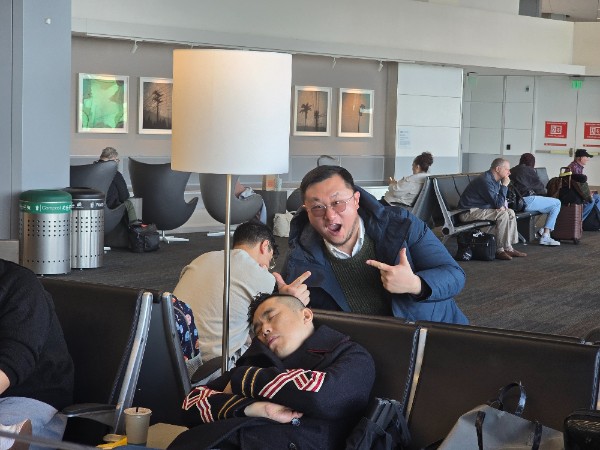
Pianist Xue Yingjia fell asleep at the airport
Two months later, I found myself in Europe as a journalist, travelling with the China National Traditional Orchestra and its conductor, Chen Xieyang (陳燮陽), on a concert tour celebrating the Chinese New Year of 2009. One stop was the BOZAR Centre for Fine Arts in Brussels. The journalists were given a day off. Some senior colleagues picked Bruges almost at random from a list of nearby towns and suggested a day trip.
My wish came true the next morning. I climbed the 83-metre Belfry of Bruges in a single breath and gazed across the medieval skyline, breathless, as if I had stepped directly into the film.
The same rhythm repeated itself over the years that followed, though I learned to be careful about what I wished for. The pinnacle came in the latter half of 2019, when I undertook a grand tour across half the globe. Beginning in Tokyo and ending in Trondheim, I travelled non-stop across Asia and Europe, attending eighteen festivals in seventy-five days, crossing ten time zones on visas issued by seven different countries.
When the journey ended in October 2019, I made another wish: to continue the tour around the world the following year by travelling to the Western Hemisphere.
In a sense, I did. In January 2020, I travelled with the Shanghai Chinese Orchestra on a concert tour across the United States, from coast to coast. But the outbreak of COVID-19 abruptly ended those ambitions. I returned to Shanghai carrying masks and hand sanitiser for my parents, sensing the vulnerability of the moment.
During the long lockdown that followed, I played the mobile game Just Dance Now to pass the time and keep fit. A terrible dancer as I am, I discovered that I simply could not stop moving to “Kulikitaka”, a special track in the game. The song, released in 2003 by Dominican musician Toño Rosario, sparked an unexpected curiosity about the musical culture of the Dominican Republic. I found myself wishing to visit the Caribbean nation one day.
That wish would take six years to fulfil.
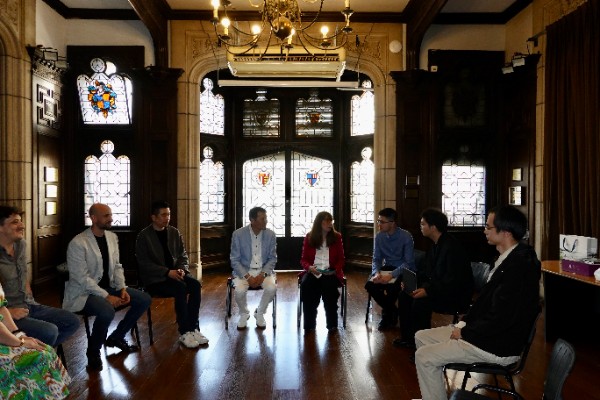
CUHKMus held talks with UNA
On 18 February, I boarded a United Airlines flight from Shanghai to San Francisco as a journalist accompanying the ensemble of the Music School of Shenzhen at The Chinese University of Hong Kong (CUHKMus) for Light on the Strings, a concert tour spanning three countries, including the Dominican Republic.
A Third Way: Chinese Composers Beyond the Binary
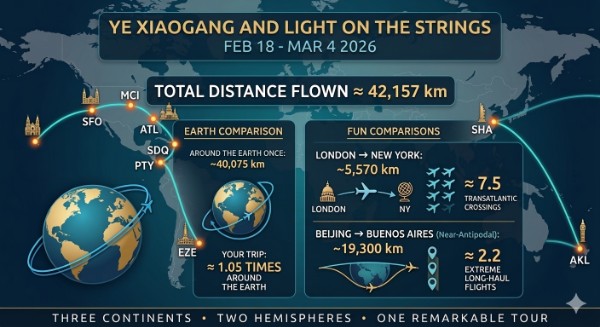
Over sixteen days, from 18 February to 4 March, I boarded eight flights. The journey traversed Asia, North America, South America and Oceania, crossing both the Eastern and Western hemispheres as well as the Northern and Southern hemispheres. The route passed through the United States, Panama, the Dominican Republic, Argentina and New Zealand.
Altogether, my flights covered approximately 42,157 kilometres, including one of the world’s longest routes, from Buenos Aires to Shanghai via Auckland. Given that the Earth’s equatorial circumference measures roughly 40,075 kilometres, the journey amounted to about 1.05 laps around the globe – effectively a round-the-world voyage.
Ye Xiaogang: Datura, Op. 57
The tour was led by Ye Xiaogang, widely regarded as one of China’s leading composers and the dean of the school. The programme consisted primarily of chamber music written by composers associated with CUHKMus and performed by its musicians.
Because the assembly date fell on the second day of the Lunar New Year holiday, the fifteen members of the delegation travelled from Beijing, Shanghai, Hong Kong, Taipei and Seoul to San Francisco. After several hours of delays, we eventually reached Kansas City late that night, ready for the first concert.
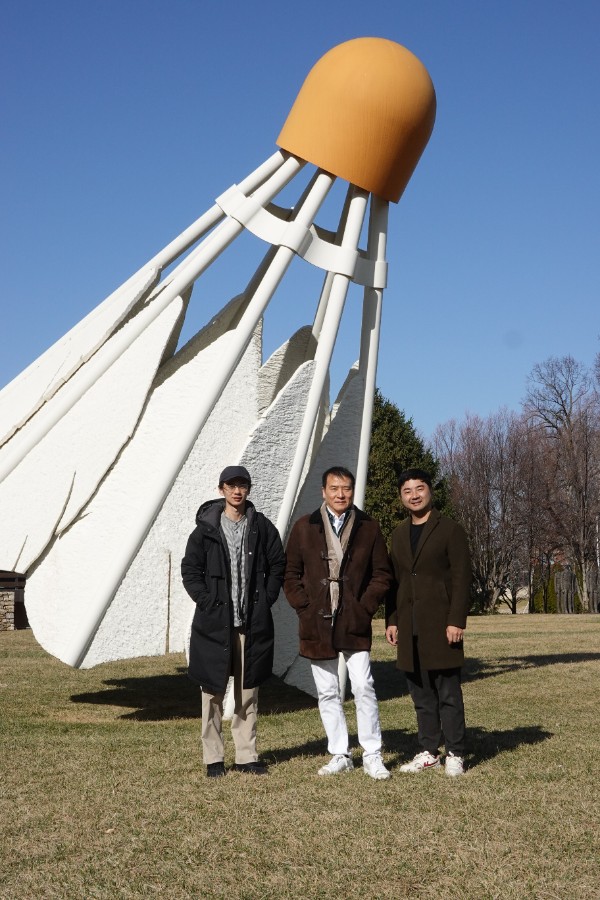
Composers on tour, from L to R Yu Pengfei, Ye Xiaogang, Shen Yiwen in Kansas City
Chinese ensembles touring abroad during the Lunar New Year is hardly unusual. What distinguished the CUHKMus tour was its repertoire. The ensemble presented three concerts devoted entirely to contemporary music, in Kansas City, Santo Domingo and Buenos Aires.
Works by composers including Ye Xiaogang (葉小綱), Chan Wing-wah (陳永華), Jin Ping (金平), Gao Ping (高平), Chen Yi (陳怡), Yu Pengfei (虞鵬飛), Shen Yiwen (沈逸文) and Li Cangxiao (李倉梟) were performed, many of them original compositions or newly arranged pieces.
The concerts took place on 20, 24 and 27 February respectively at the University of Missouri–Kansas City Conservatory, the Palacio de Bellas Artes, and the music department of Universidad Nacional de las Artes. Among the works performed were Ye Xiaogang’s Journey Towards a New Dawn, the third movement of Chen Yi’s Fiddle Suite, Gao Ping’s Contemplating Tango, Shen Yiwen’s Dragon Boat Tune, and the world premiere of Yu Pengfei’s Night-Blooming Jasmine.
Shen Yiwen’s Dragon Boat Tune
Featured performers included guest erhu soloist Li Cangxiao, violinists Yang Yoon Jung and He Shuchong, violist Cai Lei, cellist Lee Ra, pianist Xue Yingjia, flautist Yuan Long and percussionist Du Bokun. Most of the composers and performers are affiliated with CUHKMus.
CUHK-Shenzhen Chamber Ensemble Performs to Full House in Santo Domingo
Behind the concerts lay an exhausting schedule of flights, transfers and rehearsals across the Americas. At times, the musicians slept for barely an hour after a performance before checking out of the hotel at two in the morning to catch another flight, arriving at the next destination close to midnight after more than ten hours in the air.
Li Cangxiao: Kangding Capriccio
Against considerable logistical odds, Ye Xiaogang ultimately brought Chinese contemporary music to one of the farthest points on the planet from China: Argentina. At a location nearly antipodal to their homeland, composers presented their works while performers demonstrated the vitality of contemporary Chinese musical life.
In this sense, the tour was more than a sequence of concerts. It became a collective portrait of three generations of composers centred around CUHKMus, and a global exploration of China’s contemporary music.
Astor Piazzolla: Libertango
At the same time, the journey created opportunities for cultural dialogue. Ye Xiaogang held discussions with critics in the United States, festival directors and tango composers in Argentina, political leaders in the Dominican Republic and the heads of two major music schools. In the United States, he also delivered a lecture in English, sharing his artistic philosophy with students and faculty.
Ye Xiaogang Speaks on Artistic Integrity at UMKC
For him, such encounters form part of a longer effort to bring Chinese music onto the global stage.
In Western discourse, Chinese composers are often reduced to two categories. The first consists of émigré composers living and working in Europe or North America, whose music is framed as culturally hybrid or quietly oppositional. The second includes composers who remain in China, whose works are too easily dismissed as instruments of state ideology or cultural messaging.
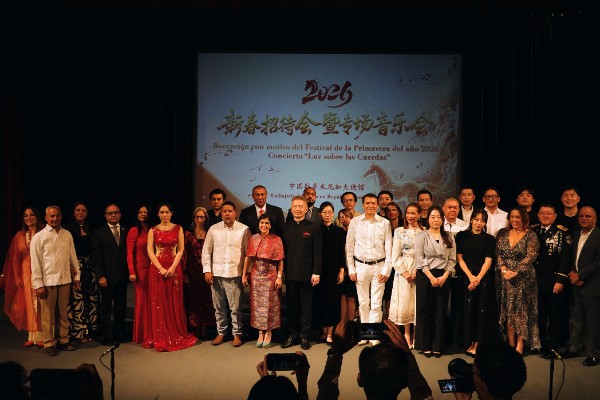
Concert in the Dominican Republic
The binary is convenient. It allows observers to organise artistic production into familiar narratives of exile and compliance, resistance and propaganda. Yet it is also reductive.
There is, I would argue, a third way.
Many composers in China hold academic posts in public conservatories and universities. They work within institutions shaped by ideological oversight and cultural regulation. These constraints are real and should not be minimised. Yet to assume that creative life within such systems is monolithic is to misunderstand both artists and art itself.
Within those same institutions are composers who wrestle with memory, doubt, spiritual longing and formal experimentation. They negotiate boundaries, sometimes cautiously and sometimes boldly. They engage with tradition, modernism and global currents not merely because policy demands it, but because artistic necessity compels it.
They may not articulate dissent in overt political language, but neither are they passive transmitters of doctrine.
Artistic conscience does not disappear under pressure; it adapts. It finds coded language, metaphor and abstraction. It finds chamber music — intimate, interior and resistant to grand narratives.
Seen in this light, the tour was more than a showcase. It was a quiet assertion that creative agency persists even within constrained environments.
The Western temptation to read every score through a geopolitical lens risks obscuring what music does best: revealing the complexity of human interior life. Contemporary Chinese composers are neither assimilated cosmopolitans nor mouthpieces of the state. Many inhabit a more ambiguous, fragile and ultimately more intriguing space.
If this tour succeeds, it will not be because it corrects political assumptions. It will succeed if audiences listen closely enough to hear the multiplicity within a single cultural sphere, and recognise that conscience, like music itself, often speaks most powerfully in nuance rather than declaration.
For more of the best in classical music, sign up for our E-Newsletter