‘With this recording, I brought to life a deeply cherished, lifelong vision: to delve into the essence and to record Frédéric Chopin’s complete cycle of 27 études – Op. 10, Op. 25, and the three études without opus numbers – as a single, organically unified whole.’ – Olga Chelova, pianist

Olga Chelova © Jan Will Fotografie
Chopin’s two sets of Études are amongst the greatest music written for the piano by Chopin, or indeed anyone. Chopin elevated the student exercises into music of great artistry and beauty, turning humble exercises into glittering concert pieces, each with its own distinctive character. These pieces still test the pianist’s technique, but they also demand a high level of musical intelligence and artistry.
In her new recording, Reflections on Chopin, pianist Olga Chelova presents the two sets of Etudes, Opp 10 and 25 and the three Nouvelles Etudes (without opus numbers). She is entering a crowded market, full of many fine recordings of this great music by some of the most significant pianists. Yet in this recording, Chelova takes a strikingly personal and philosophical approach to these pieces: here, she seeks not just to perform, but to reinterpret the very meaning of the étude.
Rather than treating each Étude as an individual whole or a virtuosic miniature, she approaches them as a unified whole – a continuous narrative, with each piece contributing to a broader emotional, contemplative and philosophical arc.
‘I came to experience the études as a reflection of the universe itself – 24 pieces like 24 hours of a day, tracing a full arc of existence: awakening and farewell, radiance and shadow, innocence and profound tragic depth.’
In my interpretation, they are interwoven through invisible harmonic constellations and spiritual resonances. Even the silences between the pieces become charged with meaning – they breathe, they speak, they extend the musical narrative beyond sound.’
Many of the Études have well-known nicknames – Tristesse (Op 10, No. 3), Black Keys (Op 10, No. 5), Revolutionary (Op 10, No. 12), Winter Wind (Op 25, No. 11) – but in her recording, Chelova assigns her own to each Étude. These poetic titles, inspired in part by the literary sensibility of Boris Pasternak, are intended as interpretative gateways, inviting the listener to engage more actively with the music. Thus, for example, Op 10, No. 3 becomes “Love of Homeland”, Op. 10, No. 12 “Warsaw in Flames” and Op 25, No. 11 “Whirlwind”. These poetic, sometimes whimsical titles certainly add an extra sense of vivid narrative to the pieces, and I wonder whether the pianist herself found that these titles influenced her interpretation.
Regardless, all the music on this recording is exceptionally well played, combining a deep appreciation of Chopin’s masterful compositional sophistication with impressive technical finesse. Chelova brings these works to life with a brilliant range of colours, often highlighting inner lines or bass details, allowing the listener to enjoy new or different nuances in the music. Chelova has an impressive command of the instrument, but throughout, one senses that virtuosity serves a deeper expressive purpose – something which Chopin would surely have appreciated.
Recorded on a Steinway D grand piano, the performance balances clarity and resonance, allowing both the structural intricacies and the emotional subtleties of the music to emerge.
The recording is accompanied by detailed liner notes, written by Olga Chelova, with a brief but informative introduction to each Étude and the title she has assigned to it.
For listeners familiar with Chopin’s Études, Chelova brings a fresh perspective, reframing them as interconnected reflections on the human condition. For newcomers, the album provides an immersive, thoughtfully curated entry point to some of the piano repertoire’s most iconic pieces.
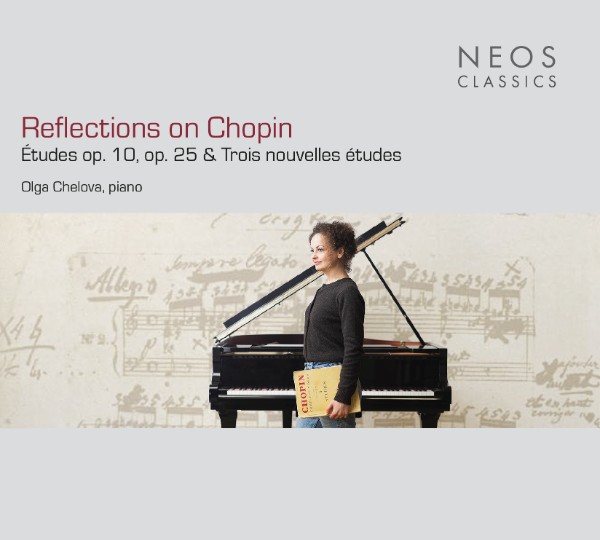
Reflections on Chopin is released on CD and streaming on the NEOS label.
For more of the best in classical music, sign up for our E-Newsletter