You wouldn’t know it from looking at a music history textbook, but women have composed music for just as long as men have.
Even when societal norms made it difficult for women to express themselves musically at a high level, extraordinary women still made music at high levels anyway, working as composers, performers, and patrons.
Today, we’re looking at the music and stories behind some of the earliest individual women composers in the historical record – Kassia, Hildegard of Bingen, and the French trobairitz.
By making music in their own time, these women helped to pave the path for all women composers active today.
Kassia (c. 810 – c. 880)
Kassia: Byzantine Hymns from the first female composer of the Medieval Occident
Kassia was born around 810 to a wealthy family in Constantinople.
The monk Theodore the Studite met her when she was a child and noted that she was already a talented poet and musician. As she grew up, her beauty and wit became legendary, too.
According to one anecdote, she was chosen to participate in a “bride show”, a ceremony for Byzantine princes to choose their wives.
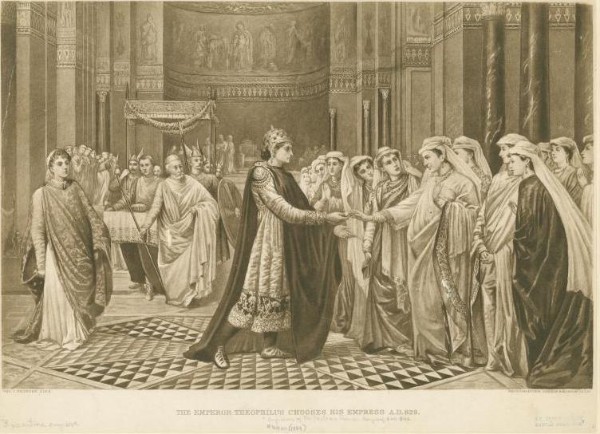
The Byzantine emperor Theophilos chooses Theodora as his empress over Kassiane in a bride show
The emperor told her, referring to the story of Eve being tempted by the serpent in the Garden of Eden, “Through a woman came the baser things.”
She responded, referring to the virgin birth of Christ, “And through a woman came the better things.”
Perhaps unsurprisingly, she wasn’t chosen to be empress!
Instead, she founded a convent and became a leader in the Orthodox church. She was scourged with a whip for defending the veneration of icons, but despite the torture, she held fast to her convictions.
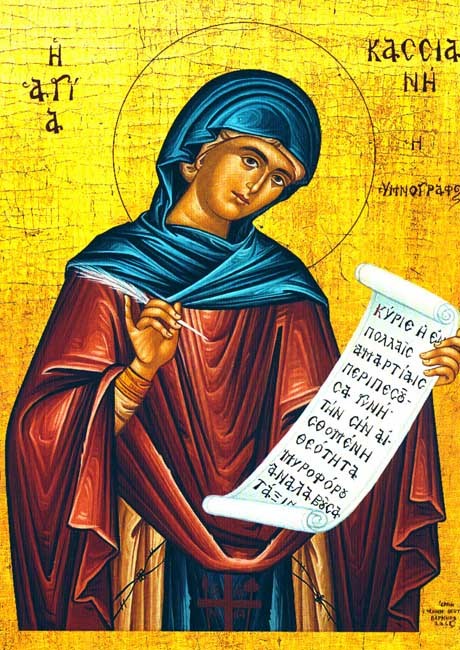
Kassia
Hymns of Kassianí, the world’s earliest music female composer: 9th-century – Cappella Romana
One romantic legend states that, toward the end of his life, the emperor came to visit her…while she was in the middle of composing her most famous hymn. When he was announced, she abandoned her unfinished work on a table and hid in a closet, so that she would not be tempted to break her vow of chastity. The emperor read what she’d written, added the line “those feet whose sound Eve heard at dusk in Paradise and hid herself for fear.” He then departed, respecting her wish not to be spoken to.
Kassia eventually moved to the small, remote island of Kasos, where she died in the latter half of the ninth century.
Kassia wrote multiple hymns that, remarkably, are still heard today and used in the Byzantine liturgy.
Hildegard von Bingen (c. 1098 – 1179)
Hildegard von Bingen: Voices of Angels – Voices of Ascension
Hildegard was born to a family of the lower nobility in Bermersheim vor der Höhe, in present-day southwest Germany, around 1098.
She was a sickly child who experienced spiritual visions beginning at the age of three.
When she was a young girl (sources differ as to her exact age), she was sent to join a Benedictine monastery in a community known as Disibodenberg.
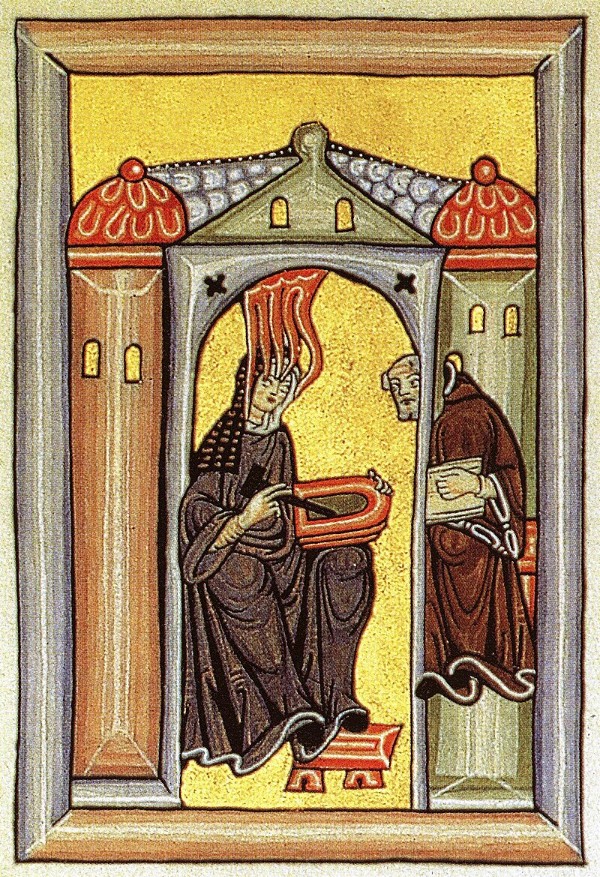
Hildegard von Bingen
While living there, she studied music and learned how to read and write.
In 1136, she was elected leader of the group of nuns. Despite protests from the abbot, she began a campaign to move her community to Rupertsberg, in the picturesque town of Bingen am Rhein. She oversaw this monastery until her death.
Hildegard von Bingen: De Spiritu Sancto (Holy Spirit, The Quickener Of Life)
When she was 42, she received a vision she believed was from God, instructing her to “write down that which you can see and hear.”
She initially refused to follow the divine instructions and fell ill. But as soon as she began to write, she began improving.
Over the course of her life, she wrote hundreds of letters, three volumes of theology, a musical morality play called Ordo Virtutum (Order of the Virtues), two volumes on medicine, and dozens of musical compositions, including many liturgical songs.
Garsenda, Countess of Forcalquier (c. 1180 – c. 1242)
Garsenda and the Trobairitz – Stories: Early Women Composers
Garsenda, Countess of Forcalquier, was born around 1180 to a noble French family in Provence.
Her mother died young, and she inherited leadership of the County of Forcalquier from her grandfather.
In 1193, she married Alfonso II, Count of Provence, and they had two children.
Her husband and grandfather both died in 1209. After tussles with her husband’s family, she emerged as regent.
During her regency, she became a patron for the troubadours. Troubadours were lyric poets based in Provence who sang and composed love songs in the courts of local aristocrats.
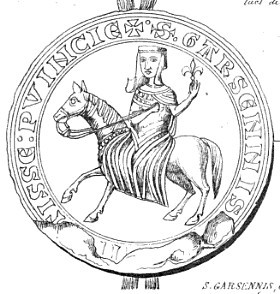
Garsenda, Countess of Forcalquier
However, Garsenda didn’t just support troubadours; she participated in their art form, and with great skill, writing poems and accompanying them with music.
Her son came of age around 1220, and a few years later, she retired to a monastery. She died sometime around 1242. But the legacy of her art would live on…even if none of her music has survived.
The Trobairitz (active between c. 1170 to c. 1260)
Ninety-five of the troubadours were male, but, as Garsenda’s existence suggests, the remaining five per cent were women.
These female troubadours became known as trobairitz, and they came to particular prominence during Garsenda’s life.
The trobairitz are important because they are the first women composers known to have composed and written down secular music. (It is believed that all of the women before them wrote only sacred music.)
Obviously, this was a major development in music history, opening the door to works like madrigals and, eventually, overtures, operas, symphonies…even modern-day pop songs!
The names of roughly twenty of these women have survived, as well as thirty-two of their works.
We’d love to tell you more about each of them, but the information – and the music itself – simply hasn’t survived.
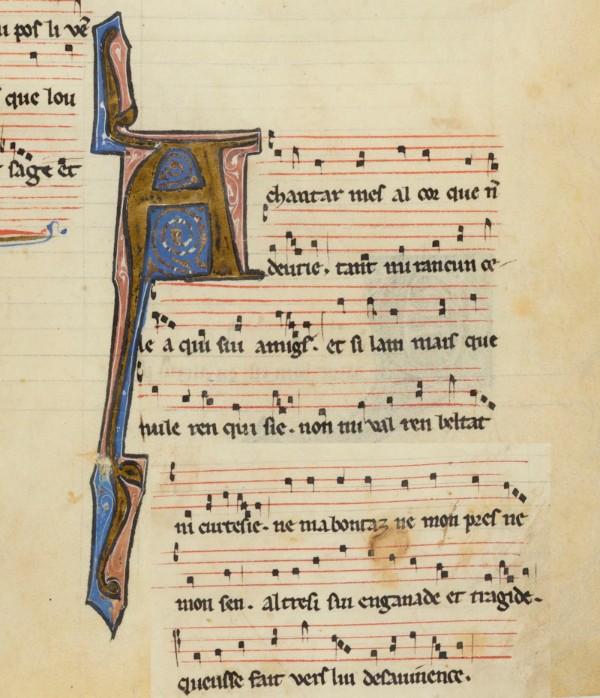
This is the score of “A chantar” by Beatriz de Dia, as found in BNF FR844
In fact, only one song has survived with its musical notation intact. It was written by a woman called the Comtessa de Dia (who likely lived from c. 1175 to c. 1212, roughly the same lifespan as Garsenda).
What we do know is that in one manuscript, she was described as “the wife of En Guillem de Poitiers, a lady beautiful and good. And she fell in love with En Raimbault d’Orange, and wrote many good chansons in his honour.”
But even those facts are questioned by modern scholarship: it is possible she was an archetype.
Here is a reconstruction of what this song might have sounded like.
Beatriz de Dia: A chantar m’ér de çò qu’eu no volria (Medieval Secular)
Conclusion
It is always difficult to guess what music made centuries ago would have sounded like, and to know what their lives were like.
It becomes more difficult when the composers in question were women, whose lives (historically speaking) have been deemed less important to document than those of their male colleagues.
However, the works and histories of these remarkable women give invaluable insight into the early achievements of women composers, who paved the path for every woman in music today.
For more of the best in classical music, sign up for our E-Newsletter