Wolfgang Amadeus Mozart (1756–1791) left us a world of music that we’re still trying to understand. A manuscript discovered in the Évora Cathedral in Portugal gives us an early 19th-century Requiem, which both follows and diverges from the normal Requiem.
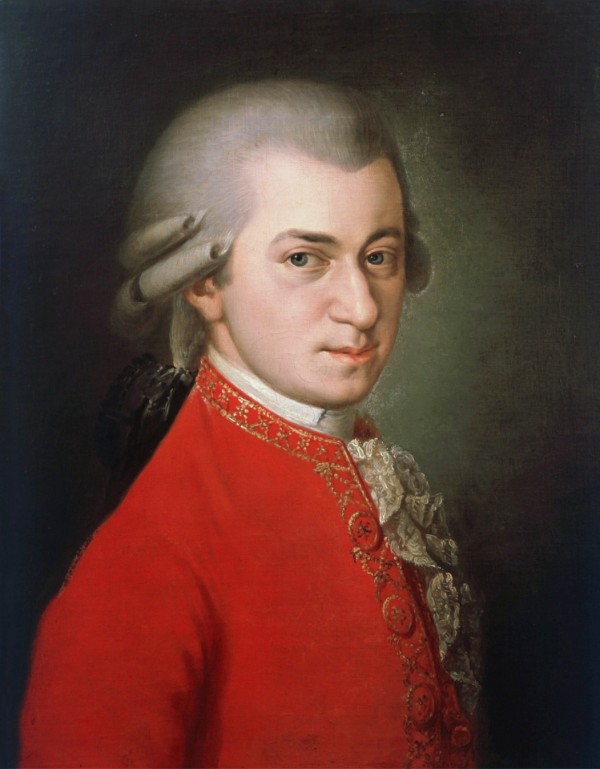
Barbara Krafft: W. A. Mozart, 1819 (Gesellschaft der Musikfreunde)
The voice parts follow the traditional Süssmayr edition exactly, and the organ part is a copy of the Breitkopf and Härtel 1803 edition, which was in circulation at the time. However, it’s the instrumental lines that take up our interest.
The instrumental parts were written by two different hands, and include parts for cello (rabecão pequeno), double bass (rabecão grande), 2 bassoons, and organ. The cello part was clearly written for someone with exceptional technical ability and virtuosity. It’s complex and shows an inventiveness that makes it destined for chamber performance.
Up to this point, most arranged versions of a work, such as Mozart’s Requiem, were ignored as being inferior, often due to the fact that they had to be adapted to a local player, meaning that they had been dumbed down. Now we are looking at these documents in a new way and using them as evidence for local practices. In the case of Évora, it speaks to a local virtuoso whose accomplishments shouldn’t be ignored.
The reason for a chamber requiem was probably driven by expediency. Following its presentation to the Royal Family in the early 19th century at the Church of Graça in Lisbon, it became a favoured work for funerals. However, outside Lisbon, few parishes had the resources to keep a large choir and orchestra on call, hence the need for this reduced version. By reducing the orchestration and using a continuo-based ensemble, the net result was a work in which the continuo group was more orchestral than merely supportive.
Even from the first movement, the Introitus, you’ll hear the difference immediately. The instrumental introduction alters the effect of Mozart’s original orchestration, allowing us to focus on the delicate voices.
Wolfgang Amadeus Mozart: Requiem in D minor, K. 626 – I. Introitus
For a broadcast performance during COVID, the performing group was told they could have only 10 musicians and needed to be spaced apart. The director knew of the Évora edition and so prepared it for performance, probably the first in over 200 years.
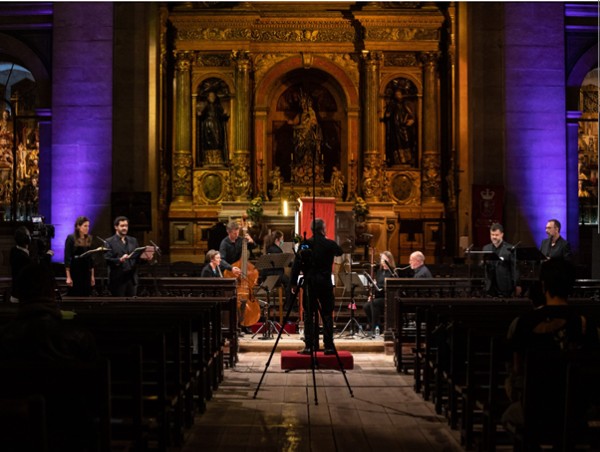
Americantiga Ensemble
For the performance, he used 4 singers and 5 instrumentalists, with the 10th person being the conductor. The singers had to perform both the solo and ensemble parts, probably a first in their careers. The organ was tuned to the 18th-century standard of A=415 Hertz (it is now A=440 Hertz as the standard).
What was discovered? Mozart’s contrapuntal richness, often hidden in the performance by larger ensembles, came to the fore. The dialogues between the instrumentalists and the singers were also highlighted. Mozart’s unique blend of older and conservative elements with his own modern harmonic language is also clearer to the ear. Transparency is the clue, and the audience is the richer for the experience.
In a movement such as Domine Jesu Christe, we hear the voices more clearly and yet are always aware of what the cello is up to.
Wolfgang Amadeus Mozart: Requiem in D minor, K. 626 – IX. Domine Jesu Christe
The performance is assured, and you will hear details in the music that were hidden before. It’s a rich and rewarding return to something that is both so familiar and, at the same time, so new.
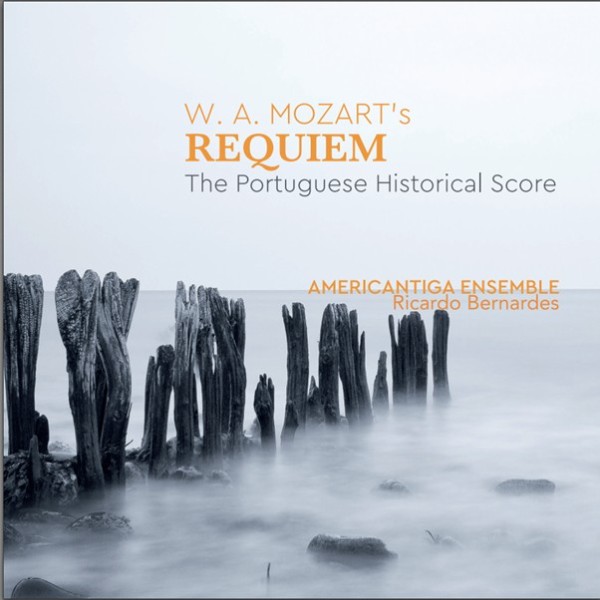
W. A. Mozart’s Requiem: The Portuguese Historical Score
Americantiga Ensemble, Riccardo Bernardes, cond.
Americantiga AAE2601
For more of the best in classical music, sign up for our E-Newsletter